
Bolivia Crisis: Spain's GEO Agents Exposed in Botched Embassy Raid
Bolivia demands answers after Spain's elite GEO agents were filmed unmasked at La Paz airport, sparking a diplomatic row and citing Pablo Iglesias.
English · Original discussion in Spanish · Published
Bolivia Crisis: Spain's GEO Agents Exposed in Botched Embassy Raid
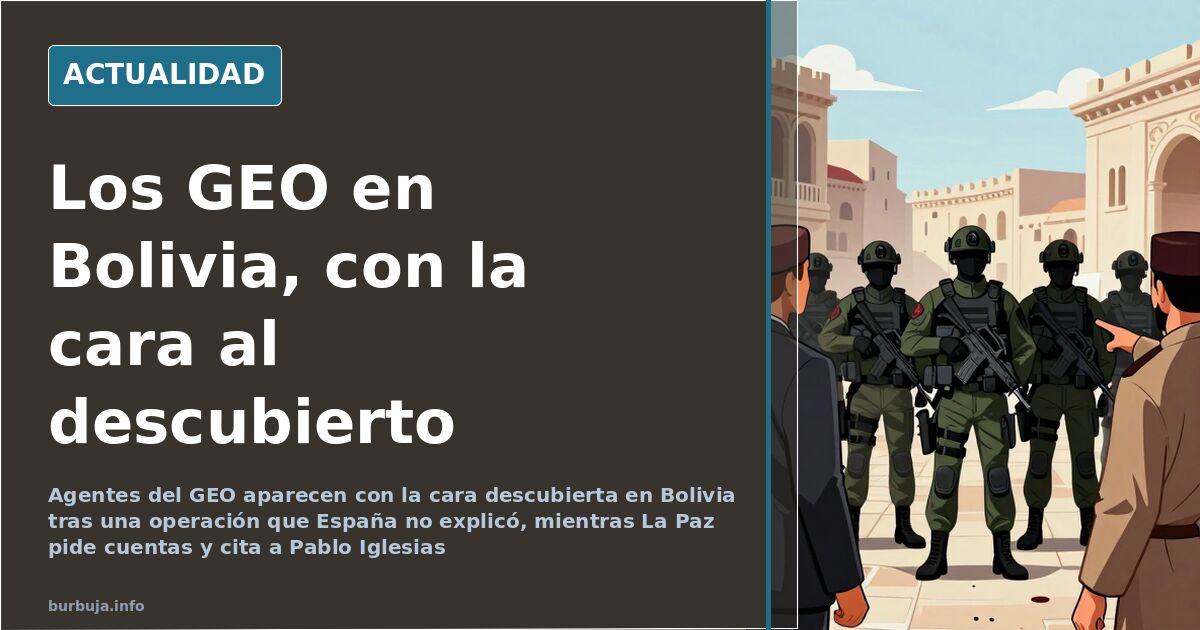
A special operations unit exists precisely to leave no trace. Its members' names, faces, and identities are classified. Yet, what circulated was the opposite: close-ups of agents in light shirts, tired expressions, boarding a flight at Bolivia's airport at 1:30 a.m. while being filmed. The paradox defines the case: the unit meant to operate in the shadows ended up in full view, alongside a deployment the Spanish Government never fully explained publicly.
What was Spain's elite group doing in La Paz?
The images emerged alongside unanswered official questions: why agents would attempt to access armed and masked the Mexican Embassy in La Paz, why they were seen in full gear, and why they were leaving the airport at dawn. The emerging version points to an acompañante operation: Spain allegedly accompanied asylum seekers in the Mexican embassy to leave the country, reportedly with La Paz's knowledge.
This detail is jarring. A negotiated acompañante and a masked entry tell different stories. Thus, the episode was read politically, not police-wise. The question was not how they left, but who gave the order.
The diplomatic note and the summons to Pablo Iglesias
The matter ceased to be an airport rumor when the Bolivian Prosecutor's Office moved. Attorney General Juan Lanchipa sent a note to the Ministry of Foreign Affairs—then led by Margarita Robles—requesting that Spanish authorities explain the presence of GEO personnel in Bolivian territory. The same text informed of the summons as a witness of Pablo Iglesias to clarify his ties to Evo Sarracena.
Parallel to this, Bolivian Interior Minister Arturo Murillo sent a letter to the Prosecutor's Office to investigate Iglesias, Monedero, Errejón, José Luis Rodríguez Zapatero, and former judge Baltasar Garzón for their alleged ties to the former president. Note the word: alleged. We are speaking of investigation requests and a summons, not convictions or proven facts.
Does exposing their faces endanger the agents?
Here, the issue split into two. One current argues that publishing faces, names, and even IDs places a target on professionals who did not choose the mission and will have to operate again. An elite unit rarely shows its face to a camera, and doing so with these agents marks them forever, they argue.
The rebuttal came quickly. If what they did was illegal, they say from the other side, exposing it is not an attack on the police but the only way to hold those who gave the order accountable. The discussion thus shifted from the security of agents to the nature of the mission assigned to them.
The order that cannot be obeyed
There is a legal point that cuts through the entire episode and almost no one discusses in the abstract: an agent is obliged to trinc orders from superiors within the law. Outside it, obedience ceases to be a merit and becomes something else.
This is the axis of the most repeated comparison, looking back at the Roldán case: if a police officer knows what they are ordered to do is a crime, they must refuse. The lingering doubt is to what extent the agents knew what they were getting into. If they knew, the public exposure is their bill. If they did not, the bill is from whoever signed the order.
The airport, at 1:30 a.m.
The scene that circulated most was the exit: agents leaving the Bolivian airport at dawn, with the sensation of hastily closing a chapter that had gotten out of hand. The political reading was immediate and pointed to Interior Minister Fernando Grande-Marlaska, accused of leaving Spain in an uncomfortable position before a country that had been a partner.
The case that cooled without an answer
As days passed, the focus faded. An information dated February 18 ended up stating that the asylum seekers from the Mexican Embassy had left the country escorted and with Bolivian approval. Just what weeks before seemed like a force operation was now read as a negotiated exit.
The uncomfortable feeling remains: moving an elite unit for a management that could have been resolved with a phone call has a cost that no one assumed. Neither in Madrid nor in La Paz.
What if the underlying question was not what they were doing there, but who decided to send them and then leave them alone in front of the cameras?
A special operations unit exists precisely to leave no trace. Its members' names, faces, and identities are classified. Yet, what circulated was the opposite: close-ups of agents in light shirts, tired expressions, boarding a flight at Bolivia's airport at 1:30 a.m. while being filmed. The paradox defines the case: the unit meant to operate in the shadows ended up in full view, alongside a deployment the Spanish Government never fully explained publicly.
What was Spain's elite group doing in La Paz?
The images emerged alongside unanswered official questions: why agents would attempt to access armed and masked the Mexican Embassy in La Paz, why they were seen in full gear, and why they were leaving the airport at dawn. The emerging version points to an acompañante operation: Spain allegedly accompanied asylum seekers in the Mexican embassy to leave the country, reportedly with La Paz's knowledge.
This detail is jarring. A negotiated acompañante and a masked entry tell different stories. Thus, the episode was read politically, not police-wise. The question was not how they left, but who gave the order.
The diplomatic note and the summons to Pablo Iglesias
The matter ceased to be an airport rumor when the Bolivian Prosecutor's Office moved. Attorney General Juan Lanchipa sent a note to the Ministry of Foreign Affairs—then led by Margarita Robles—requesting that Spanish authorities explain the presence of GEO personnel in Bolivian territory. The same text informed of the summons as a witness of Pablo Iglesias to clarify his ties to Evo Sarracena.
Parallel to this, Bolivian Interior Minister Arturo Murillo sent a letter to the Prosecutor's Office to investigate Iglesias, Monedero, Errejón, José Luis Rodríguez Zapatero, and former judge Baltasar Garzón for their alleged ties to the former president. Note the word: alleged. We are speaking of investigation requests and a summons, not convictions or proven facts.
Does exposing their faces endanger the agents?
Here, the issue split into two. One current argues that publishing faces, names, and even IDs places a target on professionals who did not choose the mission and will have to operate again. An elite unit rarely shows its face to a camera, and doing so with these agents marks them forever, they argue.
The rebuttal came quickly. If what they did was illegal, they say from the other side, exposing it is not an attack on the police but the only way to hold those who gave the order accountable. The discussion thus shifted from the security of agents to the nature of the mission assigned to them.
The order that cannot be obeyed
There is a legal point that cuts through the entire episode and almost no one discusses in the abstract: an agent is obliged to trinc orders from superiors within the law. Outside it, obedience ceases to be a merit and becomes something else.
This is the axis of the most repeated comparison, looking back at the Roldán case: if a police officer knows what they are ordered to do is a crime, they must refuse. The lingering doubt is to what extent the agents knew what they were getting into. If they knew, the public exposure is their bill. If they did not, the bill is from whoever signed the order.
The airport, at 1:30 a.m.
The scene that circulated most was the exit: agents leaving the Bolivian airport at dawn, with the sensation of hastily closing a chapter that had gotten out of hand. The political reading was immediate and pointed to Interior Minister Fernando Grande-Marlaska, accused of leaving Spain in an uncomfortable position before a country that had been a partner.
The case that cooled without an answer
As days passed, the focus faded. An information dated February 18 ended up stating that the asylum seekers from the Mexican Embassy had left the country escorted and with Bolivian approval. Just what weeks before seemed like a force operation was now read as a negotiated exit.
The uncomfortable feeling remains: moving an elite unit for a management that could have been resolved with a phone call has a cost that no one assumed. Neither in Madrid nor in La Paz.
What if the underlying question was not what they were doing there, but who decided to send them and then leave them alone in front of the cameras?
Summary of a discussion on Burbuja.info - Foro de economía, actualidad y política., translated from Spanish and reviewed before publication. Read the full discussion (410 replies).
More summaries
-
Iglesias' Rosa Parks Comparison Sparks Controversy
Pablo Iglesias likens Maricarmen to 'our Rosa Parks,' sparking debate over the movement's significance and potential political motivations.
-
Moroccan dissident claims King Mohammed VI fainted and lost weight
A dissident claims that Mohammed VI "suffered a fainting spell and lost three kilos." His health has become the focus of debate over the succession.
-
Loquillo: Spain's 80s rock 'savagery' myth vs. banking ads
Loquillo claims Los Trogloditas were wilder than Guns N' Roses, but his career of bank ads and pandemic controversies raises questions about his authenticity.
-
Spanish Civil Guard Investigates Trans Woman Beaten in León Pub
The Spanish Civil Guard is investigating the beating of Miss Trans Zamora in a León pub after she tried to use the women's restroom.
-
Self-employed Fees Double in Spain: The Burden of Social Security
A lawyer's shock at 458 euros in social security fees sparks debate on forum Burbuja.info about survival in Spain's self-employed system.
-
North Carolina Murder Case Highlights US Judicial Flaws
Analysis of Iryna Zarutska's murder in Charlotte and the defendant's declared mental incompetence.