
Bodyguard of Spanish activist Vito Quiles arrested in Romania with cocaine
Social media reports claim a bodyguard for Spanish far-right activist Vito Quiles was arrested in Romania with two kilos of cocaine. No official confirmation yet.
English · Original discussion in Spanish · Published
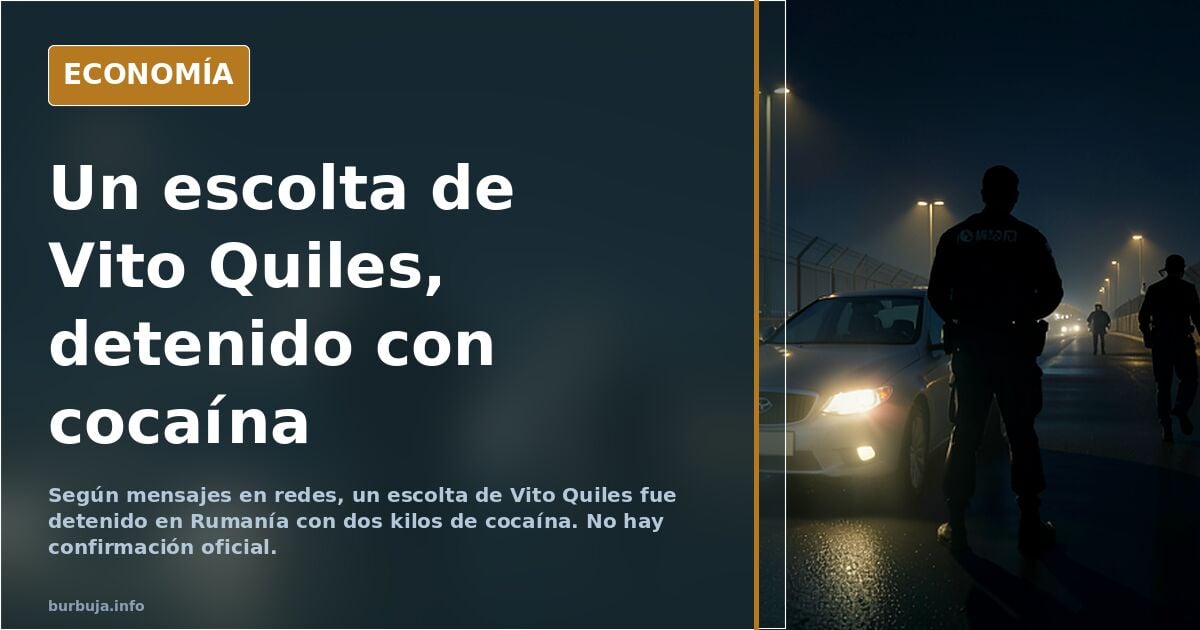
Bodyguard of Spanish activist Vito Quiles arrested in Romania with two kilos of cocaine
The news is not that a bodyguard was caught with drugs. The news is who pays him. According to messages circulating on social media and analyzed here, a bodyguard for Vito Quiles was arrested in Romania with two kilos of cocaine. On its own, this fact is an event. In context, it raises uncomfortable questions about the funding of political activism operating between media, parties, and security firms.
Vito Quiles is at the center of the conversation. He holds no public office, but his role as a media agitator has made him a recurring figure in press and online circles. The arrest of one of his bodyguards—allegedly, pending official confirmation—opens a front beyond incivil law: if the guard is paid by Quiles, who funds Quiles?
From anecdote to money trail
The discussion quickly shifts from the incident to the structure behind it. Some argue that if the bodyguard receives salary from Quiles, the money ultimately comes from those financing his activities: Vox, Alvise, or the PP, depending on circulating versions. This is a hypothesis, not proven fact, and should be treated as such. But the question of fund origins is not new: the ecosystem of digital activism and politics has blurred boundaries between militancy, business, and private security.
The conversation moves to broader ground. The cases of Koldo and Aldama are mentioned as examples that ties between politics and opaque business dealings are not exclusive to one party. This comparison is common in public debate, though each case has its own judicial path. What matters here is that a bodyguard’s arrest becomes a mirror where each side sees the other’s flaws.
Who pays for an activist’s security?
Personal bodyguards are uncommon in media activism. A guard implies monthly costs rarely covered by spontaneous donations. If Quiles has one, someone must be funding it steadily. The arrest in Romania—a country on the map of cocaine trafficking routes into Europe—adds an element highlighted in these messages: the link between private security and organized crime.
There is no official confirmation regarding the detainee’s identity or his employment relationship with Quiles. What circulates are tweets and messages from critical accounts. Presumption of innocence remains valid. Yet fruta damage is already done, not only for the bodyguard.
Right-wing vs left-wing narratives
This episode fits into a narrative war allowing no nuances. From the left, emphasis is placed on links between right-wing figures and crimes, arguing that personal protection services hired by media personalities often have incivil backgrounds. From the right, responses point to PSOE’s ties in cases like Koldo’s, accusing media of amplifying only what suits them.
The discussion increasingly degrades into insults and personal disqualifications, making it hard to separate analysis from noise. Still, a residue remains: funding of politics and activism is an opaque zone with scarce controls and voluntary transparency.
How many more bodyguards are on activists’ payrolls without us knowing who signs the transfers?
Also available in: Deutsch
Summary of a discussion on Burbuja.info - Foro de economía, actualidad y política., translated from Spanish and reviewed before publication. Read the full discussion (22 replies).
More summaries
-
Cars torched and nine arrested in Bilbao after protest
Nine arrests and privately owned cars burned out in Bilbao after the protest against Vito Quiles: the bill lands on residents and public funds
-
Vito Quiles arrested in Spain: four court cases pending
Vito Quiles, arrested at his workplace, faces four court cases: fraud against Renfe, harassment of Beatriz Corredor and more. Lawfare or justice?
-
Antifa activist assaulted at Vito Quiles rally in Spain (video)
The Antifascist Coordination of Zaragoza blames Vito Quiles supporters for an assault at a rally and points to the National Police. The statement gives no details about the injured person.
-
Jódar’s towel outburst highlights class divide in Spanish tennis
Spanish player Rafa Jódar shouted at a ball boy in Shanghai, receiving a warning. The incident reignites debate on elitism and education in the sport.
-
Lavapiés Faces Return of Public Drug Use and Taxi Avoidance
Residents in Madrid's Lavapiés district report visible intravenous drug use and taxi drivers avoiding the area at night.
-
Abdul El-Sayed wins Michigan Senate seat, boosting Democratic progressives
Abdul El-Sayed won the Michigan Senate race with 52%, becoming the first Muslim US senator. This victory signals growing momentum for the Democratic progressive wing ahead of 2028.