
Boarded-up shop windows: the rift opened by vandalism
Shops in Barcelona and Madrid are boarding up their windows out of fear of theft and vandalism. The debate over insecurity and the cost for brick-and-mortar retail.
English · Original discussion in Spanish · Published
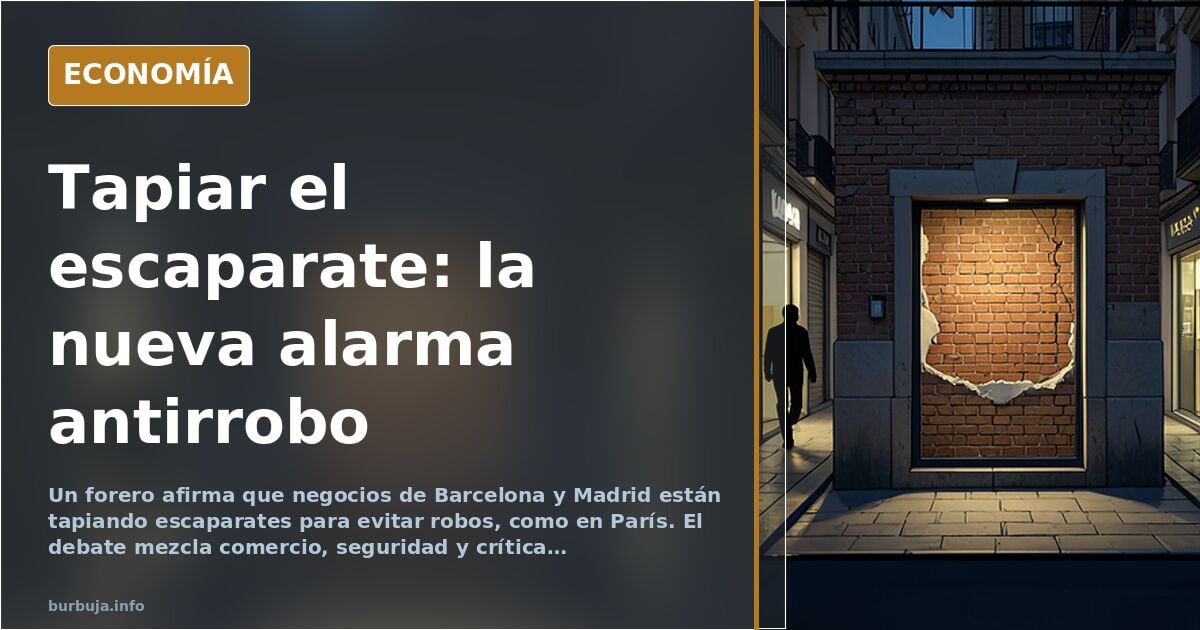
Businesses fortifying themselves against looting
A wooden board where a shop window used to be. That is the image that is starting to repeat itself on the commercial streets of Barcelona and Madrid, according to the framing that opens this discussion: out of antiestéticar of theft and vandalism —with the events in Paris as a reference point— some businesses are choosing to board up their display windows. It is not an aesthetic choice. It is a surrender. Every metre of window blocked off is a metre of potential sales that goes dark.
The conversation quickly shifts from shop windows to politics. For some, the phenomenon is the logical consequence of a legal framework that, in their view, protects offenders and abandons those who create value. For others, the scene is part of a broader decline: that of small brick-and-mortar retail facing the end-of-year shopping campaign and the pressure of the big operators. And there is a third, more uncomfortable reading: that of organised vandalism coordinated through public calls to action which, according to what is claimed in the exchange, the police fail to stop before it starts.
Brick-and-mortar retail, caught between theft and the Christmas campaign
The timing is no coincidence. The discussion places the boarding-up right in the middle of the long weekend and on the eve of the end-of-year shopping campaign, with quarterly earnings reports in the background. From that perspective, closing off shop windows would not only be a response to insecurity, but an added blow to neighbourhood retail in its decisive quarter. The suspicion raised —without proof— is that the succession of incidents ends up working as a finishing blow to brick-and-mortar business across the whole country.
Some go further and describe the scene as a kind of dress rehearsal: the city as the set of a dystopia, with echoes of Robocop or The Purge. The hyperbole serves to name a real unease: the feeling that public space has become hostile for anyone with something to lose.
Why board up windows instead of protecting them another way?
Because passive protection is cheaper than repairs. A smashed window, a forced shutter, ransacked stock: each incident adds up to a bill that a small shop's margins cannot absorb. A board, on the other hand, costs little and deters. The problem is that it also scares customers away. A blind window sells nothing.
The exchange brings up the comparison with California —the Commifornia of slang— presented as a mirror where this kind of response would have become normalised years ago. The reading is that what yesterday seemed exceptional is today taken for granted as scenery. And that normalisation, once in place, is hard to reverse: some warn that certain premises will remain boarded up forever.
Coordinated vandalism and the debate over the police response
One of the most concrete angles of the exchange points to the organisation of the riots. It is claimed that the calls to action are public, that participants meet at a set point and move as a group, and that it would be more effective to intercept them before they start than to catch them red-handed. It is a criticism of police operations, not an accusation backed by evidence. There is also talk of external interests that would benefit from social chaos, without providing any evidence to support it.
The migration backdrop appears in the exchange, and it is worth separating it from fact: the argument is made that opening the borders served to supply certain sectors with cheap labour, and that part of the problem stems from there. It is a political thesis, not a proven fact, and it is quoted as such.
The shop window as a barometer
The image of the board tells more than a burglary statistic. It tells how a shopkeeper calculates the risk of opening each morning. And above all, it tells what they are willing to sacrifice to stay open. The question left hanging is not whether the window will get its glass back, but how many shops will have decided by then that it is no longer worth it.
Also available in: Deutsch
Summary of a discussion on Burbuja.info - Foro de economía, actualidad y política., translated from Spanish and reviewed before publication. Read the full discussion (17 replies).
More summaries
-
Madrid's Sol protest camp winds down as cold, hygiene and narrative problems mount
The Puerta del Sol housing camp in Madrid faces its "de-camping" after three weeks: cold weather, Metro closure over sanitation and a fraying electoral narrative.
-
Adif hiring: 4,000 applicants, 22nd place and a family question about Renfe
A candidate ranked 22nd out of 4,000 and 2nd out of 200 at Adif, Spain's state rail infrastructure company. In the interview he was asked whether he had family at Renfe. He never heard back.
-
Victim's husband blames 'rushed capitalism' for Spain train crash
The husband of a woman killed in the Spanish rail accident blames 'rushed capitalism', sparking controversy: Adif and Renfe are state-owned. Reactions and facts.
-
José Elías, 50, marries Alexmay Valladares, 27: love and personal branding
José Elías, a 50-year-old Spanish entrepreneur worth 500 million, is marrying Alexmay Valladares, 27, with a beach proposal and a video on social media. Love and storytelling.
-
Rich countries face growing demands for a new social contract
France declares a state of emergency with debt at 119% of GDP and a deficit of 5.1%. The IMF puts the cost of social unrest at nearly half a point of growth.
-
Spain's PSOE, elections and trains: a suspicion that doesn't stand on its own
An online debate shares an El Tiempo article and repeats the suspicion that rail works are timed to elections, but the arithmetic shows no causation.