
Adif hiring: 4,000 applicants, 22nd place and a family question about Renfe
A candidate ranked 22nd out of 4,000 and 2nd out of 200 at Adif, Spain's state rail infrastructure company. In the interview he was asked whether he had family at Renfe. He never heard back.
English · Original discussion in Spanish · Published
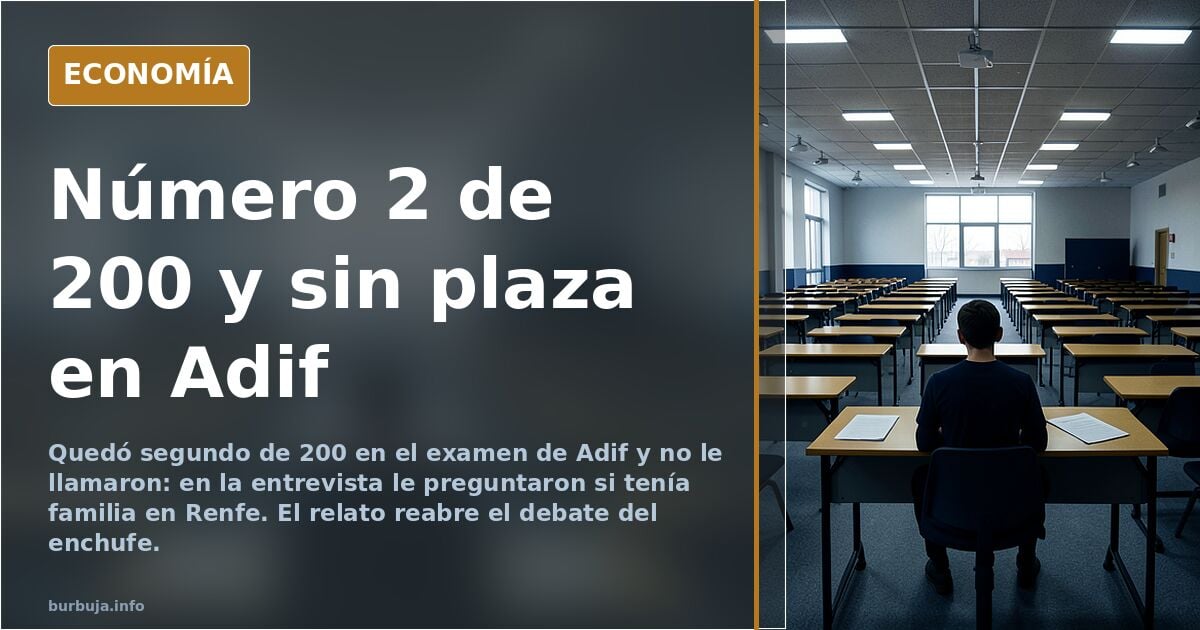
An Adif applicant: 22nd out of 4,000 and the job vanishes at the interview
A rail industry professional with experience abroad recounted on a forum that he ranked 22nd out of 4,000 applicants in Adif's selection process. He then passed an exam in Madrid and finished second out of 200. With those numbers, one of the 40 positions seemed a sure thing. It wasn't. At the personal interview, according to his account, he was asked point-blank whether he had family at Renfe. He was then given to understand that the positions were nearly all earmarked for the children and relatives of the rail union. He never heard from them again.
The story, spread on social media and echoed on an economics forum, has peine the debate over how staff are selected at state-owned companies. It is not just the complaint of a frustrated candidate: it is the confirmation, according to those taking part in the thread, that the system allows a brilliant exam result to count for nothing if the final interview — the one nobody audits — decides otherwise.
From 2nd out of 200 to nothing: the weight of the personal interview
The case described has three filters. First, a CV screening among some 4,000 candidates to narrow it down to 200. Then, an exam in Madrid. Finally, a personal interview. The applicant ranked 22nd in the first cut and second in the exam. The interview was not binding, but it weighed more than everything before it. The question about relatives at Renfe is no subtlety: it is, according to his testimony, a confession of what was really being assessed.
The law allows interviews and unregulated tests to be included in the hiring of state-owned companies. The problem is not that they exist, but that there is no audited record of what is said there. In a process with thousands of candidates, the interview becomes the door through which cronyism walks in. And nobody signs anything.
Some argue that pure competitive exams guarantee nothing either: leaked exams and suspicious top scorers have been seen. True. But there is a difference between a system that fails and a system designed with a stage where discretion is the norm. The difference between a multiple-choice exam and a personal interview is the difference between a correctable error and a door slammed shut without explanation.
Unions, families and inherited jobs
The story does not stop at Adif. Throughout the conversation, family clans at Correos, Renfe, Tragsa and other public bodies are mentioned. Nearly all participants agree on one point: cronyism is not a flaw of the system, it is a antiestéticature. Jobs are inherited the way surnames are. And the union, which should be the counterweight, appears as part of the allocation mechanism.
The case of the training of the train driver involved in a rail incident — a graduate in occupational therapy, selected from more than 1,000 candidates for an Iryo intake, according to the messages — is used as an example that the technical filter does not always prevail. It is not an accusation against her: it is the observation, according to the messages, that selection processes can prioritise opaque criteria over specific qualifications.
The conversation drifts towards the former Transport Minister, José Luis Ábalos, and his circle. It is mentioned that a person from his circle allegedly collected a public salary without showing up for work, as she herself admitted in court, according to the messages. These are claims circulating in the thread that had not been confirmed by a final court ruling at the time of the discussion. But the mere fact that they come up in a conversation about Adif shows how far the perception goes that public sector hiring operates as a system of favours.
The problem is not just Adif: the administration as a jobs agency
The initial complaint expands to the entire Spanish administration. Spanish universities are described as an ecosystem of clans in administrative staff positions. Air traffic controllers. Judges and notaries. Law enforcement bodies. The implicit conclusion is that access to public employment in Spain is governed not by merit but by connections. And that whoever lacks connections, however brilliant, is left out.
The counterpoint comes from those who defend that the competitive exam system, with all its flaws, is the only one that has allowed people without a patron to enter the administration. The lifetime position protects civil servants from political swings, but it also shields them from evaluation. The debate over whether that is an incentive or a disincentive remains open.
The question left hanging
If a candidate ranked 2nd out of 200 does not get in because he has no family at Renfe, what chance does number 150 have? The answer is not in the paperwork. It is in the interviews nobody records. And until they are audited, the story of cronyism will keep having more evidence than the story of merit.
Summary of a discussion on Burbuja.info - Foro de economía, actualidad y política., translated from Spanish and reviewed before publication. Read the full discussion (126 replies).
More summaries
-
Grusch’s Blonde Alien Leak Raises Doubts
David Grusch told Joe Rogan about blonde aliens in blue suits. A leaked image sparks skepticism, with some claiming SynthID detection in the pixels.
-
New Basque nationalist party forms against uncontrolled immigration
Former members of the Basque nationalist left have founded a party that rejects uncontrolled immigration and argues that migrants detained for crimes should leave…
-
Victim's husband blames 'rushed capitalism' for Spain train crash
The husband of a woman killed in the Spanish rail accident blames 'rushed capitalism', sparking controversy: Adif and Renfe are state-owned. Reactions and facts.
-
José Elías, 50, marries Alexmay Valladares, 27: love and personal branding
José Elías, a 50-year-old Spanish entrepreneur worth 500 million, is marrying Alexmay Valladares, 27, with a beach proposal and a video on social media. Love and storytelling.
-
Rich countries face growing demands for a new social contract
France declares a state of emergency with debt at 119% of GDP and a deficit of 5.1%. The IMF puts the cost of social unrest at nearly half a point of growth.
-
Spain's PSOE, elections and trains: a suspicion that doesn't stand on its own
An online debate shares an El Tiempo article and repeats the suspicion that rail works are timed to elections, but the arithmetic shows no causation.