
Bitcoin loss drives neighbor to knock on door
A 23-year-old neighbor knocks after ten days of instant soup meals, following her family's total loss in Bitcoin.
English · Original discussion in Spanish · Published
The Bitcoin ruin that pushes a neighbor to knock
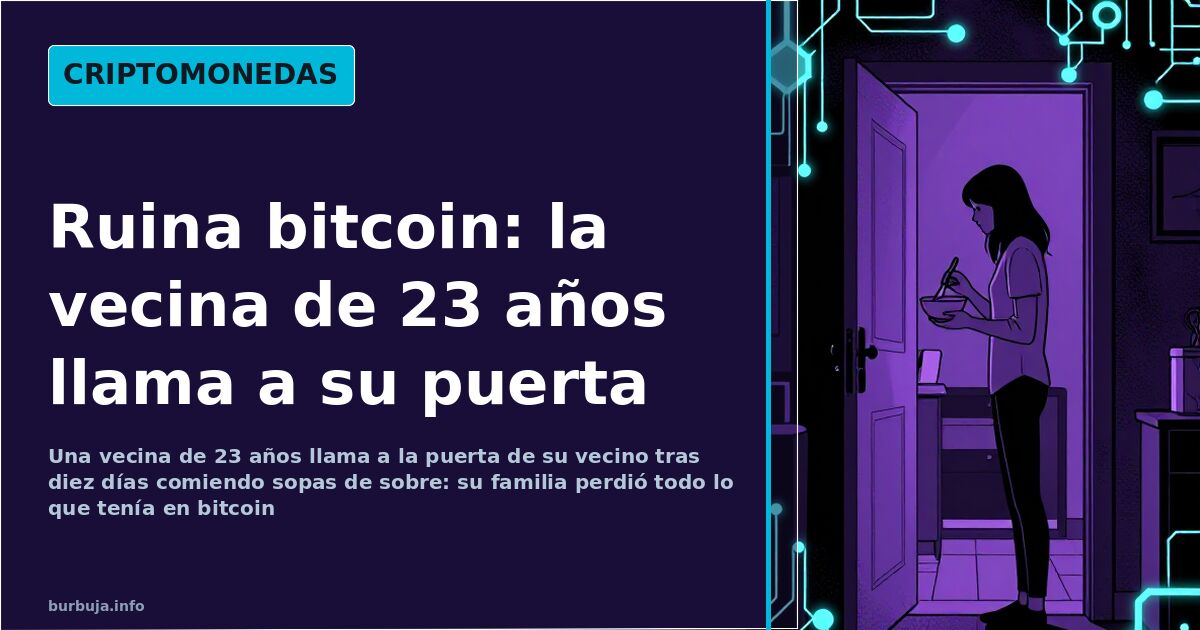
What happens when a family's bankruptcy spills into the hallway? A 23-year-old neighbor — the same one who went to school with a backpack a decade ago — waits for a man in his late thirties. She holds his hand, gets nervous, looks away. It’s not a lobby romance: in her home, she says, there is nothing left but instant soups.
The story is told by the protagonist himself and starts with a mundane purchase: potatoes with kebab meat and a can of soda. On the way back, the neighbor approaches him on the landing. He suggests going down for an ice cream, and once seated, the conversation turns into a litany against her father. According to her version, the man dragged the entire family into Bitcoin, pulled in several building neighbors, and left their accounts at zero.
How much is lost when a whole family enters Bitcoin?
The figures in the story are domestic and devastating. The family had been eating instant soups for ten days, buying a block of cold cuts for 8 euros at the cash store, and another block of something "similar to cheese" that, according to the young woman, is not cheese. That same morning — always according to her testimony — the father announced that there is nothing left in the bank: even the 2,000 euros sent by the grandmother to pay next year's tuition would have vanished, an amount he hoped to turn into 10,000.
The list doesn't end there. The family allegedly also lost two rented premises at good prices because the head of the household believed he would earn more with Bitcoin. And the damage isn't confined to the home: "half the building is in our situation" because, again according to this version, a brother-in-law convinced several neighbors to invest. This part should be read with caution — everything comes from the mouth of one alleged victim — but it describes a recognizable pattern: the promise of quick returns that spreads door-to-door until the money evaporates.
The story received with skepticism by the public
The tale has generated more doubts than support. Some responses dismiss it without hesitation — "it falls apart by the third paragraph," summarizes one — suspecting a literary construction stitched together with clichés: Andalusian elections, Bitcoin, and a multicultural detail involving kebab. Another current, more generous, gives it a high mark and defends the value of the story as a snapshot of everyday ruin.
There is a recurring detail that sets the tone: many ratings score the story out of ten, and some debate whether the ice cream should have been a specific brand to raise the grade. In between, messages sharpen the sarcasm: saying such scenes only happen to those with good looks, or that the author can't even write his name. The narrator himself responds to the jabs with an argument circulating in financial circles: he doesn't defend Bitcoin, he defends having sold in time, and calls anyone who bought at 60,000 euros not very sharp.
Two public salaries, a house, and the repeated calculation
When asked about his age, the protagonist places it in his late thirties and clarifies his situation: he is preparing for civil service exams, waiting for study books, and if he fails, will continue living off rents. He also confesses to expecting an inheritance — exempt in Andalusia — and owning more than one property. He is not, precisely, the profile of someone who needs rescuing with an ice cream.
That detail disorients the story and, at the same time, grounds it in a very real issue: the perception that certain couples calculate their future based on two civil servant positions and a combined payroll of four to six thousand euros. The narrator states this without shame and adds that he has seen knives peine as someone approaches the position. Whether true or not, the core of the matter remains the same: money, when it comes in or goes out, reorders neighborhood relationships.
The ballot paper at 2 AM
The ending of the story is almost a caricature. The neighbor rings the bell at 2:10 in the early hours, waking the dog, which barks whenever someone approaches the door. The protagonist, who had gone to bed at seven in the morning, goes down thinking they are the exam books. They are not. What he finds upstairs is a VOX ballot paper: the plan the young woman had proposed was to go vote together.
Thus ends, for now, a story that began with an ice cream and a trembling hand and concludes with two ballot boxes and a family in the red. How much ruin has Bitcoin brought, says the young woman. How much ruin, and how little was needed for someone to confuse it with a declaration of love.
What happens when a family's bankruptcy spills into the hallway? A 23-year-old neighbor — the same one who went to school with a backpack a decade ago — waits for a man in his late thirties. She holds his hand, gets nervous, looks away. It’s not a lobby romance: in her home, she says, there is nothing left but instant soups.
The story is told by the protagonist himself and starts with a mundane purchase: potatoes with kebab meat and a can of soda. On the way back, the neighbor approaches him on the landing. He suggests going down for an ice cream, and once seated, the conversation turns into a litany against her father. According to her version, the man dragged the entire family into Bitcoin, pulled in several building neighbors, and left their accounts at zero.
How much is lost when a whole family enters Bitcoin?
The figures in the story are domestic and devastating. The family had been eating instant soups for ten days, buying a block of cold cuts for 8 euros at the cash store, and another block of something "similar to cheese" that, according to the young woman, is not cheese. That same morning — always according to her testimony — the father announced that there is nothing left in the bank: even the 2,000 euros sent by the grandmother to pay next year's tuition would have vanished, an amount he hoped to turn into 10,000.
The list doesn't end there. The family allegedly also lost two rented premises at good prices because the head of the household believed he would earn more with Bitcoin. And the damage isn't confined to the home: "half the building is in our situation" because, again according to this version, a brother-in-law convinced several neighbors to invest. This part should be read with caution — everything comes from the mouth of one alleged victim — but it describes a recognizable pattern: the promise of quick returns that spreads door-to-door until the money evaporates.
The story received with skepticism by the public
The tale has generated more doubts than support. Some responses dismiss it without hesitation — "it falls apart by the third paragraph," summarizes one — suspecting a literary construction stitched together with clichés: Andalusian elections, Bitcoin, and a multicultural detail involving kebab. Another current, more generous, gives it a high mark and defends the value of the story as a snapshot of everyday ruin.
There is a recurring detail that sets the tone: many ratings score the story out of ten, and some debate whether the ice cream should have been a specific brand to raise the grade. In between, messages sharpen the sarcasm: saying such scenes only happen to those with good looks, or that the author can't even write his name. The narrator himself responds to the jabs with an argument circulating in financial circles: he doesn't defend Bitcoin, he defends having sold in time, and calls anyone who bought at 60,000 euros not very sharp.
Two public salaries, a house, and the repeated calculation
When asked about his age, the protagonist places it in his late thirties and clarifies his situation: he is preparing for civil service exams, waiting for study books, and if he fails, will continue living off rents. He also confesses to expecting an inheritance — exempt in Andalusia — and owning more than one property. He is not, precisely, the profile of someone who needs rescuing with an ice cream.
That detail disorients the story and, at the same time, grounds it in a very real issue: the perception that certain couples calculate their future based on two civil servant positions and a combined payroll of four to six thousand euros. The narrator states this without shame and adds that he has seen knives peine as someone approaches the position. Whether true or not, the core of the matter remains the same: money, when it comes in or goes out, reorders neighborhood relationships.
The ballot paper at 2 AM
The ending of the story is almost a caricature. The neighbor rings the bell at 2:10 in the early hours, waking the dog, which barks whenever someone approaches the door. The protagonist, who had gone to bed at seven in the morning, goes down thinking they are the exam books. They are not. What he finds upstairs is a VOX ballot paper: the plan the young woman had proposed was to go vote together.
Thus ends, for now, a story that began with an ice cream and a trembling hand and concludes with two ballot boxes and a family in the red. How much ruin has Bitcoin brought, says the young woman. How much ruin, and how little was needed for someone to confuse it with a declaration of love.
Also available in: Deutsch
Summary of a discussion on Burbuja.info - Foro de economía, actualidad y política., translated from Spanish and reviewed before publication. Read the full discussion (130 replies).
More summaries
-
Valdeande Mágico: The YouTuber Who Bought Bitcoin at $20
He recommended Bitcoin at $20 and Ethereum at $1. Today Valdeande Mágico posts on private channels and awaits 200 bitcoin lost in Mt. Gox.
-
Three-Value Currency: Paying with +1, -1, or Zero
A fringe proposal suggests a currency using +1 and -1 bills where payment signs are negotiated. The backing would be labor, not gold.
-
Telegram Crypto Mini-Apps: The Notcoin and Blum Boom
Notcoin hit $0.03 with 35 million users, while Blum reached 10 million. An analysis of Telegram's crypto mini-apps and their airdrops.
-
Kaspa: PoW Blockchain Hits $557M Cap, Promises 3,000 TPS
Kaspa claims 3,000 TPS via proof-of-work with a $557M market cap. Debate rages on whether it is Bitcoin's successor or a scam.
-
Bitcoin Confiscation: The 99% Cannot Hide Assets
Spanish tax authorities track crypto via KYC records. Most users cannot hide holdings despite Bitcoin's cryptographic privacy.
-
Crypto Stolen After Seed Phrase Copied by Cleaner
A forum user reports losing crypto after a cleaner copied his Ledger seed phrase hidden in books. He suspects the employee, with no…