
Crypto Stolen After Seed Phrase Copied by Cleaner
A forum user reports losing crypto after a cleaner copied his Ledger seed phrase hidden in books. He suspects the employee, with no…
English · Original discussion in Spanish · Published
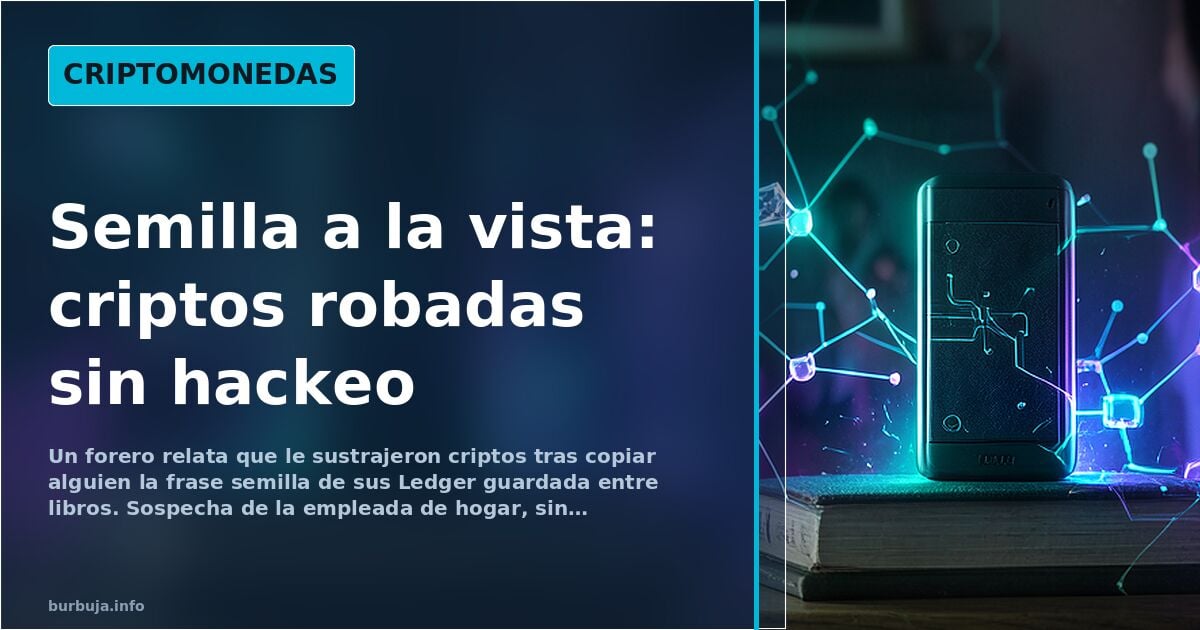
The Crypto Theft That Didn't Require Hacking
How do you empty a cold wallet without touching the Ledger? By copying the 12 words. An investor shares on a cryptocurrency forum that his Bitcoin and other coins were stolen after someone found his seed phrases hidden between books on his nightstand. According to his reconstruction, the thief was likely the cleaning lady hired a month and a half earlier, who never imagined those slips of paper held value. The victim admits candidly: he had two Ledger Nano seeds in the bedroom, accessible to anyone entering the house.
This case shatters the fantasy of the hardware wallet as an infallible safe. The device encrypts keys, but the backing seed phrase is just paper. If someone photographs, copies, or takes it, the Ledger becomes nothing more than a paperweight. The victim acknowledges this: "What good were the Ledger, Google Authenticator, and all that then?"
What Is a Seed Phrase and Why It Changes Everything
A seed phrase is the sequence of 12 or 24 words that allows recovery of a cryptocurrency wallet on any compatible device. Whoever holds it owns the coins. No password protects it, no 2FA stops it, and no bank can reverse the transaction. The victim had funds spread across two Ledger Nanos, plus positions on Kraken and Solflare, and noticed the theft across all fronts.
Two-factor authentication, often considered the last line of defense, proved useless. Not because it failed, but because the attacker didn't need to log in. With the seed phrase, one can rebuild the wallet on another device and move funds bypassing all controls. The victim summarizes bitterly: "I couldn't find any explanation for it."
The Simplest Hypothesis: The Housekeeper
His most probable theory points to the woman who started cleaning his home a month and a half before the theft. The seeds were hidden among books on the nightstand, a spot he deemed safe since he lived alone and no one else entered. When the cleaner arrived, he forgot those papers were still there.
Suspicion is reinforced by domestic details: the books appeared disordered. While he doesn't believe she understood what they were, he suspects she might have mentioned them to someone in her circle who did. "She's friends with some of my acquaintances, and one of them talks too much," he notes. An alternative hypothesis, discussed with a local hostel owner, involves a friend aware of his holdings. Neither scenario is proven.
Police Report, Lawyer, and an Added Problem: Tax Authorities
The victim eventually filed a police report. The outcome wasn't what he expected: according to his account, the cleaner burst into tears, denied the facts, and threatened to sue him for harassment. He claims everything is recorded and his vvife was present. "The last thing I wanted was ending up at the police station," he admits.
The case exposes an uncomfortable flank for those operating crypto outside the tax radar. The victim admits it took "enormous effort to buy everything anonymously" and now antiestéticars exposure. Forum users note that self-custody holdings aren't declared, but foreign exchange balances over €50,000 must be reported via Form 721 (Spanish tax declaration for foreign assets) by December 31. The line separating privacy from tax trouble is thinner than it seems.
What Can Be Done Once the Seed Is Copied
Short answer: almost nothing. Without proof someone copied the seed, incivil prosecution is a dead end. On-chain tracing can identify where funds went, but if the attacker moves them to an identity-verified exchange, traceability improves; if dispersed, it complicates matters. The repeated advice is to file a report and wait for the thief to make a mistake.
On the preventive side, cited measures are common sense: split the seed into fragments stored in different locations, write it in scrambled order, engrave it on metal plates, or use multisig. Some suggest hiding it on page X of a book, leaving only the page number visible. Anything but leaving it between nightstand books.
The sarracena is uncomfortable: self-custody security depends not on the device, but on the discretion of the user. And unlike the Ledger, discretion doesn't come in the box.
How do you empty a cold wallet without touching the Ledger? By copying the 12 words. An investor shares on a cryptocurrency forum that his Bitcoin and other coins were stolen after someone found his seed phrases hidden between books on his nightstand. According to his reconstruction, the thief was likely the cleaning lady hired a month and a half earlier, who never imagined those slips of paper held value. The victim admits candidly: he had two Ledger Nano seeds in the bedroom, accessible to anyone entering the house.
This case shatters the fantasy of the hardware wallet as an infallible safe. The device encrypts keys, but the backing seed phrase is just paper. If someone photographs, copies, or takes it, the Ledger becomes nothing more than a paperweight. The victim acknowledges this: "What good were the Ledger, Google Authenticator, and all that then?"
What Is a Seed Phrase and Why It Changes Everything
A seed phrase is the sequence of 12 or 24 words that allows recovery of a cryptocurrency wallet on any compatible device. Whoever holds it owns the coins. No password protects it, no 2FA stops it, and no bank can reverse the transaction. The victim had funds spread across two Ledger Nanos, plus positions on Kraken and Solflare, and noticed the theft across all fronts.
Two-factor authentication, often considered the last line of defense, proved useless. Not because it failed, but because the attacker didn't need to log in. With the seed phrase, one can rebuild the wallet on another device and move funds bypassing all controls. The victim summarizes bitterly: "I couldn't find any explanation for it."
The Simplest Hypothesis: The Housekeeper
His most probable theory points to the woman who started cleaning his home a month and a half before the theft. The seeds were hidden among books on the nightstand, a spot he deemed safe since he lived alone and no one else entered. When the cleaner arrived, he forgot those papers were still there.
Suspicion is reinforced by domestic details: the books appeared disordered. While he doesn't believe she understood what they were, he suspects she might have mentioned them to someone in her circle who did. "She's friends with some of my acquaintances, and one of them talks too much," he notes. An alternative hypothesis, discussed with a local hostel owner, involves a friend aware of his holdings. Neither scenario is proven.
Police Report, Lawyer, and an Added Problem: Tax Authorities
The victim eventually filed a police report. The outcome wasn't what he expected: according to his account, the cleaner burst into tears, denied the facts, and threatened to sue him for harassment. He claims everything is recorded and his vvife was present. "The last thing I wanted was ending up at the police station," he admits.
The case exposes an uncomfortable flank for those operating crypto outside the tax radar. The victim admits it took "enormous effort to buy everything anonymously" and now antiestéticars exposure. Forum users note that self-custody holdings aren't declared, but foreign exchange balances over €50,000 must be reported via Form 721 (Spanish tax declaration for foreign assets) by December 31. The line separating privacy from tax trouble is thinner than it seems.
What Can Be Done Once the Seed Is Copied
Short answer: almost nothing. Without proof someone copied the seed, incivil prosecution is a dead end. On-chain tracing can identify where funds went, but if the attacker moves them to an identity-verified exchange, traceability improves; if dispersed, it complicates matters. The repeated advice is to file a report and wait for the thief to make a mistake.
On the preventive side, cited measures are common sense: split the seed into fragments stored in different locations, write it in scrambled order, engrave it on metal plates, or use multisig. Some suggest hiding it on page X of a book, leaving only the page number visible. Anything but leaving it between nightstand books.
The sarracena is uncomfortable: self-custody security depends not on the device, but on the discretion of the user. And unlike the Ledger, discretion doesn't come in the box.
Also available in: Deutsch
Summary of a discussion on Burbuja.info - Foro de economía, actualidad y política., translated from Spanish and reviewed before publication. Read the full discussion (90 replies).
More summaries
-
Cyberattack on Liquid: 4,000 BTC Stolen While Bitcoin Remains Intact
Cyberattack on Liquid: 4,000 BTC stolen ($320 million). Bitcoin remains stable. Learn what a sidechain is and why this attack didn't affect the main network.
-
Valdeande Mágico: The YouTuber Who Bought Bitcoin at $20
He recommended Bitcoin at $20 and Ethereum at $1. Today Valdeande Mágico posts on private channels and awaits 200 bitcoin lost in Mt. Gox.
-
Bitcoin defies crash warnings, up 15% since alert
Bitcoin rises 15% since crash warning and 75% yearly as ETFs buy 12.5x daily issuance.
-
Bitcoin Gold Ratio: From 3 to Over 30 Ounces in 2021
Bitcoin rose from 3 to over 30 gold ounces (2018-2021) per stock-to-flow models, later correcting to 18.
-
Pi Network Price Under Pressure as Daily Token Unlocks Hit 12.5M
Pi Network unlocks 12.5 million tokens daily while developers withhold full migration schedules, raising concerns about price stability.
-
Bitcoin tops $61,000; gold debate remains open
Bitcoin surpasses $61,000 as some claim investment flows are shifting from gold to Bitcoin ETFs. The discussion on whether…