
Three-Value Currency: Paying with +1, -1, or Zero
A fringe proposal suggests a currency using +1 and -1 bills where payment signs are negotiated. The backing would be labor, not gold.
English · Original discussion in Spanish · Published
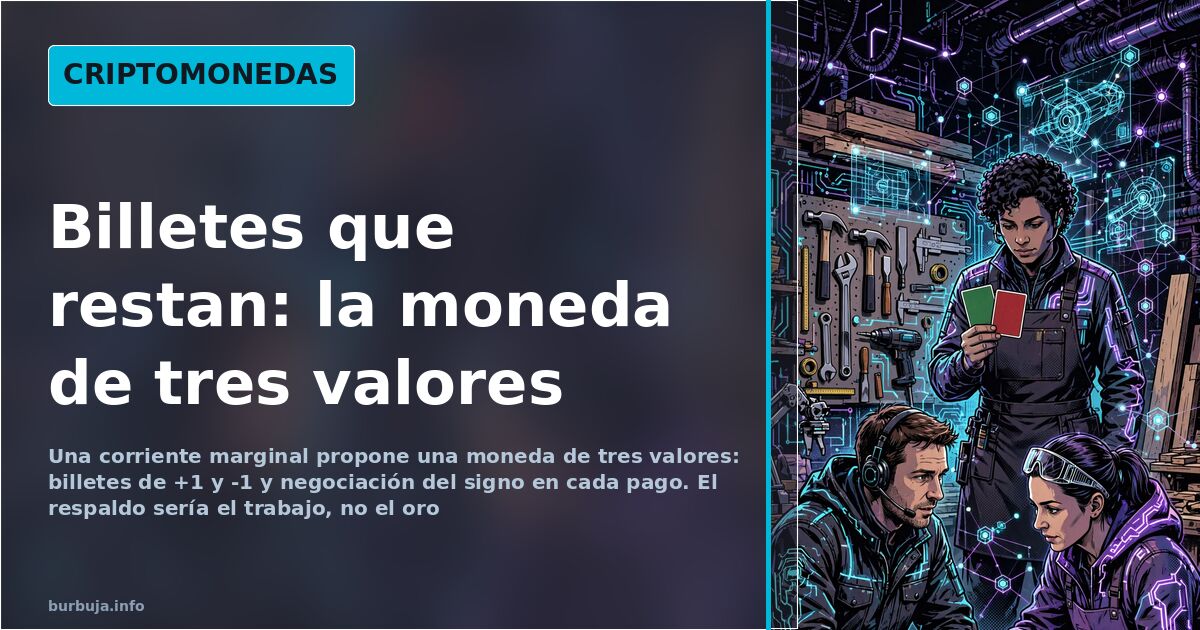
Paying with +1, 0, or -1: The three-value currency challenging fiat
Some bills add value, others subtract it. This is the premise of the three-value currency, a concept circulating for years in the margins of digital economics: each unit has a sign—positive, negative, or neutral—and payment becomes a negotiation over how much is transferred and its type. The idea doesn't come from central banks, but from distrust of them.
What a +1, 0, and -1 currency proposes
The basic design is dizzyingly simple. Three operational values are set: +1, 0, and -1. There would be two types of paper money, one worth positive one and another worth negative one, while zero is assumed obvious. Sellers keep the sign they accept: receiving a -1 lowers their balance; receiving a +1 raises it. Buyers do the opposite. Each exchange leaves a balance between positive and negative money, and the system bets on these flows compensating each other.
Price isn't set only by sellers. This is the most debated part: buyer and seller negotiate the payment's sign. Examples are everyday scenarios. A liter of water might be exchanged "for zero"—free, without market value changing—and that zero is described as peace. Another common case: two people with seven units each, one asks to drop to six, the other proposes staying at seven, and the deal ends wherever they agree.
Why moving beyond ±1 is discarded
Large values break the system. Staying within ±1 allows doing almost anything without chaos; jumping to figures like -10 opens the door, according to the proposal itself, to dynamics best left unexplained and firmly rejected. The repeated conclusion: with +1, -1, and 0, things can be done without harm. Going higher means entering a different game.
From Gold Standard to Labor Standard
Here the conversation gets serious. Against debt-created money, there's a proposal to back currency with labor: the workforce transforming raw materials, the intelligence behind invention and production. Gold, they argue, has no intrinsic value; it works because someone accepts it, and if nobody wants it, it ceases to be money. The "Labor Standard" movement cites interwar economic models as antecedents, a reference introduced in the thread without development.
Accounting proposals even include -€5 and -€10 bills to reactivate the economy: issued as pending debt, recipients settle them later with work or other consideration. Presented as a perfect trick, the effectiveness of deception is admitted without shame. Another figure appears, based on a calculation launched in the thread: for every euro spent, debt would drag around 814.7.
Word money, heavy marbles, and multiplying coins
Ideas abound. One path proposes monetary units as letters or words, valued by sender and receiver. Another bets on colored marbles: minimum two colors, optimal 16, with 378 marbles for the ambitious version, value determined by physical weight. Also appears a coin that multiplies by ten when its owner does good deeds and disappears if they stop. For pragmatists, a periodic equal allocation for everyone, regardless of circumstances.
Nano, Monero, and the obsession with anonymity
When debate shifts from theory to software, names are Nano and Monero. Traceability is seen as a problem, not virtue: if every move is recorded and linked to a name, exchange ceases to be free. Hence, defense of transaction anonymity and the idea that money must circulate without anyone logging its use.
Criticism: Creating wealth by creating need
Not all applause. The most repeated objection is that many schemes start by fabricating a need to sell solutions, generating no new wealth. References to classical economic literature on price formation are made, concluded ironically: boredom causes havoc. Another warning: opening the system to high values turns debt from accounting detail into business center.
That's where it stands. Between discovering a bill could have a sign and asking who monitors the balance, there's no closed answer. Numbers remain small, examples domestic, and the underlying doubt—if currency backing can be labor instead of metal—remains unresolved.
Some bills add value, others subtract it. This is the premise of the three-value currency, a concept circulating for years in the margins of digital economics: each unit has a sign—positive, negative, or neutral—and payment becomes a negotiation over how much is transferred and its type. The idea doesn't come from central banks, but from distrust of them.
What a +1, 0, and -1 currency proposes
The basic design is dizzyingly simple. Three operational values are set: +1, 0, and -1. There would be two types of paper money, one worth positive one and another worth negative one, while zero is assumed obvious. Sellers keep the sign they accept: receiving a -1 lowers their balance; receiving a +1 raises it. Buyers do the opposite. Each exchange leaves a balance between positive and negative money, and the system bets on these flows compensating each other.
Price isn't set only by sellers. This is the most debated part: buyer and seller negotiate the payment's sign. Examples are everyday scenarios. A liter of water might be exchanged "for zero"—free, without market value changing—and that zero is described as peace. Another common case: two people with seven units each, one asks to drop to six, the other proposes staying at seven, and the deal ends wherever they agree.
Why moving beyond ±1 is discarded
Large values break the system. Staying within ±1 allows doing almost anything without chaos; jumping to figures like -10 opens the door, according to the proposal itself, to dynamics best left unexplained and firmly rejected. The repeated conclusion: with +1, -1, and 0, things can be done without harm. Going higher means entering a different game.
From Gold Standard to Labor Standard
Here the conversation gets serious. Against debt-created money, there's a proposal to back currency with labor: the workforce transforming raw materials, the intelligence behind invention and production. Gold, they argue, has no intrinsic value; it works because someone accepts it, and if nobody wants it, it ceases to be money. The "Labor Standard" movement cites interwar economic models as antecedents, a reference introduced in the thread without development.
Accounting proposals even include -€5 and -€10 bills to reactivate the economy: issued as pending debt, recipients settle them later with work or other consideration. Presented as a perfect trick, the effectiveness of deception is admitted without shame. Another figure appears, based on a calculation launched in the thread: for every euro spent, debt would drag around 814.7.
Word money, heavy marbles, and multiplying coins
Ideas abound. One path proposes monetary units as letters or words, valued by sender and receiver. Another bets on colored marbles: minimum two colors, optimal 16, with 378 marbles for the ambitious version, value determined by physical weight. Also appears a coin that multiplies by ten when its owner does good deeds and disappears if they stop. For pragmatists, a periodic equal allocation for everyone, regardless of circumstances.
Nano, Monero, and the obsession with anonymity
When debate shifts from theory to software, names are Nano and Monero. Traceability is seen as a problem, not virtue: if every move is recorded and linked to a name, exchange ceases to be free. Hence, defense of transaction anonymity and the idea that money must circulate without anyone logging its use.
Criticism: Creating wealth by creating need
Not all applause. The most repeated objection is that many schemes start by fabricating a need to sell solutions, generating no new wealth. References to classical economic literature on price formation are made, concluded ironically: boredom causes havoc. Another warning: opening the system to high values turns debt from accounting detail into business center.
That's where it stands. Between discovering a bill could have a sign and asking who monitors the balance, there's no closed answer. Numbers remain small, examples domestic, and the underlying doubt—if currency backing can be labor instead of metal—remains unresolved.
Also available in: Deutsch
Summary of a discussion on Burbuja.info - Foro de economía, actualidad y política., translated from Spanish and reviewed before publication. Read the full discussion (129 replies).
More summaries
-
Nano: Zero fees, fixed supply, security doubts
Nano offers zero fees and a fixed supply of 133 million coins, but faces security concerns after a potential attack and stagnant price.
-
Spanish Tax Agency Crypto Guide: FIFO Rules
Spain's AEAT mandates FIFO for crypto taxes. Learn about the 25% rate, calculation tools, and audit risks.
-
Valdeande Mágico: The YouTuber Who Bought Bitcoin at $20
He recommended Bitcoin at $20 and Ethereum at $1. Today Valdeande Mágico posts on private channels and awaits 200 bitcoin lost in Mt. Gox.
-
Bitcoin and illicit funds: The issue is tax compliance, not the currency
A 20% return over ten years fails to cover inflation, while Spanish tax authorities claim nearly 20% of profits. Bitcoin does not launder illicit money...
-
Astrologer’s Bitcoin Crash Prediction Fails as Market Rallies
Bitcoin posted its best month since October 2021, while the crash predicted by an astrologer for late July never materialized.
-
Withdrawing €1M in Crypto Is Not a Simple Bank Transfer
Cashing out €1M in crypto isn't automatic. We analyze tax rates, fiscal residency strategies, and real-world extraction methods.