
Bitcoin Gold Ratio: From 3 to Over 30 Ounces in 2021
Bitcoin rose from 3 to over 30 gold ounces (2018-2021) per stock-to-flow models, later correcting to 18.
English · Original discussion in Spanish · Published
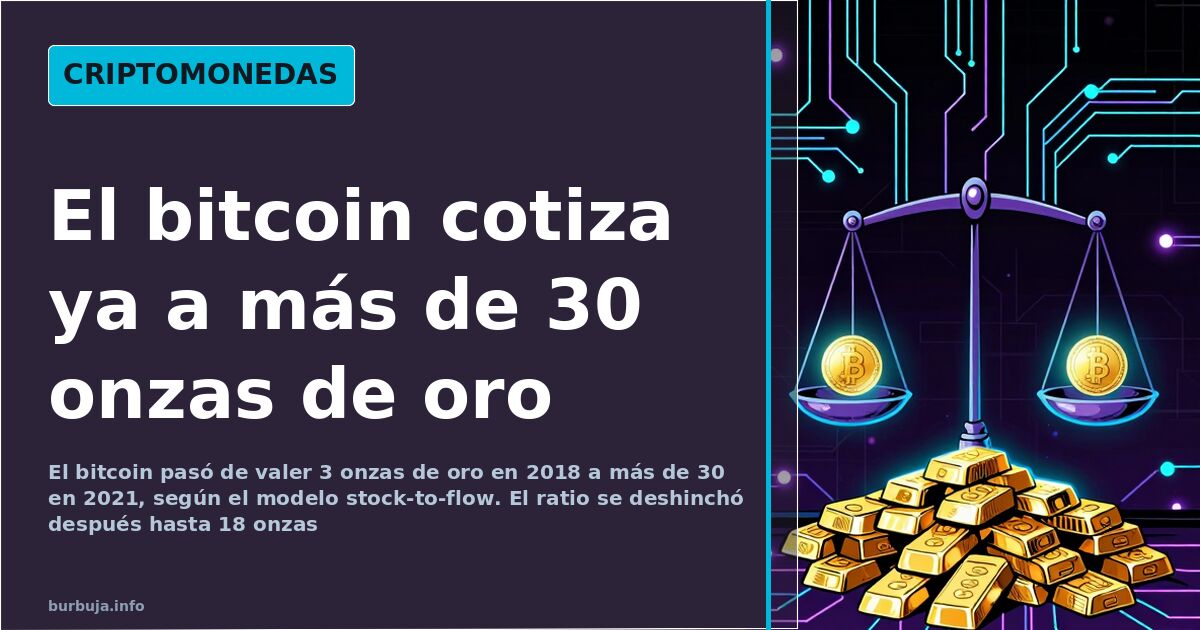
From 3 gold ounces per bitcoin in 2018 to more than 30 in 2021
In 2021, the comparison ceased to be a boutade of casual debate. The question raised then—whether bitcoin is destined to become "the new aluminum," as Max Keiser argues, and if gold will continue rising against fiat money but no longer against this new standard—summarized a very specific antiestéticar: that the golden metal loses its monetary function just when more people are buying it. The trigger was a sarcastic message from presenter Peter McCormack ridiculing gold as a store of value. From there, the discussion evolved into something more useful: numbers.
What the model comparing bitcoin and gold says
The data that organized everything was an exchange ratio. Bitcoin was equivalent to 3 gold ounces in 2018, 5 ounces at the end of 2019, and 15 ounces at the peak of 2021, according to the stock-to-flow model disseminated by the analyst known as PlanB. That same calculation suggests that if bitcoin multiplied gold's value by a hundred—excluding the effect of printed money, relying solely on scarcity—the digital currency would be worth $188,000.
The series in ounces acted as a thermometer. It first marked 29.46 ounces per bitcoin (835.37 grams). Then, 30.45 ounces (863.42 grams). In other words: bitcoin was buying increasingly more yellow metal, not the reverse.
Is bitcoin the only limited asset that exists?
No, if one looks at the entire ecosystem. The star argument—that bitcoin is the only truly limited asset in history, with a cap of 18,585,781 coins compared to gold, which is mined at 2% annually, or housing, which is built without restraint—has an obvious flaw: hundreds of cryptocurrencies exist with also closed issuance. Dash, Litecoin, Monero, or Ripple circulate with their own rules.
The uncomfortable objection is not that, but cloning. Anyone can copy the code, replicate the limit, and launch a substitute. If scarcity were the only virtue, the asset would be trivially replaceable. Bitcoin defenders argue that it does not compete on code, but on network: the age, liquidity, and accumulated security of the first mover. The doubt about whether that is sufficient remains open. 18,585,781 is the exact figure used for total supply, not the rounded 18 million that almost everyone repeats.
Gold retains jewelry and industry, but the best money serves no purpose
The classic defense of the metal is tangible: it will always have demand in jewelry and industrial applications, so its value does not depend solely on faith. The deployed counteroffensive is more sophisticated: precisely because it has uses, gold is not perfect money. An ideal monetary asset should not have alternative applications, so that its price is set solely by reserve demand.
The same reasoning applies to housing. If a large part of a house's price did not come from those who live in it but from those who use it to protect themselves from inflation, real estate would cost less. The conclusion is uncomfortable for both sides: the metal has an industrial floor, the cryptocurrency has no floor of any kind.
Neither gold nor silver were quiet havens
Volatility is not exclusive to bitcoin. In 2011, gold dropped 40% in two months and silver 50% in the same period, with a fall of 75% from highs to lows. Those who demand stability from bitcoin should explain why they grant it to the metal.
Silver advocates exploited that gap: the answer, they say, is silver, with prices that are already difficult to find in physical format. The doubt they leave hanging is more about supply than quotation.
China, Basel III, and gold as a future reserve currency
One of the most striking turns was geopolitical. China banned cryptocurrencies while maintaining the largest gold reserves on the planet and allowing mining. The reading of this double standard is that, before presenting gold as a new world currency, it is advisable to deactivate digital competition.
The sequence fits. Already in 2004, before the London Bullion Market Association, the Chinese central bank announced its desire to reintroduce gold into the financial system and encourage its citizens to accumulate it. Some estimate Chinese residents' savings available for this purpose at 12 trillion yuan.
The other argument is regulatory. Basel III and the actual audit of gold in European banks could reveal that paper metal vastly exceeds physical holdings. Or never happen: too much money in vouchers to blow up the system, skeptics maintain.
How much would a bitcoin be worth if it absorbed global debt?
A napkin calculation circulates often: if bitcoin absorbed all derivatives and all debt on the planet, each coin would be worth 50 million. It should not be taken literally, but it serves to measure the distance between the narrative and the market price.
The thermometer in ounces later marked 18.281 ounces per bitcoin (518.265 grams). Bitcoin lost more than a third of the purchasing power in gold it had reached, and projections cooled accordingly.
With the ratio back at 18 ounces, the question of whether gold is being devoured or simply correcting remains unanswered. And there, exactly, is where the analysis stalls.
In 2021, the comparison ceased to be a boutade of casual debate. The question raised then—whether bitcoin is destined to become "the new aluminum," as Max Keiser argues, and if gold will continue rising against fiat money but no longer against this new standard—summarized a very specific antiestéticar: that the golden metal loses its monetary function just when more people are buying it. The trigger was a sarcastic message from presenter Peter McCormack ridiculing gold as a store of value. From there, the discussion evolved into something more useful: numbers.
What the model comparing bitcoin and gold says
The data that organized everything was an exchange ratio. Bitcoin was equivalent to 3 gold ounces in 2018, 5 ounces at the end of 2019, and 15 ounces at the peak of 2021, according to the stock-to-flow model disseminated by the analyst known as PlanB. That same calculation suggests that if bitcoin multiplied gold's value by a hundred—excluding the effect of printed money, relying solely on scarcity—the digital currency would be worth $188,000.
The series in ounces acted as a thermometer. It first marked 29.46 ounces per bitcoin (835.37 grams). Then, 30.45 ounces (863.42 grams). In other words: bitcoin was buying increasingly more yellow metal, not the reverse.
Is bitcoin the only limited asset that exists?
No, if one looks at the entire ecosystem. The star argument—that bitcoin is the only truly limited asset in history, with a cap of 18,585,781 coins compared to gold, which is mined at 2% annually, or housing, which is built without restraint—has an obvious flaw: hundreds of cryptocurrencies exist with also closed issuance. Dash, Litecoin, Monero, or Ripple circulate with their own rules.
The uncomfortable objection is not that, but cloning. Anyone can copy the code, replicate the limit, and launch a substitute. If scarcity were the only virtue, the asset would be trivially replaceable. Bitcoin defenders argue that it does not compete on code, but on network: the age, liquidity, and accumulated security of the first mover. The doubt about whether that is sufficient remains open. 18,585,781 is the exact figure used for total supply, not the rounded 18 million that almost everyone repeats.
Gold retains jewelry and industry, but the best money serves no purpose
The classic defense of the metal is tangible: it will always have demand in jewelry and industrial applications, so its value does not depend solely on faith. The deployed counteroffensive is more sophisticated: precisely because it has uses, gold is not perfect money. An ideal monetary asset should not have alternative applications, so that its price is set solely by reserve demand.
The same reasoning applies to housing. If a large part of a house's price did not come from those who live in it but from those who use it to protect themselves from inflation, real estate would cost less. The conclusion is uncomfortable for both sides: the metal has an industrial floor, the cryptocurrency has no floor of any kind.
Neither gold nor silver were quiet havens
Volatility is not exclusive to bitcoin. In 2011, gold dropped 40% in two months and silver 50% in the same period, with a fall of 75% from highs to lows. Those who demand stability from bitcoin should explain why they grant it to the metal.
Silver advocates exploited that gap: the answer, they say, is silver, with prices that are already difficult to find in physical format. The doubt they leave hanging is more about supply than quotation.
China, Basel III, and gold as a future reserve currency
One of the most striking turns was geopolitical. China banned cryptocurrencies while maintaining the largest gold reserves on the planet and allowing mining. The reading of this double standard is that, before presenting gold as a new world currency, it is advisable to deactivate digital competition.
The sequence fits. Already in 2004, before the London Bullion Market Association, the Chinese central bank announced its desire to reintroduce gold into the financial system and encourage its citizens to accumulate it. Some estimate Chinese residents' savings available for this purpose at 12 trillion yuan.
The other argument is regulatory. Basel III and the actual audit of gold in European banks could reveal that paper metal vastly exceeds physical holdings. Or never happen: too much money in vouchers to blow up the system, skeptics maintain.
How much would a bitcoin be worth if it absorbed global debt?
A napkin calculation circulates often: if bitcoin absorbed all derivatives and all debt on the planet, each coin would be worth 50 million. It should not be taken literally, but it serves to measure the distance between the narrative and the market price.
The thermometer in ounces later marked 18.281 ounces per bitcoin (518.265 grams). Bitcoin lost more than a third of the purchasing power in gold it had reached, and projections cooled accordingly.
With the ratio back at 18 ounces, the question of whether gold is being devoured or simply correcting remains unanswered. And there, exactly, is where the analysis stalls.
Also available in: Deutsch
Summary of a discussion on Burbuja.info - Foro de economía, actualidad y política., translated from Spanish and reviewed before publication. Read the full discussion (132 replies).
More summaries
-
Valdeande Mágico: The YouTuber Who Bought Bitcoin at $20
He recommended Bitcoin at $20 and Ethereum at $1. Today Valdeande Mágico posts on private channels and awaits 200 bitcoin lost in Mt. Gox.
-
Crypto Stolen After Seed Phrase Copied by Cleaner
A forum user reports losing crypto after a cleaner copied his Ledger seed phrase hidden in books. He suspects the employee, with no…
-
Bitcoin defies crash warnings, up 15% since alert
Bitcoin rises 15% since crash warning and 75% yearly as ETFs buy 12.5x daily issuance.
-
Pi Network Price Under Pressure as Daily Token Unlocks Hit 12.5M
Pi Network unlocks 12.5 million tokens daily while developers withhold full migration schedules, raising concerns about price stability.
-
Bitcoin tops $61,000; gold debate remains open
Bitcoin surpasses $61,000 as some claim investment flows are shifting from gold to Bitcoin ETFs. The discussion on whether…
-
Bitcoin Breaks $20,000 as Market Splits
Bitcoin surpassed $20,000 in December 2020 and neared $30,000 weeks later. Analysis of the rally, derivatives' role, and subsequent crash.