
Bitcoin Drops Below $60k Amid Mining Energy Debate
Bitcoin breaks the $60,000 support as Tesla halts crypto payments over mining energy use, sparking short-selling interest.
English · Original discussion in Spanish · Published
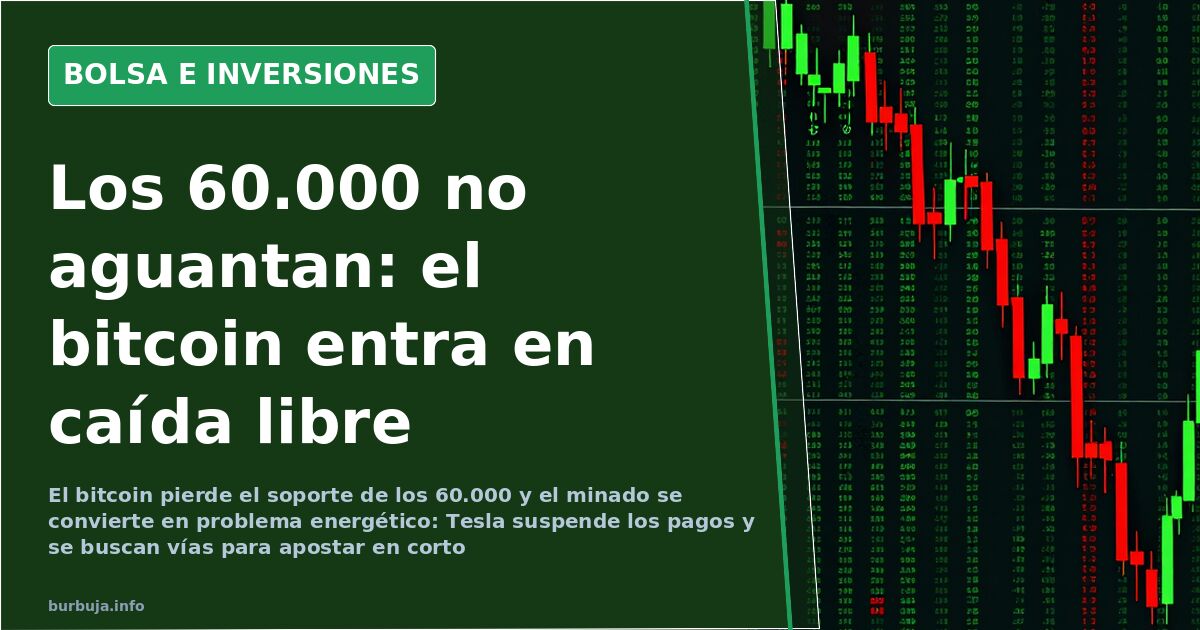
Bitcoin in Freefall: The $60,000 Support Breaks
Bitcoin lost the $60,000 level, shattering the narrative that every correction was a buying opportunity. According to forum discussions, the drop accelerated after Tesla announced it would stop accepting cryptocurrency for vehicle purchases due to the energy consumption required for mining, a move that dragged down both the coin and the manufacturer's stock. One calculation circulating suggests that during the plunge, units were still trading around €42,000, more than 400% above prices from a few months prior and over 1,000% higher than March 2020 lows. The $60,000 mark was the line separating correction from panic. With that reference gone, the question is no longer how much it rises, but how long the punishment lasts.
Why Did Bitcoin Crash?
The immediate trigger came via Twitter. Elon Musk announced that Tesla was reversing course on Bitcoin payments due to the environmental cost of mining. Some interpret this episode as a billionaire’s joke, comfortable moving markets with a single message. His ability to shake prices with a post is undisputed; his intent is debated. Critics accuse him of inflating and deflating the currency at will, citing his appearance on a US TV show as evidence of indifference.
This blow coincided with fiscal concerns. Part of the analysis suggests the US administration is preparing a 40% tax rate for cryptocurrencies, arguing prices won’t recover until the news is digested. Others deny this outright: false, they claim, asserting the rate is 37% and only applies to incomes over one million. This denial doesn’t improve market sentiment, which weighs headlines heavier than regulations.
With the $60,000 floor broken, warnings pile up. The bleakest take sums up the day with $30,000 and falling and twisted comfort: nobody could have known. The irony works because nobody promised otherwise.
Mining Consumes Power and Graphics Cards
The energy cost of mining is Musk’s argument and the most resonant point. Forum users link thermal plant reopenings to power data centers, the disappearance of graphics cards from retail, and a semiconductor crisis halting car assembly lines. One message bluntly states: never has a mediocre scam been so expensive.
Consequently, some view the crash with non-spiritual interests. They recall the last major crash when ex-mining GPUs were sold new with two-year warranties for pennies, hoping to repeat the purchase for 4K gaming. Others demand state intervention to shut down the business, arguing electricity consumption provides a perfect excuse to ban activity without invading privacy.
How to Short Bitcoin from Spain?
The search for an accessible short fund yields no answer in the thread, shifting focus to listed miners. Marathon and Riot are cited as proxies: they don’t replicate Bitcoin’s movement 100%, but suffer when it falls, serving those wanting to position bearishly. The usual warning applies: correlation is imperfect, and miners carry their own risks, including recent investments in mining equipment.
Buying More When It Falls: The Faith of the Holder
On the other side are opportunists. Some bought more Bitcoin at €39,000 and admit they haven’t looked at it all day. Comparisons with gold aren’t taken for granted: while gold is finite, the number of protocols and issuance is, according to one user, more infinite than printing Monopoly money, undermining its safe-haven status. The elegant formulation circulating is that the currency is, among other things, a machine transferring wealth from speculators to patient holders.
The corollary is schadenfreude. Some enjoy watching those who buy assets to resell them lose money. Others retort that these same celebrators have suffered ulcers from rising prices for a year, hiding when it goes up and speaking only during crashes. The underlying fight isn’t today’s price, but whether crypto money will eventually pass through the State’s tiller, as happens in some European jurisdictions where conversion to fiat is taxed.
The War Against Bitcoin: Printers, Taxes, and States
The most repeated pro-argument isn’t utility, but what it says about official money: Bitcoin isn’t worth much; the dollar is worth little, hence needing many dollars to buy one unit. Skeptics counter that Bitcoin’s value exists because states allow it, and laws can condition its price. Taxing each transaction or making USD conversion expensive are levers that don’t require closing the internet or spying.
With the $60,000 support broken and mining becoming an energy problem, the lingering question is uncomfortable: what must happen for Bitcoin to stop being a faith-based bet and start behaving like an asset.
Bitcoin lost the $60,000 level, shattering the narrative that every correction was a buying opportunity. According to forum discussions, the drop accelerated after Tesla announced it would stop accepting cryptocurrency for vehicle purchases due to the energy consumption required for mining, a move that dragged down both the coin and the manufacturer's stock. One calculation circulating suggests that during the plunge, units were still trading around €42,000, more than 400% above prices from a few months prior and over 1,000% higher than March 2020 lows. The $60,000 mark was the line separating correction from panic. With that reference gone, the question is no longer how much it rises, but how long the punishment lasts.
Why Did Bitcoin Crash?
The immediate trigger came via Twitter. Elon Musk announced that Tesla was reversing course on Bitcoin payments due to the environmental cost of mining. Some interpret this episode as a billionaire’s joke, comfortable moving markets with a single message. His ability to shake prices with a post is undisputed; his intent is debated. Critics accuse him of inflating and deflating the currency at will, citing his appearance on a US TV show as evidence of indifference.
This blow coincided with fiscal concerns. Part of the analysis suggests the US administration is preparing a 40% tax rate for cryptocurrencies, arguing prices won’t recover until the news is digested. Others deny this outright: false, they claim, asserting the rate is 37% and only applies to incomes over one million. This denial doesn’t improve market sentiment, which weighs headlines heavier than regulations.
With the $60,000 floor broken, warnings pile up. The bleakest take sums up the day with $30,000 and falling and twisted comfort: nobody could have known. The irony works because nobody promised otherwise.
Mining Consumes Power and Graphics Cards
The energy cost of mining is Musk’s argument and the most resonant point. Forum users link thermal plant reopenings to power data centers, the disappearance of graphics cards from retail, and a semiconductor crisis halting car assembly lines. One message bluntly states: never has a mediocre scam been so expensive.
Consequently, some view the crash with non-spiritual interests. They recall the last major crash when ex-mining GPUs were sold new with two-year warranties for pennies, hoping to repeat the purchase for 4K gaming. Others demand state intervention to shut down the business, arguing electricity consumption provides a perfect excuse to ban activity without invading privacy.
How to Short Bitcoin from Spain?
The search for an accessible short fund yields no answer in the thread, shifting focus to listed miners. Marathon and Riot are cited as proxies: they don’t replicate Bitcoin’s movement 100%, but suffer when it falls, serving those wanting to position bearishly. The usual warning applies: correlation is imperfect, and miners carry their own risks, including recent investments in mining equipment.
Buying More When It Falls: The Faith of the Holder
On the other side are opportunists. Some bought more Bitcoin at €39,000 and admit they haven’t looked at it all day. Comparisons with gold aren’t taken for granted: while gold is finite, the number of protocols and issuance is, according to one user, more infinite than printing Monopoly money, undermining its safe-haven status. The elegant formulation circulating is that the currency is, among other things, a machine transferring wealth from speculators to patient holders.
The corollary is schadenfreude. Some enjoy watching those who buy assets to resell them lose money. Others retort that these same celebrators have suffered ulcers from rising prices for a year, hiding when it goes up and speaking only during crashes. The underlying fight isn’t today’s price, but whether crypto money will eventually pass through the State’s tiller, as happens in some European jurisdictions where conversion to fiat is taxed.
The War Against Bitcoin: Printers, Taxes, and States
The most repeated pro-argument isn’t utility, but what it says about official money: Bitcoin isn’t worth much; the dollar is worth little, hence needing many dollars to buy one unit. Skeptics counter that Bitcoin’s value exists because states allow it, and laws can condition its price. Taxing each transaction or making USD conversion expensive are levers that don’t require closing the internet or spying.
With the $60,000 support broken and mining becoming an energy problem, the lingering question is uncomfortable: what must happen for Bitcoin to stop being a faith-based bet and start behaving like an asset.
Also available in: Deutsch
Summary of a discussion on Burbuja.info - Foro de economía, actualidad y política., translated from Spanish and reviewed before publication. Read the full discussion (130 replies).
More summaries
-
US Investors Drive Up Spanish Lince Gold Coin Prices
The FNMT Lince gold coin price in the US has surged from 1,700 to over 2,500 euros, driven by limited supply and strong collector demand.
-
Bringing gold from Dubai: 10,000 euros is the declaration limit
Gold prices are identical in Dubai and Madrid, eliminating any bargain. Travelers carrying over 10,00 euros in cash or gold must declare it to customs.
-
Record bank profits in Spain widen inequality gap
Santander pays €840m dividends as four Spanish banks cut 14,759 jobs amid record earnings.
-
Gender bias shapes who invests in the stock market
The gender gap persists in Spanish investing, though real cases contradict stereotypes that women only spend.
-
Disney near 52-week lows ahead of earnings
Disney trades near 52-week lows while peers hit highs. Investors who bought in 2020 have reportedly lost half their value.
-
Selling Stocks in Small Lots: Commissions Eat Profits
A method claiming 3.1% daily gains sells tiny stock lots; recalculations show losses after fees.