
Birds on the terrace: the neighbour noise nobody wants to measure
There is a legal route to report the noise from a bird on a neighbour's terrace, but it is slow: decibel measurements, a complaint and months of waiting. The…
English · Original discussion in Spanish · Published
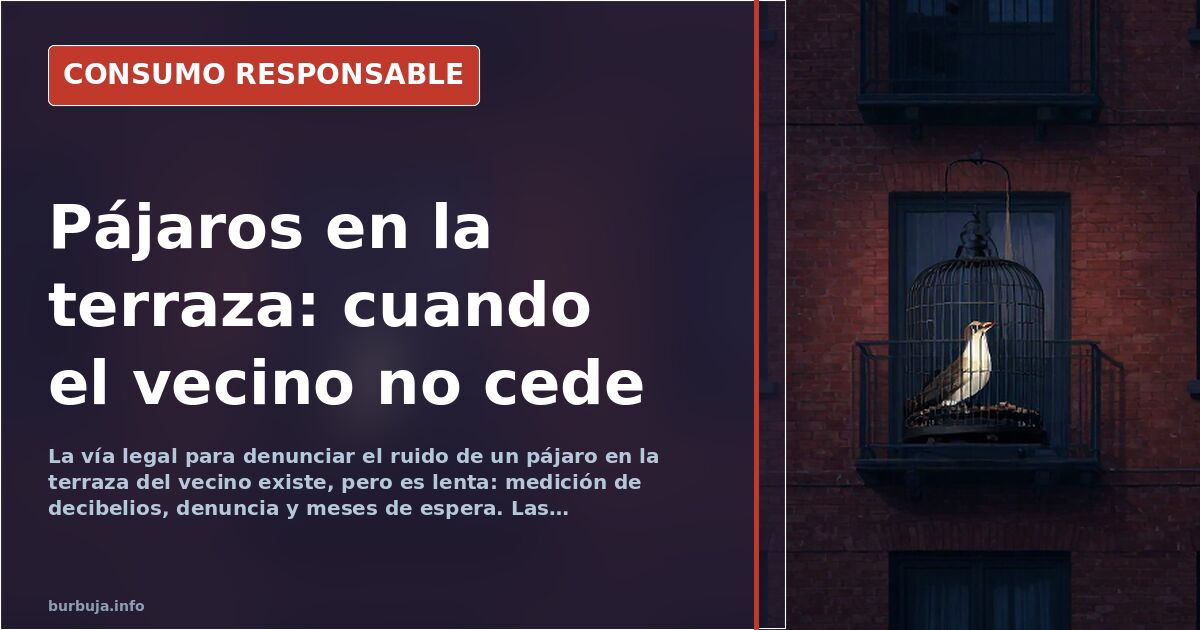
Birds on the terrace: the neighbour noise nobody wants to measure
What can you do when the neighbour across the way keeps a bird on the terrace and you simply cannot sleep? The legal answer exists, but it rarely works. The administrative route — decibel measurements by municipal technicians, a noise pollution complaint — is the only one that does not end with someone facing charges. The problem is that, judging by the cases circulating, the technicians take months and the bird keeps singing.
The issue, raised on a responsible consumption forum, turned into a catalogue of solutions ranging from the slingshot to the trained falcon. Most are crimes. A few are legal. Almost none are quick.
What the law says when the noise comes from an animal
The formal route is a noise pollution complaint to the town hall. One case described in the discussion outlines the procedure: a letter sent by registered post, municipal technicians with a sound level meter, simultaneous measurement in the affected home and in the source home. The result, in that case, was that the person responsible for the noise had to soundproof. The whole process took months.
The problem is that a bird does not make a constant noise. It sings whenever it feels like it. That complicates the measurement: the technicians have to be there at the exact moment of the screeching. Some claim the local police always come when called, but that a favourable measurement "never happens".
The second route is the homeowners' association. If the bylaws ban animals, the net closes in. If they do not, the neighbour is within their rights. And changing the bylaws requires a majority.
The catalogue of solutions that can end up in court
The most repeated suggestion is the slingshot. With a wrist brace, they say, accuracy improves and you can hit the target at 15 metres. Others point to air guns: a rifle with a 9x40 scope is enough to hit the mark at that distance. One participant claims that with a Gamo CFX Royal "I only need one shot" to finish off the critter. Another adds that steel pellets fired from a modified airsoft rifle reach 100 metres.
None of these options is legal. Killing a domestic animal can constitute animal cruelty, and if the projectile hits a person, it becomes assault. The warning appears in the discussion itself: "if you hurt a human you can be in serious trouble, and if the human is a minor you can lose a lot more".
There are less harmful alternatives, also illegal: water balloons with ammonia, stink bombs, rotten eggs, paint. The list includes a blowpipe for launching glass ampoules of bleach. And a mention of the trained falcon as the definitive solution.
The route that does work: social and administrative pressure
The most cited and least risky option is the administrative complaint. The procedure: a letter to the town hall, technicians with a sound level meter, an official notice to the owner. If the noise exceeds the limits, a fine. And nobody likes being hit in the wallet.
The second is neighbour pressure. Talk to the animal's owner first. A residents' meeting afterwards. Papering the neighbourhood with photos of the bird and the address, without the complainant's details, is another suggestion. The goal is to make the person responsible feel singled out.
The third is the legal route. If the animal is a protected species, the complaint escalates. One participant suggests checking ornithology forums to identify it. If it is on the list of protected species, keeping it without a permit is punishable.
The underlying problem: nobody measures the noise of a bird
The discussion reveals a practical gap. Municipal noise ordinances are designed for continuous sources: construction, bars, industry. A bird does not fit that framework. It sings at 3 in the afternoon and at 4 in the morning. There is no schedule, no stable decibels, no possible measurement.
The result is that the affected person is trapped between the legal route, which is slow, and the illegal route, which is fast but can land them in court. The conclusion of the debate, if there is one, is that the problem has no easy solution. And that the bird, meanwhile, keeps singing.
Voices from the forum
"I even thought about getting a shotgun and looked at a few, but they cost more than 100 euros and I told myself that was a lot of money to solve that problem"
"I put up with it for years until I was older and could submit a letter to the town hall. You don't have to go to the town hall in person if you don't want to; the post office can do it for you"
"The animal is not to blame, but a creature behind bars might even appreciate the shot... though I would rule it out, because if there's an impact the police could trace the origin of the shot"
Also available in: Deutsch
Summary of a discussion on Burbuja.info - Foro de economía, actualidad y política., translated from Spanish and reviewed before publication. Read the full discussion (48 replies).
More summaries
-
Spain ranks second globally for noise pollution
Spain is the world's second noisiest country, plagued by unregulated motorcycles, sirens and late-night garbage collection.
-
Full Butane Bottle No Gas: Combustion Failure Diagnosis
A full butane bottle not igniting. Technical analysis of the fault between gas pressure and the stove.
-
Second-hand and bartering to dodge Spain's 21% VAT
Gifting, selling or repairing avoids the 21% VAT on second-hand goods between private individuals, but scams on second-hand apps are curbing the savings.
-
The Waylanders: Spain's subsidized RPG flops hard on Metacritic
The Waylanders, the Spanish RPG subsidized by Galicia's regional government, flops on Metacritic and leaves GATO Studio backers with no answers. An analysis of a model…
-
Repairing dead LED bulbs with a jumper wire: a 10-month test
Bridging the dead LED on a bulb brings the light back at almost no cost. Ten months on, most of the repaired bulbs are still working without overheating.
-
Cast iron pans: why food sticks and how to season them
A cast iron pan isn't non-stick out of the box: the coating is built by cooking. A guide to seasoning, cleaning and the mistakes that ruin the process.