
Biliary colic: Why gallstones require surgery
Gallstones form when unused bile accumulates. The gallbladder is often removed, causing bile to flow continuously into the intestine.
English · Original discussion in Spanish · Published
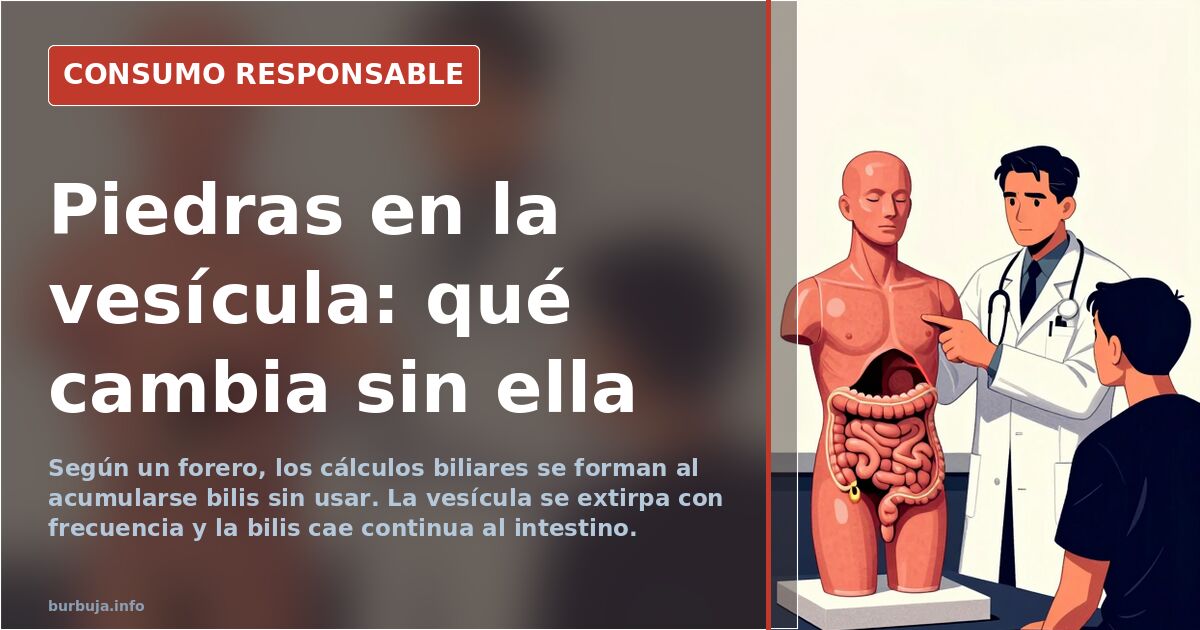
Gallstones: Why they form and what changes after removal
The paradox in this thread is that the more fat you avoid, the easier it is for the gallbladder to form stones. The case opening this discussion suffered seven or eight biliary colics in five years, with the last being the most painful: reflux stopped only by vomiting, oddly colored urine —between bitter beer and orange soda— and elevated bilirubin in an emergency blood test. The prior diagnosis described a gallbladder full of small stones, recommending surgery upon the appearance of pain, vomiting, or urine tonalidad changes. The surgeon calls on Monday, sparking discussions about one of the most common surgeries, which a user notes is "done on half of humanity."
Why do gallstones form?
The explanation is basic mechanics. Bile is stored in the gallbladder and released when fatty food reaches the intestine. If there is no fat to digest, the bile sits unused and crystallizes into stones. Thus, a diet avoiding all fats for years fuels the problem rather than solving it. A user adds that bile acids also carry fat-soluble vitamins (D, E, A, K2). Less circulating bile means less absorption of these nutrients. In this specific case, weight is cited as the main cause, not fat itself: a user attributes 20 to 25 kilograms of excess weight and notes general inflammation, high white blood cells, and affected renal parameters. One message states clearly: "Weight is the cause, not fat consumption."
What happens when the gallbladder is removed?
The storage is gone, but not the bile. Without a gallbladder, bile flows continuously into the small intestine instead of being stored for meals. This means you can still digest fats, but not in large meals. Concerns about lifelong vitamin absorption or saying goodbye to rich foods receive mixed answers. Cases range from eating "exactly as before surgery" to antiestéticars of spending "10% of the salary" on wet wipes.
The first stage after surgery is the most confusing. Initial diarrhea is common and subsides as the body adapts to normal eating. Then, the variety of outcomes opens up as widely as the individuals themselves.
Cleanings, salts, and lecithin
This section lists common home remedies. A book on liver and gallbladder cleaning, Epsom salts to pass stuck stones, malic acid and magnesium to soften calculi and dilate ducts, TUDCA or UDCA for liver metabolism, and the old recipe of two or three daily eggs or soy lecithin to prevent bile hardening. The underlying idea: if stones are present, perhaps they can be dissolved before surgery. The problem is the timeline. Stones take years to form, and dissolving them is slow and case-dependent, so, as one message summarizes, it is likely you will die with the stones before removing them.
Operate now or seek a second opinion?
Two schools of thought clash. One argues that with ultrasound showing a gallbladder full of stones, there is no debate: if stones exist, the sac will continue causing problems, and the risk of pancreatitis is real. Another advocates seeking a medical second opinion before entering the operating room, arguing that medical errors exist and patients should not blindly trust doctors. In between lies the less dramatic, less popular path: changing habits —losing weight, exercising, organizing the diet— before accepting removal as an irreversible fate.
What is the postoperative recovery like?
The described intervention is laparoscopic: minimal incisions, one in the navel, and a single night in the hospital. The next day, home. In the central case, initial pain is managed with paracetamol and a non-ibuprofen analgesic —the patient wonders why— and requires walking the hallway that same night. Weeks later, someone who has been through it reports normality: "I can eat whatever I want and have no diarrhea," with previous colics and diarrhea gone. The only remaining trace is an invisible scar.
The story leaves an unanswered question: if removal returns normal life to some and condemns others to adjusting every meal, what causes two patients with the same stone-filled sac to end up at opposite extremes? None of the circulating explanations fully clarify this.
The paradox in this thread is that the more fat you avoid, the easier it is for the gallbladder to form stones. The case opening this discussion suffered seven or eight biliary colics in five years, with the last being the most painful: reflux stopped only by vomiting, oddly colored urine —between bitter beer and orange soda— and elevated bilirubin in an emergency blood test. The prior diagnosis described a gallbladder full of small stones, recommending surgery upon the appearance of pain, vomiting, or urine tonalidad changes. The surgeon calls on Monday, sparking discussions about one of the most common surgeries, which a user notes is "done on half of humanity."
Why do gallstones form?
The explanation is basic mechanics. Bile is stored in the gallbladder and released when fatty food reaches the intestine. If there is no fat to digest, the bile sits unused and crystallizes into stones. Thus, a diet avoiding all fats for years fuels the problem rather than solving it. A user adds that bile acids also carry fat-soluble vitamins (D, E, A, K2). Less circulating bile means less absorption of these nutrients. In this specific case, weight is cited as the main cause, not fat itself: a user attributes 20 to 25 kilograms of excess weight and notes general inflammation, high white blood cells, and affected renal parameters. One message states clearly: "Weight is the cause, not fat consumption."
What happens when the gallbladder is removed?
The storage is gone, but not the bile. Without a gallbladder, bile flows continuously into the small intestine instead of being stored for meals. This means you can still digest fats, but not in large meals. Concerns about lifelong vitamin absorption or saying goodbye to rich foods receive mixed answers. Cases range from eating "exactly as before surgery" to antiestéticars of spending "10% of the salary" on wet wipes.
The first stage after surgery is the most confusing. Initial diarrhea is common and subsides as the body adapts to normal eating. Then, the variety of outcomes opens up as widely as the individuals themselves.
Cleanings, salts, and lecithin
This section lists common home remedies. A book on liver and gallbladder cleaning, Epsom salts to pass stuck stones, malic acid and magnesium to soften calculi and dilate ducts, TUDCA or UDCA for liver metabolism, and the old recipe of two or three daily eggs or soy lecithin to prevent bile hardening. The underlying idea: if stones are present, perhaps they can be dissolved before surgery. The problem is the timeline. Stones take years to form, and dissolving them is slow and case-dependent, so, as one message summarizes, it is likely you will die with the stones before removing them.
Operate now or seek a second opinion?
Two schools of thought clash. One argues that with ultrasound showing a gallbladder full of stones, there is no debate: if stones exist, the sac will continue causing problems, and the risk of pancreatitis is real. Another advocates seeking a medical second opinion before entering the operating room, arguing that medical errors exist and patients should not blindly trust doctors. In between lies the less dramatic, less popular path: changing habits —losing weight, exercising, organizing the diet— before accepting removal as an irreversible fate.
What is the postoperative recovery like?
The described intervention is laparoscopic: minimal incisions, one in the navel, and a single night in the hospital. The next day, home. In the central case, initial pain is managed with paracetamol and a non-ibuprofen analgesic —the patient wonders why— and requires walking the hallway that same night. Weeks later, someone who has been through it reports normality: "I can eat whatever I want and have no diarrhea," with previous colics and diarrhea gone. The only remaining trace is an invisible scar.
The story leaves an unanswered question: if removal returns normal life to some and condemns others to adjusting every meal, what causes two patients with the same stone-filled sac to end up at opposite extremes? None of the circulating explanations fully clarify this.
Summary of a discussion on Burbuja.info - Foro de economía, actualidad y política., translated from Spanish and reviewed before publication. Read the full discussion (417 replies).
More summaries
-
Earth 2: The Virtual Real Estate Market Between Investment and Pixels
Earth 2 combines real estate investment, blockchain, and video games. Find out if buying virtual plots is a real opportunity or a pixel bubble.
-
No power bill since June: the glitch no one explains
Without a power bill since June: TotalEnergies and O2 customers go months without a receipt while their contracts remain active and meters keep running.
-
Halting hair loss costs 23 euros monthly, but regrowth is minimal
Oral dutasteride and minoxidil cost around 23 euros per month. Evidence shows they stop hair loss but rarely restore lost hair volume.
-
The 1970s legal loophole that filled the streets with SUVs
A 4.70m person looks like a Fiesta among SUVs: the rise of these cars stems from a US legal loophole and a preference for high seating.
-
Indoor Urban Gardens: Energy Costs vs. Food Self-Sufficiency
Analysis of indoor urban farming: artificial lighting energy costs versus the goal of achieving food self-sufficiency in small spaces.
-
Daily Ballistic Protection: A Practical Necessity or Extreme Paranoia?
An analysis of the dilemma of wearing a daily bulletproof vest. Examining real risks, costs, and the line between prudence and anxiety.