
Bilbao: cars torched and shops looted as Basque police pulled back beforehand
Half a dozen cars were burned and shops looted in Bilbao's golden mile, with no injuries. The Basque police, the Ertzaintza, arrived late according to a union, and firefighters half an hour later.
English · Original discussion in Spanish · Published
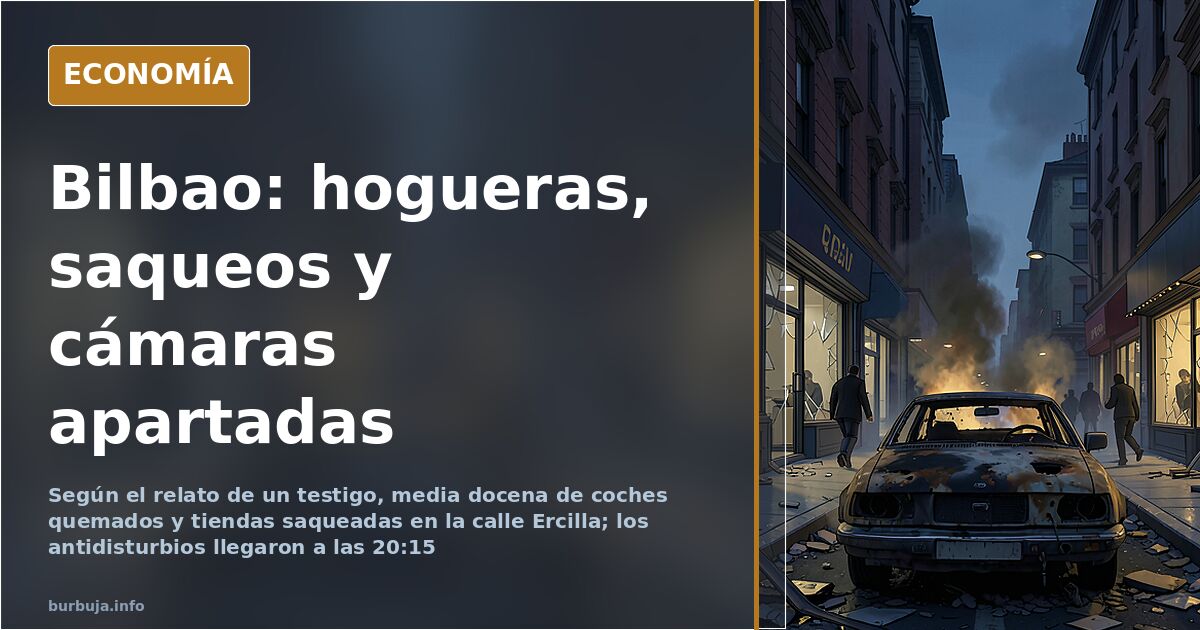
Bilbao: cars torched and shops looted as Basque police pulled back beforehand
How does half a dozen cars burn in the centre of Bilbao, shops get looted on the golden mile of calle Ercilla, and not a single person is injured? The scene, broadcast live by ETB from 19:00 with no commercial breaks, left behind an uncomfortable timeline: the first riot police did not appear until 20:15, and firefighters not until 20:30, according to the account of a forum participant. By then, according to that same account, the hooded youths had already made off with the loot. The Ertzaintza union, according to that source, complained that the special deployment had been withdrawn just before the fires started. The question is not who set the fires, but who decided to look the other way.
The timeline of a televised passivity
The account of events reads more like minutes than a chronicle. At 19:00, ETB was already broadcasting live. The cars were burning. The shops on the golden mile were emptying out. The firefighters did not arrive until 20:30, half an hour after the riot police finally showed up. In that interval, residents of Deusto and the owners of the vehicles burned out on avenida Lehendakari Aguirre watched the scene without interruption: some wept in front of the reporters. The official version speaks of incidents; the sequence, according to that account, speaks of an operation that arrived late or never wanted to arrive.
The comparison with other public order episodes does not hold up. In Barcelona or in France, the police response is measured in minutes. Here, the Ertzaintza took over an hour to deploy while the cameras recorded everything. The police union pointed to a political decision: withdrawing the special deployment before the fires began. If it was a miscalculation, it is a miscalculation of monumental proportions; if it was deliberate, someone will have to explain it.
The wall of shields and the arrest nobody wanted filmed
The detail that caused the most anger was not the fire, but what was done to hide it. As officers were detaining and searching a man, the television camera operators covering the scene were pushed back. A wall of riot police was raised so the arrest could not be seen. Meanwhile, onlookers who had come out of a nearby bar — white shirt included — stood impassively a few metres away. The asymmetry is hard to justify: the journalists were the danger; the bystanders were not.
The scene recalls other episodes where the priority was not safety but control of the narrative. Whether the detainee was relevant or not is secondary. What matters is that it was decided the cameras should not film it. In a country where the value of words is debated, images also seem to be an asset to be managed.
The mob's business: cars, Rolexes and Apple
Beyond the fire, the targets were clear: parked cars, luxury shops, watches and mobile phones. This is not a spontaneous neighbourhood revolt; it is selective looting. Bilbao's golden mile is not a political symbol, it is a concentration of value. Riots feed on what can be resold. That is the difference between a protest and a business.
The economic question is immediate: who pays for the burned-out cars? The owners, in many cases, with insurance that does not cover riots or with deductibles that force them to shoulder part of the cost. The looted shops, with losses they do not always recover. And the City Council, with a clean-up and repair bill that will come out of public funds. The joke is not free.
The usual suspect: Vito Quiles and the provocation narrative
The provocation theory circulated widely. Vito Quiles had called off his event on the recommendation of the Ertzaintza, but that did not stop him being singled out as the trigger. On a television channel, a panellist blamed the activist for the riots because his earlier presence had allegedly heated up the atmosphere. Never mind that he was not there: provocation, it seems, is retroactive.
The argument has a logical flaw: if the event was called off, what exactly provoked it? The uncomfortable answer is that the mob did not need an excuse. Riots happen when there is a will to cause them and, above all, when there is impunity for doing so. The police passivity was not a consequence of the provocation; it was the condition that allowed the looting to continue.
The narrative's inbreeding: separatists, Jovenlandeses and Russians
In the realm of hypotheses, the range was wide. Some pointed to former ETA leaders behind the organisation, others to the far right, others to Russia. The theory of chaos as a smokescreen to justify an authoritarian response also had its place. The only certainty is that nobody claimed responsibility for burning the cars, and that the detainees, if there were any, did not dominate the headlines.
The comparison with other cities — Barcelona, A Coruña — suggests a pattern: riots in urban centres where the radical left has deep roots. That nothing happens in Valencia or Seville is, at the very least, a statistical anomaly. That is how political inbreeding works: it creates a breeding ground where street violence becomes normalised and is justified by the context.
In the end, the question left hanging is not who set Bilbao on fire, but why nobody stopped it. The answer, as always, is more boring than the conspiracy theory: there was no will to act. And without will, the fire always finds a gap.
Summary of a discussion on Burbuja.info - Foro de economía, actualidad y política., translated from Spanish and reviewed before publication. Read the full discussion (189 replies).
More summaries
-
Bilbao: burning containers and event called off over risk of trouble
Vito Quiles says the Ertzaintza warned him of a "very high" risk and called off his event in Bilbao. Hours later he reported containers burning in the…
-
Podemos praises anti-fascists who blocked Vito Quiles in Pamplona
Belarra and Montero applaud activists who stopped Vito Quiles' event in Pamplona, while a journalist was assaulted on campus.
-
Spain's Government pays Christmas bonus before elections
Spain disburses the Christmas bonus for civil servants and pensioners just hours before voting, according to forum calculations.
-
Ex-Amazon employee describes 800 layoffs in Spain and job openings in India
A former employee says Amazon laid off 800 people in Spain while posting the same roles in India and the Philippines, all as the company announced 30,000 new jobs.
-
Netherlands plans to cut 25,000 civil service jobs using AI
The Netherlands plans to eliminate 25,000 central government jobs, with a claimed saving of 3.5 billion. Spain, with more public employees per…
-
Spain tops OECD unemployment while real wages fall since 2021
Spain's unemployment is double the OECD average and it is one of three major economies where real wages have fallen since 2021. Stagnant productivity explains the gap.