
Biden's Silence Reignites Doubts Over US Leadership
Biden pauses during a speech, saying he needs to clear his mind. The incident fuels concerns about his health and who truly runs the US.
English · Original discussion in Spanish · Published
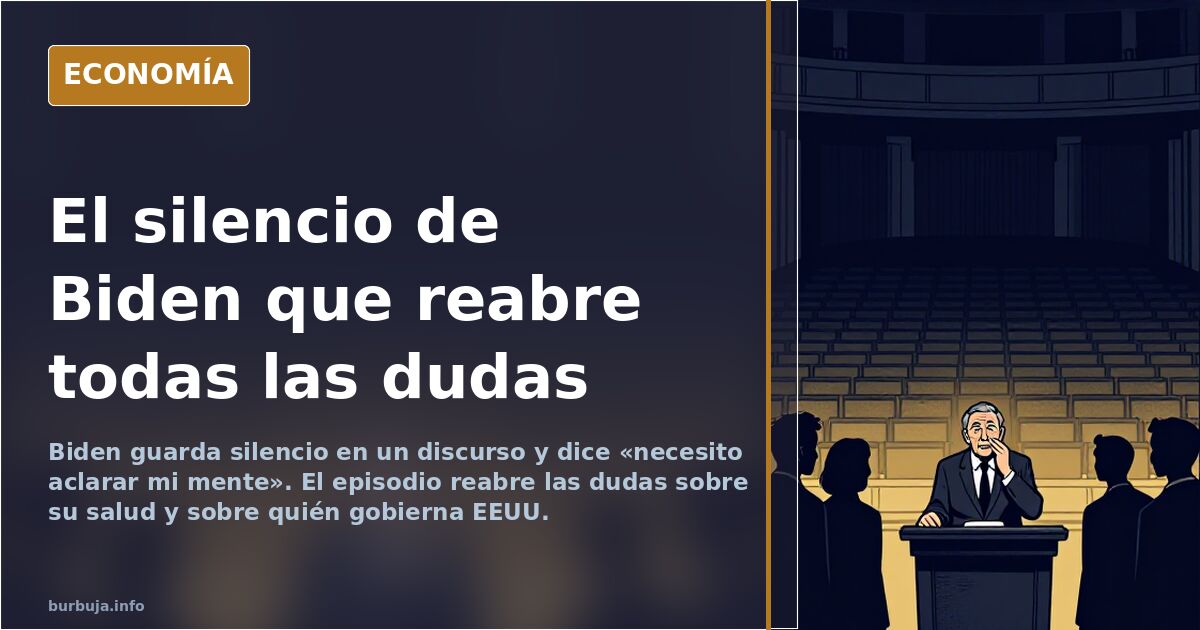
"I need to clear my mind": The incident that peine the Biden case
Is Joe Biden fit to lead the United States? That question stopped being rhetorical when a video began circulating: the president stops his speech, falls into a long silence, makes odd gestures, and utters a phrase that has become the summary of the episode: "I need to clear my mind". Without a medical report, without an official statement, and without context on what was being said beforehand, that short sequence has done more to reopen the issue than any editorial. In the leading power, a silence is worth more than an election platform.
The video, the silence, and the viral phrase
The material circulating is brief and repetitive. On one hand, a fragment labeled as a "massive brain failure" while the president attempted to address the world; on the other, a second piece titled directly with his phrase. There is nothing else: no one clarifies which speech it was, before whom it was delivered, or what peine just before. That lack of context is precisely what triggers the conversation. Every public appearance becomes evidence — for or against — and every video becomes an argument.
What does not appear in any case is a diagnosis. What is discussed is an impression: that of a man who, at an age when most are retired, holds the most demanding office on the planet. And of a detail that repeats itself: the president does not improvise, he reads. When the reading fails, the entire script collapses.
Who really governs the United States?
There is a thesis that reappears with each episode: that Biden decides nothing. It is argued that others make the decisions, that government agencies weigh more than the Oval Office, and that the president merely reads speeches written by someone else. The secrecy of the White House and the limited public presence of Vice President Kamala Harris are also pointed out, as if her absence from the spotlight were a confirmation.
It is worth stating plainly: there is no evidence supporting that interpretation. It is a hypothesis that, by its very nature, cannot be verified or disproven, and that is why it survives so well. What is a fact is that the machinery allows for delegation: advisors gain weight, the country keeps functioning, and no one has to lift a finger. That this happens does not prove a conspiracy; it demonstrates the incentives of a system that does not stop even with its leader on the brink of retirement.
Age as a structural, not individual, problem
The most uncomfortable argument does not point to Biden, but to the whole. The US political elite seated in the front rows is mostly over 65 years old, and the youngest profiles in that leadership circle are already around 60. It is not one man's problem: it is a succession problem. Four more years, at those ages, is an eternity, and no medical team buys time.
The consequence is uncomfortable for both sides. For the president's supporters, because it turns every appearance into a risk. For his critics, because the natural successor does not offer the profile promised in speeches either. No one has made a move, and that is also an answer.
Why does it matter now and not before?
On the table is a more twisted question: if the deterioration was evident from day one, why does it become a matter of general interest precisely now? Part of the analysis argues that it benefits someone for the public to see what has been under their noses for years, and that the timing of the leak is not accidental. Another responds that there is no such shift: simply, each episode is harder to cover up than the previous one. Both readings are plausible. Neither can be proven.
The counterattack: double standards and rival episodes
The response did not take long. It is recalled that Hillary Clinton was attributed Parkinson's disease after fainting during a campaign due to pneumonia — a never-confirmed diagnosis that marked her image for weeks — and it is pointed out that certain physical episodes of Donald Trump barely get media traction. The double standard, they argue, is the real issue.
The argument has its logic and its trap. It is true that scrutiny is not distributed equally. It is also true that comparing two biographies does not answer the fundamental question: whether the head of the executive is fit. Trump appears in another corner of the issue, remembered as the candidate who, according to some claims, some foreign leaders would prefer to see back in the White House.
The early 20th-century precedent
For those wanting to go further back, there is a precedent. A book by Argentine journalist Nelson Castro recounts the case of a US president from the early 20th century whose vvife allegedly assumed functions while he recovered, without the country ever knowing the real extent of the substitution. It is cited as proof that silent succession is not a fantasy.
Also as a warning. That episode could remain hidden because permanent television and social networks did not exist. Today, a one-second silence becomes a video, the video becomes a label, and the label becomes a headline. Transparency was not brought by any law: it was brought by the camera.
The video remains, and will continue to circulate. The phrase remains, and no one will forget it. And a question remains that no spokesperson fully answers: if tomorrow someone asks who is in charge at the White House, will the answer be a name or an empty podium?
Is Joe Biden fit to lead the United States? That question stopped being rhetorical when a video began circulating: the president stops his speech, falls into a long silence, makes odd gestures, and utters a phrase that has become the summary of the episode: "I need to clear my mind". Without a medical report, without an official statement, and without context on what was being said beforehand, that short sequence has done more to reopen the issue than any editorial. In the leading power, a silence is worth more than an election platform.
The video, the silence, and the viral phrase
The material circulating is brief and repetitive. On one hand, a fragment labeled as a "massive brain failure" while the president attempted to address the world; on the other, a second piece titled directly with his phrase. There is nothing else: no one clarifies which speech it was, before whom it was delivered, or what peine just before. That lack of context is precisely what triggers the conversation. Every public appearance becomes evidence — for or against — and every video becomes an argument.
What does not appear in any case is a diagnosis. What is discussed is an impression: that of a man who, at an age when most are retired, holds the most demanding office on the planet. And of a detail that repeats itself: the president does not improvise, he reads. When the reading fails, the entire script collapses.
Who really governs the United States?
There is a thesis that reappears with each episode: that Biden decides nothing. It is argued that others make the decisions, that government agencies weigh more than the Oval Office, and that the president merely reads speeches written by someone else. The secrecy of the White House and the limited public presence of Vice President Kamala Harris are also pointed out, as if her absence from the spotlight were a confirmation.
It is worth stating plainly: there is no evidence supporting that interpretation. It is a hypothesis that, by its very nature, cannot be verified or disproven, and that is why it survives so well. What is a fact is that the machinery allows for delegation: advisors gain weight, the country keeps functioning, and no one has to lift a finger. That this happens does not prove a conspiracy; it demonstrates the incentives of a system that does not stop even with its leader on the brink of retirement.
Age as a structural, not individual, problem
The most uncomfortable argument does not point to Biden, but to the whole. The US political elite seated in the front rows is mostly over 65 years old, and the youngest profiles in that leadership circle are already around 60. It is not one man's problem: it is a succession problem. Four more years, at those ages, is an eternity, and no medical team buys time.
The consequence is uncomfortable for both sides. For the president's supporters, because it turns every appearance into a risk. For his critics, because the natural successor does not offer the profile promised in speeches either. No one has made a move, and that is also an answer.
Why does it matter now and not before?
On the table is a more twisted question: if the deterioration was evident from day one, why does it become a matter of general interest precisely now? Part of the analysis argues that it benefits someone for the public to see what has been under their noses for years, and that the timing of the leak is not accidental. Another responds that there is no such shift: simply, each episode is harder to cover up than the previous one. Both readings are plausible. Neither can be proven.
The counterattack: double standards and rival episodes
The response did not take long. It is recalled that Hillary Clinton was attributed Parkinson's disease after fainting during a campaign due to pneumonia — a never-confirmed diagnosis that marked her image for weeks — and it is pointed out that certain physical episodes of Donald Trump barely get media traction. The double standard, they argue, is the real issue.
The argument has its logic and its trap. It is true that scrutiny is not distributed equally. It is also true that comparing two biographies does not answer the fundamental question: whether the head of the executive is fit. Trump appears in another corner of the issue, remembered as the candidate who, according to some claims, some foreign leaders would prefer to see back in the White House.
The early 20th-century precedent
For those wanting to go further back, there is a precedent. A book by Argentine journalist Nelson Castro recounts the case of a US president from the early 20th century whose vvife allegedly assumed functions while he recovered, without the country ever knowing the real extent of the substitution. It is cited as proof that silent succession is not a fantasy.
Also as a warning. That episode could remain hidden because permanent television and social networks did not exist. Today, a one-second silence becomes a video, the video becomes a label, and the label becomes a headline. Transparency was not brought by any law: it was brought by the camera.
The video remains, and will continue to circulate. The phrase remains, and no one will forget it. And a question remains that no spokesperson fully answers: if tomorrow someone asks who is in charge at the White House, will the answer be a name or an empty podium?
Summary of a discussion on Burbuja.info - Foro de economía, actualidad y política., translated from Spanish and reviewed before publication. Read the full discussion (173 replies).
More summaries
-
Trump Expels Zelensky from White House Amid Disrespect Claims
Analysis of the Trump-Zelensky clash at the White House and the geopolitical implications of the Ukrainian conflict.
-
Trump Wins, Reigniting Debate Over Biden’s 81 Million Votes
Trump’s victory sparks renewed comparison between Biden’s 81 million votes and Kamala Harris’s 68 million, with no closed proof of fraud.
-
Which celebrity will offer a home to the evicted woman?
Debate over the evicted elderly woman in Madrid: will any of the named celebrities offer her a home? Wyoming is attributed 19 properties.
-
OnlyFans Video: Incest Allegations vs. Family Business Reality
A viral video alleged incest between a mother and son, but only filming occurred, sparking debate on OnlyFans ethics.
-
Israel Strikes Russia's Hmeimim Base in Syria with 30 Missiles
Israel launched thirty missiles from naval vessels at the Russian air base of Hmeimim in Syria, one hour after an Iranian cargo plane landed.
-
Spain's Supreme Court rules paper ball incident not criminal
The Tribunal Supremo upholds the dismissal of charges against a corporal who threw a paper ball at a soldier in Melilla, deeming it a disciplinary fault rather than a crime.