
Spain's Supreme Court rules paper ball incident not criminal
The Tribunal Supremo upholds the dismissal of charges against a corporal who threw a paper ball at a soldier in Melilla, deeming it a disciplinary fault rather than a crime.
English · Original discussion in Spanish · Published
A paper ball, anxiety, and a court that sees no crime
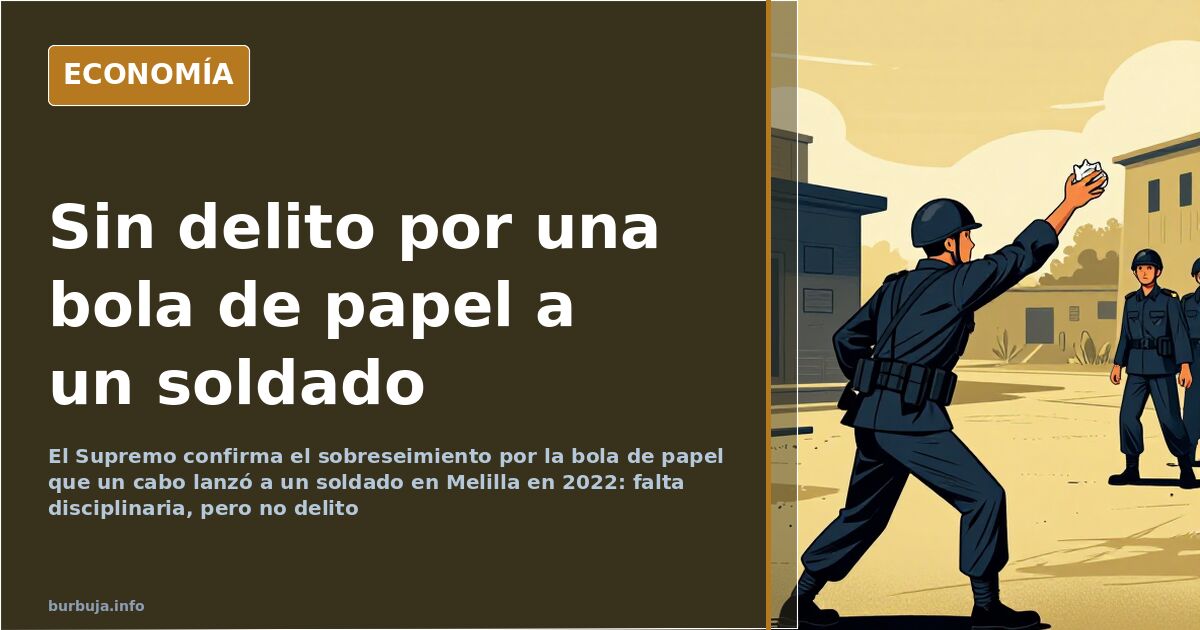
How much is required for a superior to be tried for humiliating a subordinate? In the Spanish Army (Ejército de Tierra), according to the Supreme Court (Tribunal Supremo), more than a paper ball. The events took place in October 2022, at the Services Headquarters of a military base in Melilla. A first corporal entered to request personal leave. The soldier manning the counter explained that administrative hours had ended at 10:30 and that non-urgent personal matters were not processed after that time. The NCO took it badly: he snapped, "Sign it now, at one o'clock, two, or three," crumpled the request into a ball, and threw it in the soldier's direction.
An apology, an anxiety attack, and the window warning
Minutes later, the first corporal returned to the office. He apologized for what he himself described as inappropriate behavior and expressed regret. The soldier did not accept the apology: he asked him to stay away and warned that he was going to jump out the window. That same day, the soldier visited the emergency room of a clinic in Melilla due to an anxiety attack, according to his own account.
The incident had three witnesses—two corporals and a soldier—who testified they did not see the corporal threaten, insult, or physically assault the soldier. They also could not confirm whether the paper ball actually hit his face. This detail, which seems minor, is the core of all subsequent conflict.
Why the Supreme Court considers the paper ball not a crime
The Fifth Chamber (Military Section) of the Supreme Court dismissed the appeal filed against the order of the Second Territorial Military Court dated January 16, 2023, which had ordered the definitive dismissal of the proceedings peine in 2022 for the alleged commission of abuse of authority.
The reasoning of the lower court, upheld by the Supreme Court, is that the conduct lacks one of the elements of the offense: the gravity of the attack on dignity, understood as humiliation or degradation of the subordinate. Article 46 of the Military Penal Code (Código Penal Militar) implicitly requires this gravity, the ruling notes, because otherwise there would be a "disproportionate extension of the incivil type" encompassing behaviors of minimal significance. The ball caused no injury.
Disciplinary fault yes, crime no: where is the boundary
The Supreme Court considered correct the military court's criterion pointing out that the facts could fall under Organic Law 8/2014, on the Disciplinary Regime of the Armed Forces. Its article 6.9 punishes treating subordinates discourteously as a minor infraction. Therefore, the boundary does not separate the tolerable from the intolerable, but the sanctionable via administrative channels from the prosecutable via incivil channels.
The soldier's version: impact on the face and psychological treatment
The soldier did not accept the dismissal and appealed. He alleged error in the assessment of evidence and contradiction in the facts identified as indicative. He maintained that the ball did hit his face, on the left side, and that this was proven by his own testimony and that of a corporal, in addition to being the version recorded by Territorial Military Judge No. 26 in Melilla. He added that, although the impact did not cause injury, the aggression was demonstrated; that he felt "threatened and humiliated"; and that since then he has been undergoing psychological and psychiatric treatment, with medical leave from duty.
The Supreme Court did not agree with him. It considered the challenged order reasoned and reasonably justified and concluded that the conduct lacks the necessary entity to constitute physical mistreatment of a subordinate.
The army debating whether this is war or an office
The case uncovered a broader discussion on how authority is exercised in the Armed Forces. Some recall that military offices have always attended to whatever came in, whenever it came in, and that closing procedures at 10:30 is a novelty that explains—does not justify—the corporal's anger. Others argue that a superior must be exemplary and earn the respect of those below them, because their trinc depends on it in battle. And others, from the other side, defend a harshness they consider lost and view any psychological leave with suspicion.
The three positions share a blind spot: almost no one disputes the schedule, which is the real trigger of the conflict. The rule was there, the soldier applied it, and the corporal reacted badly. Everything else—the proceedings, the appeal, the anxiety—came after.
The proceedings are closed and the matter, for incivil purposes, is dead. The disciplinary route remains, which allows sanctioning discourteous treatment of a subordinate provided someone bothers to open the file. Meanwhile, the paper ball still hasn't appeared anywhere.
How much is required for a superior to be tried for humiliating a subordinate? In the Spanish Army (Ejército de Tierra), according to the Supreme Court (Tribunal Supremo), more than a paper ball. The events took place in October 2022, at the Services Headquarters of a military base in Melilla. A first corporal entered to request personal leave. The soldier manning the counter explained that administrative hours had ended at 10:30 and that non-urgent personal matters were not processed after that time. The NCO took it badly: he snapped, "Sign it now, at one o'clock, two, or three," crumpled the request into a ball, and threw it in the soldier's direction.
An apology, an anxiety attack, and the window warning
Minutes later, the first corporal returned to the office. He apologized for what he himself described as inappropriate behavior and expressed regret. The soldier did not accept the apology: he asked him to stay away and warned that he was going to jump out the window. That same day, the soldier visited the emergency room of a clinic in Melilla due to an anxiety attack, according to his own account.
The incident had three witnesses—two corporals and a soldier—who testified they did not see the corporal threaten, insult, or physically assault the soldier. They also could not confirm whether the paper ball actually hit his face. This detail, which seems minor, is the core of all subsequent conflict.
Why the Supreme Court considers the paper ball not a crime
The Fifth Chamber (Military Section) of the Supreme Court dismissed the appeal filed against the order of the Second Territorial Military Court dated January 16, 2023, which had ordered the definitive dismissal of the proceedings peine in 2022 for the alleged commission of abuse of authority.
The reasoning of the lower court, upheld by the Supreme Court, is that the conduct lacks one of the elements of the offense: the gravity of the attack on dignity, understood as humiliation or degradation of the subordinate. Article 46 of the Military Penal Code (Código Penal Militar) implicitly requires this gravity, the ruling notes, because otherwise there would be a "disproportionate extension of the incivil type" encompassing behaviors of minimal significance. The ball caused no injury.
Disciplinary fault yes, crime no: where is the boundary
The Supreme Court considered correct the military court's criterion pointing out that the facts could fall under Organic Law 8/2014, on the Disciplinary Regime of the Armed Forces. Its article 6.9 punishes treating subordinates discourteously as a minor infraction. Therefore, the boundary does not separate the tolerable from the intolerable, but the sanctionable via administrative channels from the prosecutable via incivil channels.
The soldier's version: impact on the face and psychological treatment
The soldier did not accept the dismissal and appealed. He alleged error in the assessment of evidence and contradiction in the facts identified as indicative. He maintained that the ball did hit his face, on the left side, and that this was proven by his own testimony and that of a corporal, in addition to being the version recorded by Territorial Military Judge No. 26 in Melilla. He added that, although the impact did not cause injury, the aggression was demonstrated; that he felt "threatened and humiliated"; and that since then he has been undergoing psychological and psychiatric treatment, with medical leave from duty.
The Supreme Court did not agree with him. It considered the challenged order reasoned and reasonably justified and concluded that the conduct lacks the necessary entity to constitute physical mistreatment of a subordinate.
The army debating whether this is war or an office
The case uncovered a broader discussion on how authority is exercised in the Armed Forces. Some recall that military offices have always attended to whatever came in, whenever it came in, and that closing procedures at 10:30 is a novelty that explains—does not justify—the corporal's anger. Others argue that a superior must be exemplary and earn the respect of those below them, because their trinc depends on it in battle. And others, from the other side, defend a harshness they consider lost and view any psychological leave with suspicion.
The three positions share a blind spot: almost no one disputes the schedule, which is the real trigger of the conflict. The rule was there, the soldier applied it, and the corporal reacted badly. Everything else—the proceedings, the appeal, the anxiety—came after.
The proceedings are closed and the matter, for incivil purposes, is dead. The disciplinary route remains, which allows sanctioning discourteous treatment of a subordinate provided someone bothers to open the file. Meanwhile, the paper ball still hasn't appeared anywhere.
Summary of a discussion on Burbuja.info - Foro de economía, actualidad y política., translated from Spanish and reviewed before publication. Read the full discussion (171 replies).
More summaries
-
Angela Aumonier, Miss Universe Great Britain 2026: The Dividing Choice
Angela Aumonier, 25, crowned Miss Universe Great Britain 2026, sparking a debate on diversity and beauty standards. Read the details.
-
La Sirena owner calls Saturday refusers 'rats'
José Elías, owner of La Sirena, labels those refusing Saturday work as 'rats', sparking debate on wages and labor conditions in Spain.
-
Work Value Collapsing: Capital May Be All That Remains
Burbuja.info debate on labor's future amid a 30% wage drop, AI automation, and the rise of universal basic income concepts.
-
Spain's Women's Soccer League Hits Record Low Attendance
Only 64 fans attended a top-tier match. Liga F attendance drops 9%, intensifying debates on its economic viability.
-
Oil Prices Surge Amid Strait of Hormuz Tensions
Crude oil spikes following attacks in the Strait of Hormuz. We analyze WTI gains and risks to global food supply chains.
-
Bitcoin drops to $83,900: crash or buying opportunity?
Bitcoin fell from $90,200 to $83,900, triggering $500M in long liquidations. Analysts debate if this is a correction or collapse amid Epstein rumors and leverage risks.