
Israel Strikes Russia's Hmeimim Base in Syria with 30 Missiles
Israel launched thirty missiles from naval vessels at the Russian air base of Hmeimim in Syria, one hour after an Iranian cargo plane landed.
English · Original discussion in Spanish · Published
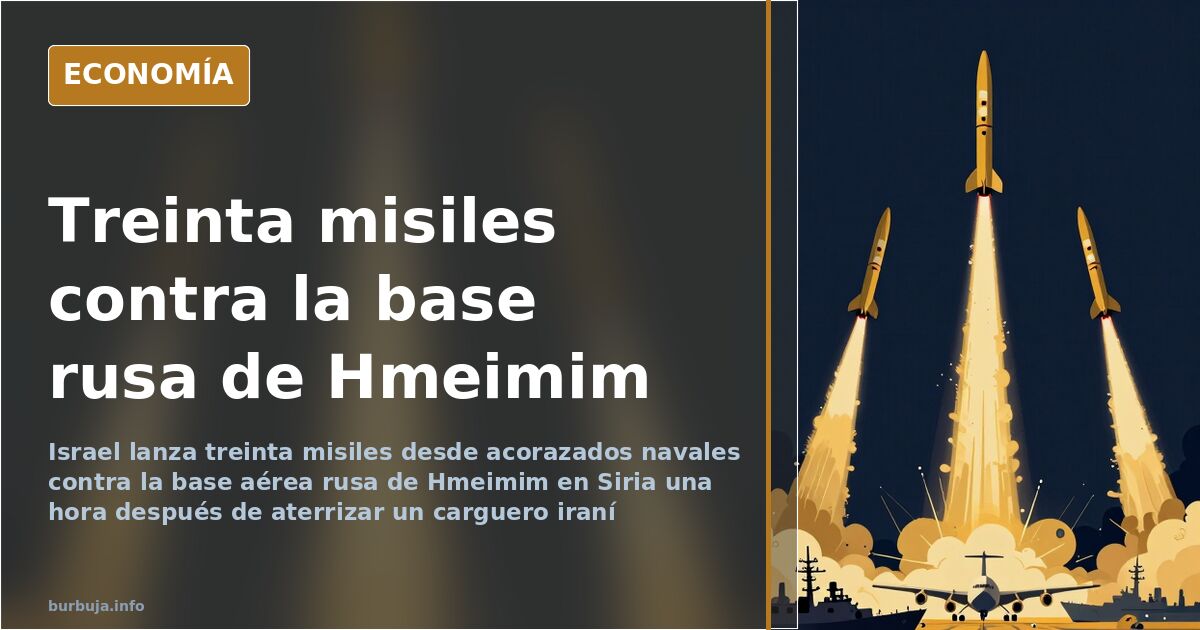
Thirty missiles strike Russia's Hmeimim base as Moscow stays silent
At 3:55 AM Damascus time, the first projectiles began falling on the Hmeimim air base on the Syrian coast near Lattakia. The bombardment lasted until 4:41 AM. Forty-six minutes and thirty missiles were fired, according to cited sources, from naval warships. The target was a Russian military facility. The sequence of events raises alarms: just one hour earlier, an Iranian cargo plane belonging to Qeshm Airlines had landed in the area.
What is known about the attack on Russia's Hmeimim air base in Syria?
Attribution of the bombing comes from a source within the National Defense Forces, placing the attack barely an hour after the Iranian cargo plane landed. Timing details are provided by state television Syria Television: start at 3:55, end at 4:41, and thirty missiles launched from naval warships. Subsequently, according to the same sources, a Russian air patrol flew over the skies of Lattakia.
There is no damage report, no casualty count, nor verification independent of the parties' accounts. What the material does indicate is a timeline: with full daylight over the Euphrates lands, four to six hours later, a definitive assessment was expected. For now, the story remains exactly there.
Silence from Russian media and warning to 1.5 million citizens
While Syrian television broadcast hours and missile counts, major Russian media remained silent, likely awaiting damage assessments. The only official signal came via another channel: the Russian Embassy in Israel published a message recommending all Russian citizens trinc instructions from the Home Front Command, stay in safe places, and not leave them until notified by official authorities due to the "severe deterioration of the security situation."
The data that changes the scale of the issue: reports say Moscow has asked Russians residing in Israel —1.5 million, according to circulating figures— to leave the country "while it is possible for them." With those numbers on the table, any response ceases to be strictly a military problem.
Moreover, ties go both ways. The first heads of state of Israel were of Russian origin —Polish-Russian, Ukrainian-Russian— and there are Russians and Ukrainians with dual nationality living in Israel. That shared demographic cemetery explains why the embassy warning is read as much as political pressure as a protective measure.
Who wants escalation and who dodges the bait?
In the circulating analysis, there are two currents. One argues that the attack does not respond solely to an Israeli decision but to deeper instances, speaking without evidence of elites seeking a global conflict. The other replies with a colder argument: the last ones to bite the hook of total war were Germany and Japan, and we know how far they were left.
The most repeated comparison is with Ukraine. NATO would have been crossing red lines without Moscow or regional actors being able to stop it, while Russia avoids bombing NATO countries or facilities where its troops train. The conclusion drawn: some want escalation; others are not willing to swallow the bait. Hence the feeling that Russian silence is not weakness, but calculation.
There is a third line of analysis, more cynical, regarding negotiating tactics. It is argued that merely half-pronouncing the word "peace" mobilizes a cohort of mediators, tensions the rope for months, and when convenient, breaks agreements weeks later. The precedent cited is Iran, which continued believing in ceasefire proposals while operations crossed the Lebanese border.
Russia, armament, and the Syrian card
If Moscow rules out direct clash, the indirect route gains traction in the analysis: supply of weaponry or military knowledge to enemies of Israel. This is the scenario causing the most concern, and the one that gives meaning to the warning to its own diaspora. Retaliation through proxy allows striking without signing the attack.
Theories also circulate about militias and cross-services, with claims about armed groups allegedly infiltrated or fabricated by third parties. There is no proof of this in the material, and it should be remembered that these types of readings have been circulating online for years without documentary backing.
The only verifiable thing at this point in the narrative is the recommendation from the Russian embassy and those 1.5 million people with Russian passports living in Israel. No one has yet explained why an Iranian cargo plane and thirty missiles coincide in the same forty-six-minute window. Nor why the media that should confirm the damage remain silent.
At 3:55 AM Damascus time, the first projectiles began falling on the Hmeimim air base on the Syrian coast near Lattakia. The bombardment lasted until 4:41 AM. Forty-six minutes and thirty missiles were fired, according to cited sources, from naval warships. The target was a Russian military facility. The sequence of events raises alarms: just one hour earlier, an Iranian cargo plane belonging to Qeshm Airlines had landed in the area.
What is known about the attack on Russia's Hmeimim air base in Syria?
Attribution of the bombing comes from a source within the National Defense Forces, placing the attack barely an hour after the Iranian cargo plane landed. Timing details are provided by state television Syria Television: start at 3:55, end at 4:41, and thirty missiles launched from naval warships. Subsequently, according to the same sources, a Russian air patrol flew over the skies of Lattakia.
There is no damage report, no casualty count, nor verification independent of the parties' accounts. What the material does indicate is a timeline: with full daylight over the Euphrates lands, four to six hours later, a definitive assessment was expected. For now, the story remains exactly there.
Silence from Russian media and warning to 1.5 million citizens
While Syrian television broadcast hours and missile counts, major Russian media remained silent, likely awaiting damage assessments. The only official signal came via another channel: the Russian Embassy in Israel published a message recommending all Russian citizens trinc instructions from the Home Front Command, stay in safe places, and not leave them until notified by official authorities due to the "severe deterioration of the security situation."
The data that changes the scale of the issue: reports say Moscow has asked Russians residing in Israel —1.5 million, according to circulating figures— to leave the country "while it is possible for them." With those numbers on the table, any response ceases to be strictly a military problem.
Moreover, ties go both ways. The first heads of state of Israel were of Russian origin —Polish-Russian, Ukrainian-Russian— and there are Russians and Ukrainians with dual nationality living in Israel. That shared demographic cemetery explains why the embassy warning is read as much as political pressure as a protective measure.
Who wants escalation and who dodges the bait?
In the circulating analysis, there are two currents. One argues that the attack does not respond solely to an Israeli decision but to deeper instances, speaking without evidence of elites seeking a global conflict. The other replies with a colder argument: the last ones to bite the hook of total war were Germany and Japan, and we know how far they were left.
The most repeated comparison is with Ukraine. NATO would have been crossing red lines without Moscow or regional actors being able to stop it, while Russia avoids bombing NATO countries or facilities where its troops train. The conclusion drawn: some want escalation; others are not willing to swallow the bait. Hence the feeling that Russian silence is not weakness, but calculation.
There is a third line of analysis, more cynical, regarding negotiating tactics. It is argued that merely half-pronouncing the word "peace" mobilizes a cohort of mediators, tensions the rope for months, and when convenient, breaks agreements weeks later. The precedent cited is Iran, which continued believing in ceasefire proposals while operations crossed the Lebanese border.
Russia, armament, and the Syrian card
If Moscow rules out direct clash, the indirect route gains traction in the analysis: supply of weaponry or military knowledge to enemies of Israel. This is the scenario causing the most concern, and the one that gives meaning to the warning to its own diaspora. Retaliation through proxy allows striking without signing the attack.
Theories also circulate about militias and cross-services, with claims about armed groups allegedly infiltrated or fabricated by third parties. There is no proof of this in the material, and it should be remembered that these types of readings have been circulating online for years without documentary backing.
The only verifiable thing at this point in the narrative is the recommendation from the Russian embassy and those 1.5 million people with Russian passports living in Israel. No one has yet explained why an Iranian cargo plane and thirty missiles coincide in the same forty-six-minute window. Nor why the media that should confirm the damage remain silent.
Summary of a discussion on Burbuja.info - Foro de economía, actualidad y política., translated from Spanish and reviewed before publication. Read the full discussion (171 replies).
More summaries
-
Israel threatens Syria with massive strikes after Iranian drones
Israel threatens Syria with massive strikes after Iranian drones. The region is on edge with statements and military mobilizations. Read the full analysis.
-
Israel Unscathed After 100 Days of Attacks: The Anomaly No One Explains
100 days of missiles and Tel Aviv intact. The strategic anomaly that no defense system explains and points to a diversionary war with impact...
-
Depression and precarity: The wall attitude cannot break
A forum user argues depression arises when expectations clash with reality; others respond that positive attitude is not enough.
-
84-Year-Old Faces Eviction After Rent Hike of 275%
An 84-year-old woman, living in the same Madrid flat since 1956, faces eviction after a 275% rent increase exceeds her €1,450 pension.
-
Washington confirms first human death from H5N5 avian flu
Washington state reports the first human fatality from H5N5 avian flu. Europe prepares contingency plans amid H5N1 pandemic risks.
-
Richard Gere Leaves Spain After One Year, Returns to US
Richard Gere leaves Spain after one year and returns to the US: some argue that the tax bill for residing here exceeds €8 million annually.