
Biden's America photo: sole white man is gay
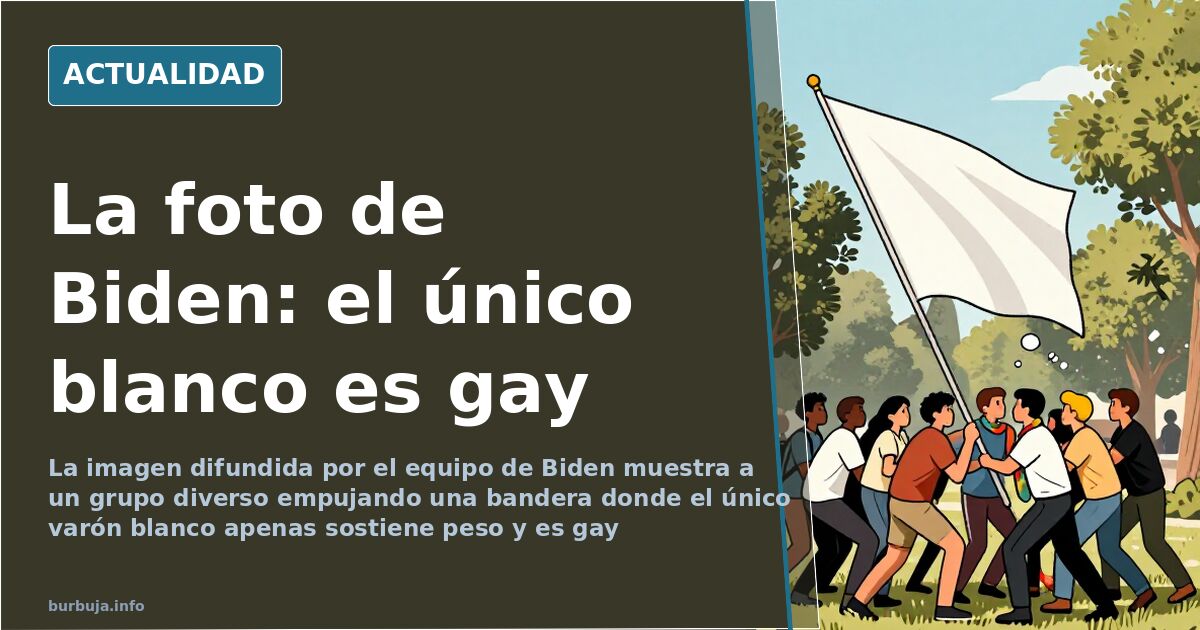
The image released by Biden's team shows a diverse group pushing a flag, where the only white male barely bears weight and is gay.
English · Original discussion in Spanish · Published
Biden's official image of America: one white man, who is lgtb
Can a single photograph capture an entire nation? The one circulated by Joe Biden's team claims it can. In it, people from various backgrounds push a flag, and looking at who bears the load explains why the image sparked debate. The only white male barely holds a corner. He is also lgtb. This detail doesn't seem like an accidental framing: it is the thesis.
What the photo exactly shows
The cast isn't random. A widely repeated reading dissects the composition figure by figure: two robust healthcare workers bearing the most weight; an elderly migrant man in the load; a religious figure coordinating without apparent effort; a Black man—associated in this reading with the civil rights movement—in the hardest drag; a young woman as support; and, cornered, the white male who barely pushes.
The conclusion drawn is uncomfortable. Diversity looks good on paper, but the actual burden seems distributed by quota rather than effort. The only white male barely supports any weight, a gesture read as filling the slot without ceding power. The photo, intended as a collective portrait, ends up looking like an org chart.
The usual punchline of this interpretation is that the only white male figure is also gai, which many see as completing the stereotype. The image presents itself as a representation of society, assigning each figure a role. That is what lit the fuse.
Why does an inclusive image feel exclusive?
Because it tries to include everyone but ends up pigeonholing each group. One sharp comment summarizes the paradox: the photo "aims to be inclusive, yet proves to be the opposite." When the goal is leaving no one out, the result is that no one fits without a label.
One side of the analysis misses that its own tool—visual quotas—is a message of exclusion. The other side misses nothing. Tokenism cuts both ways: pleasing the campaign designers while offending those portrayed. The photo doesn't unite; it divides by tonalidad.
From Iwo Jima to the flag as a slogan
The most repeated comparison is the flag raising at Iwo Jima during World War II. Then, analyses note, there wasn't a single woman among those lifting the pole: men were dying on the front. Today, the flag is held by a casting call.
That gap turns the image into propaganda. The flag stops being a shared symbol and becomes a campaign poster. Underlying the reasoning is a recurring idea: the official narrative prefers the photo over reality. Nostalgia for the symbol allows saying, without saying it, that the nation was once different and is now sustained by those who didn't die for it.
Forecasts of fracture: immigration and civil war
Jumping from a photo to predicting the country's future is short. Forecasts circulate depicting deep fractures in the United States, even imminent civil conflict. In this reading, the image isn't the cause but the symptom.
Other voices downplay the diagnosis as mere continuity. They argue Biden's America is identical to Trump's, that only one establishment with one agenda exists, and that a Democratic victory will only accelerate polarization. The flag changes hands; the varnish doesn't. Another comment calculates that in fifty years, the US will have the political and economic weight Europe has today, with sustained immigration as the accelerator.
Skeptical closures are also common: claiming nothing will be rebuilt, that unity propaganda will come with the same bill as division. Welcome to unity.
Agenda 2030 and other unproven theories
Alongside political analysis, grander frameworks circulate. Talk includes an "Agenda 2030" and a supposed new world order coordinating operations from the shadows. These claims appear in conversation but are not backed by evidence: they function as rhetorical frames, not verifiable data.
This distrust extends to Spain. One line of commentary suggests none of the groups depicted would hold the Spanish bicolor flag here; they'd burn it. The comparison serves less to explain Spain than to measure disillusionment.
Neither the photo nor its predictions prove any engineering. Only the framing is verifiable.
What the image ultimately reveals is who designed it
The photograph fulfills its purpose better than intended. It doesn't depict a country of hundreds of millions: it depicts whoever chose the cast. And if the only white male barely pushes, it's because he didn't need to. Someone had to hold the flag without getting their hands dirty.
Can a single photograph capture an entire nation? The one circulated by Joe Biden's team claims it can. In it, people from various backgrounds push a flag, and looking at who bears the load explains why the image sparked debate. The only white male barely holds a corner. He is also lgtb. This detail doesn't seem like an accidental framing: it is the thesis.
What the photo exactly shows
The cast isn't random. A widely repeated reading dissects the composition figure by figure: two robust healthcare workers bearing the most weight; an elderly migrant man in the load; a religious figure coordinating without apparent effort; a Black man—associated in this reading with the civil rights movement—in the hardest drag; a young woman as support; and, cornered, the white male who barely pushes.
The conclusion drawn is uncomfortable. Diversity looks good on paper, but the actual burden seems distributed by quota rather than effort. The only white male barely supports any weight, a gesture read as filling the slot without ceding power. The photo, intended as a collective portrait, ends up looking like an org chart.
The usual punchline of this interpretation is that the only white male figure is also gai, which many see as completing the stereotype. The image presents itself as a representation of society, assigning each figure a role. That is what lit the fuse.
Why does an inclusive image feel exclusive?
Because it tries to include everyone but ends up pigeonholing each group. One sharp comment summarizes the paradox: the photo "aims to be inclusive, yet proves to be the opposite." When the goal is leaving no one out, the result is that no one fits without a label.
One side of the analysis misses that its own tool—visual quotas—is a message of exclusion. The other side misses nothing. Tokenism cuts both ways: pleasing the campaign designers while offending those portrayed. The photo doesn't unite; it divides by tonalidad.
From Iwo Jima to the flag as a slogan
The most repeated comparison is the flag raising at Iwo Jima during World War II. Then, analyses note, there wasn't a single woman among those lifting the pole: men were dying on the front. Today, the flag is held by a casting call.
That gap turns the image into propaganda. The flag stops being a shared symbol and becomes a campaign poster. Underlying the reasoning is a recurring idea: the official narrative prefers the photo over reality. Nostalgia for the symbol allows saying, without saying it, that the nation was once different and is now sustained by those who didn't die for it.
Forecasts of fracture: immigration and civil war
Jumping from a photo to predicting the country's future is short. Forecasts circulate depicting deep fractures in the United States, even imminent civil conflict. In this reading, the image isn't the cause but the symptom.
Other voices downplay the diagnosis as mere continuity. They argue Biden's America is identical to Trump's, that only one establishment with one agenda exists, and that a Democratic victory will only accelerate polarization. The flag changes hands; the varnish doesn't. Another comment calculates that in fifty years, the US will have the political and economic weight Europe has today, with sustained immigration as the accelerator.
Skeptical closures are also common: claiming nothing will be rebuilt, that unity propaganda will come with the same bill as division. Welcome to unity.
Agenda 2030 and other unproven theories
Alongside political analysis, grander frameworks circulate. Talk includes an "Agenda 2030" and a supposed new world order coordinating operations from the shadows. These claims appear in conversation but are not backed by evidence: they function as rhetorical frames, not verifiable data.
This distrust extends to Spain. One line of commentary suggests none of the groups depicted would hold the Spanish bicolor flag here; they'd burn it. The comparison serves less to explain Spain than to measure disillusionment.
Neither the photo nor its predictions prove any engineering. Only the framing is verifiable.
What the image ultimately reveals is who designed it
The photograph fulfills its purpose better than intended. It doesn't depict a country of hundreds of millions: it depicts whoever chose the cast. And if the only white male barely pushes, it's because he didn't need to. Someone had to hold the flag without getting their hands dirty.
Also available in: Deutsch
Summary of a discussion on Burbuja.info - Foro de economía, actualidad y política., translated from Spanish and reviewed before publication. Read the full discussion (130 replies).
More summaries
-
Trump announces 'permanent control' over Greenland
Trump announces 'permanent control' over Greenland after an agreement with Denmark; according to one participant, the text must pass through parliaments.
-
Peruvian candidate named Hitler Mussolini wins local election
Hitler Mussolini Simeon won the mayoral race in Peru's Queropalca district for the left-wing party Ahora Nación, sparking social media debate.
-
Moroccan 'Green March' toward Ceuta and Melilla heightens Spain tensions
Activists from the Liberation Committee are coordinating a new 'Green March' toward Ceuta and Melilla in Nador and Tetuan, reportedly backed by Moroccan authorities.
-
Ada Colau's Gaza Flotilla Boat Breaks Down, Halting Journey
The vessel carrying former Barcelona mayor Ada Colau suffered a mechanical failure and will not continue to Gaza. She is being transferred to another boat as the expedition faces delays.
-
12-year-old girl killed by tram in Zaragoza
A 12-year-old girl died after being hit by a tram in Zaragoza. The forum highlights six fatalities since 2011 on an unprotected platform.
-
Spanish Judge Approves Hormone Treatment for Minor, Sparking Consent Debate
A Spanish judge authorized irreversible hormone treatment for a minor with parental support, reigniting debates on consent.