
Bernedo Camp Controversy: 12 Complaints Filed Amidst Support Signatures
Ertzaintza investigates 12 family complaints against Bernedo camp. Meanwhile, 137 parents sign a letter supporting the monitors.
English · Original discussion in Spanish · Published
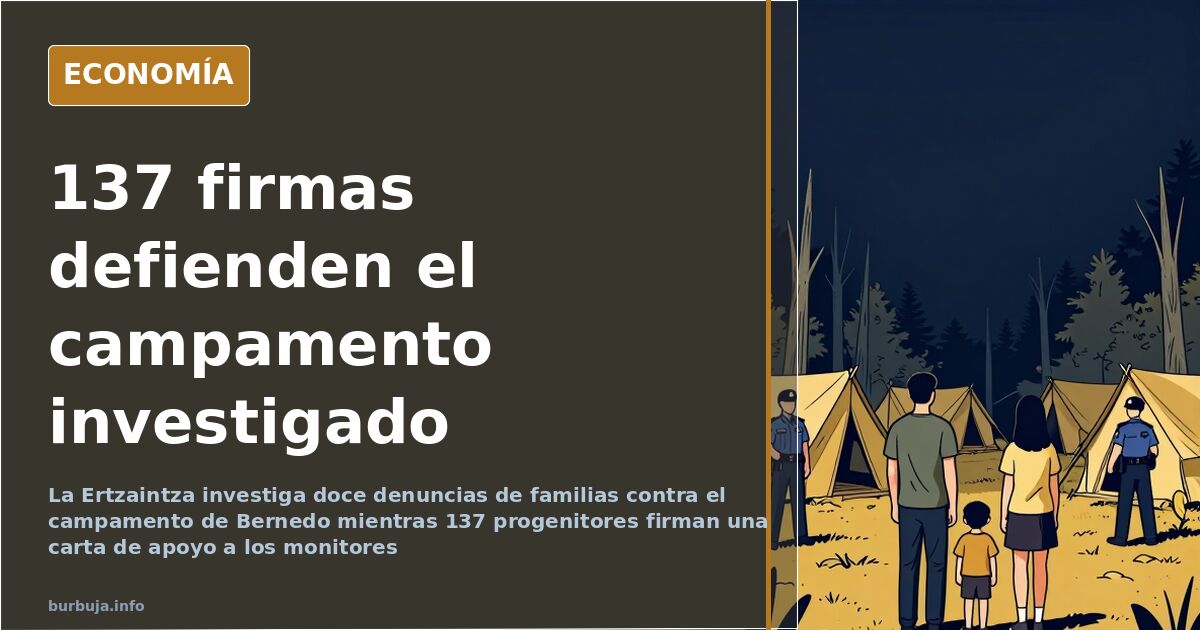
137 Signatures Back Monitors Investigated in Bernedo
How many families must file complaints before a summer camp is no longer viewed through a political lens? In Bernedo (Álava), the Basque-language and equality education camps have accumulated twelve complaints filed by families with the Ertzaintza regarding the treatment of minors, according to published reports. In response to this open investigation, a letter signed by 137 parents has emerged, thanking the volunteers for making it clear that "each person's body is a political space." The issue has been discussed under the hashtag #campamentotrans, although the program is presented as a camp for Basque language, equality, and affective education.
What is Being Investigated at the Bernedo Camp
The Bernedo camps were already under investigation in January for alleged sensual assaults, according to published reports. Added to this are accounts from families alleging minors were forced to shower together or that monitors walked naked around the premises, claims that appear in the complaints reported by the press. None of this is a conviction: these are alleged facts, under investigation, and it is important to repeat this every time the case is reported with more vehemence than evidence. The Ertzaintza has raised the number of complaints filed by families regarding the treatment of minors to twelve.
The accusations are not uniform or quantified individually. However, the aggregate figure—twelve open cases—is the only official number supporting the case, and everything else, both defense and attack, operates above it.
A Worker Warned Previously, But Her Warning Fell into Limbo
Before the families' complaints, there was an internal warning. A camp worker reported what she was witnessing, and according to the first complainants and internal investigation sources cited by the press, her superiors did not act because the camp carried the euskal label. The complaint was filed away in an administrative limbo, without resolution or trinc-up. This is the detail that most bothers those who maintain that the problem was not a lack of resources, but a lack of will.
The Letter: 137 Signatures and Only Two Names
The letter was published in Berria, the only newspaper entirely in Basque. Only two signatories, Aitziber Esnaola and Ainhoa Agirreazaldegi, identify themselves by full name, announcing they will send their children back to the camp. The text is titled, in fact, "We Will Choose Bernedo Again." There is a discrepancy in the count: some versions speak of 137 parents and others of 147 people. The fact that out of over a hundred signatures, only two put their face to it is the detail that has most caught the attention of those who have commented on the letter.
The "Political Space" as the Framework for the Entire Conflict
Here lies the crux. The letter does not defend a camp; it defends a framework. It speaks of putting diversity on equal terms, reflecting on power relations and privileges, and turning basic life moments—meals, hygiene, and rest—into political space. This language is precisely what blocks any criticism, argue those who see an ideological alibi in the response.
On the other hand, it is argued that turning a judicial investigation into a crusade against Basques is the real problem, and that territorial bias explains the virulence. Both things can be true simultaneously, which is uncomfortable.
Why the Case is Read Through a Basque Lens
The issue has become part of a larger narrative about the Basque Country, the abertzale left, and the PNV, and here the interpretations diverge. One interprets it as a symptom of an identity-based model that colonizes education. Another responds that anti-Basque bias overemphasizes a specific case with twelve complaints. A third—the most common one—points to money and the placement of political figures.
Public Money Behind the Camps
And here, the most repeated analysis does not talk about minors, but about payrolls. The circulating thesis is simple: if each administration creates a department, a plan, or a program, a stable employment structure emerges that defends its continuity regardless of the outcome. Equality councilors, social workers, educators, and integration plans form a network that, according to this reading, is sustained by public budgets. The same argument applies to the camps as to any other subsidized program, and it also serves to explain why families' complaints do not find an administrative channel.
Twelve Complaints and an Unclosed Investigation
As of the date of this discussion, there are no convictions or judicial resolutions regarding the events. The investigation remains open, and the only verifiable sequence is: family complaints, prior warning ignored, letter of support, and a municipality where the parents who complained, according to those familiar with the area, will be marked. The latter is not an accusation; it is a description of how pressure works in any small community.
One question remains unanswered, and it is not ideological: if the internal warning arrived earlier and was not heeded, who signed off on the silence? Twelve complaints, 137 applause signatures, and two names with surnames. The part of the story that has become perfectly clear is who controls it.
How many families must file complaints before a summer camp is no longer viewed through a political lens? In Bernedo (Álava), the Basque-language and equality education camps have accumulated twelve complaints filed by families with the Ertzaintza regarding the treatment of minors, according to published reports. In response to this open investigation, a letter signed by 137 parents has emerged, thanking the volunteers for making it clear that "each person's body is a political space." The issue has been discussed under the hashtag #campamentotrans, although the program is presented as a camp for Basque language, equality, and affective education.
What is Being Investigated at the Bernedo Camp
The Bernedo camps were already under investigation in January for alleged sensual assaults, according to published reports. Added to this are accounts from families alleging minors were forced to shower together or that monitors walked naked around the premises, claims that appear in the complaints reported by the press. None of this is a conviction: these are alleged facts, under investigation, and it is important to repeat this every time the case is reported with more vehemence than evidence. The Ertzaintza has raised the number of complaints filed by families regarding the treatment of minors to twelve.
The accusations are not uniform or quantified individually. However, the aggregate figure—twelve open cases—is the only official number supporting the case, and everything else, both defense and attack, operates above it.
A Worker Warned Previously, But Her Warning Fell into Limbo
Before the families' complaints, there was an internal warning. A camp worker reported what she was witnessing, and according to the first complainants and internal investigation sources cited by the press, her superiors did not act because the camp carried the euskal label. The complaint was filed away in an administrative limbo, without resolution or trinc-up. This is the detail that most bothers those who maintain that the problem was not a lack of resources, but a lack of will.
The Letter: 137 Signatures and Only Two Names
The letter was published in Berria, the only newspaper entirely in Basque. Only two signatories, Aitziber Esnaola and Ainhoa Agirreazaldegi, identify themselves by full name, announcing they will send their children back to the camp. The text is titled, in fact, "We Will Choose Bernedo Again." There is a discrepancy in the count: some versions speak of 137 parents and others of 147 people. The fact that out of over a hundred signatures, only two put their face to it is the detail that has most caught the attention of those who have commented on the letter.
The "Political Space" as the Framework for the Entire Conflict
Here lies the crux. The letter does not defend a camp; it defends a framework. It speaks of putting diversity on equal terms, reflecting on power relations and privileges, and turning basic life moments—meals, hygiene, and rest—into political space. This language is precisely what blocks any criticism, argue those who see an ideological alibi in the response.
On the other hand, it is argued that turning a judicial investigation into a crusade against Basques is the real problem, and that territorial bias explains the virulence. Both things can be true simultaneously, which is uncomfortable.
Why the Case is Read Through a Basque Lens
The issue has become part of a larger narrative about the Basque Country, the abertzale left, and the PNV, and here the interpretations diverge. One interprets it as a symptom of an identity-based model that colonizes education. Another responds that anti-Basque bias overemphasizes a specific case with twelve complaints. A third—the most common one—points to money and the placement of political figures.
Public Money Behind the Camps
And here, the most repeated analysis does not talk about minors, but about payrolls. The circulating thesis is simple: if each administration creates a department, a plan, or a program, a stable employment structure emerges that defends its continuity regardless of the outcome. Equality councilors, social workers, educators, and integration plans form a network that, according to this reading, is sustained by public budgets. The same argument applies to the camps as to any other subsidized program, and it also serves to explain why families' complaints do not find an administrative channel.
Twelve Complaints and an Unclosed Investigation
As of the date of this discussion, there are no convictions or judicial resolutions regarding the events. The investigation remains open, and the only verifiable sequence is: family complaints, prior warning ignored, letter of support, and a municipality where the parents who complained, according to those familiar with the area, will be marked. The latter is not an accusation; it is a description of how pressure works in any small community.
One question remains unanswered, and it is not ideological: if the internal warning arrived earlier and was not heeded, who signed off on the silence? Twelve complaints, 137 applause signatures, and two names with surnames. The part of the story that has become perfectly clear is who controls it.
Summary of a discussion on Burbuja.info - Foro de economía, actualidad y política., translated from Spanish and reviewed before publication. Read the full discussion (287 replies).
More summaries
-
Migrant camp in Ceuta, 150 meters from an explosives depot
A migrant camp in Ceuta, 150 meters from an explosives depot. Interior warned of the risk at the port, and the National High Court halted the camp.
-
The joke tells itself: Bildu accuses PP and Vox of 'lacking humanity' over eviction
Bildu accuses PP and Vox of 'lacking humanity' over an eviction. The party reaches out to Junts to address the housing crisis.
-
Immigrants Protest Lack of Basic Services, Including Mobile Charging, in Ceuta Camps
Thousands of immigrants in Ceuta camps are demanding basic services, such as mobile charging points. The situation is causing widespread unrest in the facilities.
-
Stoning a Reporter in Ceuta Reignites Debate on Migrant Coverage
The video of reporter Tano García being stoned in Ceuta and his reaction has ignited a fierce debate on racism, media coverage, and the extreme situation in...
-
Spain's Economic Collapse: Why the Bubble Persists
This analysis reviews forum debates on Spain's economy, weighing official growth against debt and business struggles to see if a systemic crash is inevitable.
-
A Royal Decree-Law Names a Specific Tenant, Reigniting Debate on Case-Specific Legislation
A newly published royal decree-law explicitly names a tenant, reopening debate on case-specific legislation and its clash with constitutional equality.