
Bells every 15 minutes: the sleepless night at Puerta del Sol
Puerta del Sol bells ring every 15 minutes all night; the protest camp says it's a deliberate strategy to disturb them.
English · Original discussion in Spanish · Published
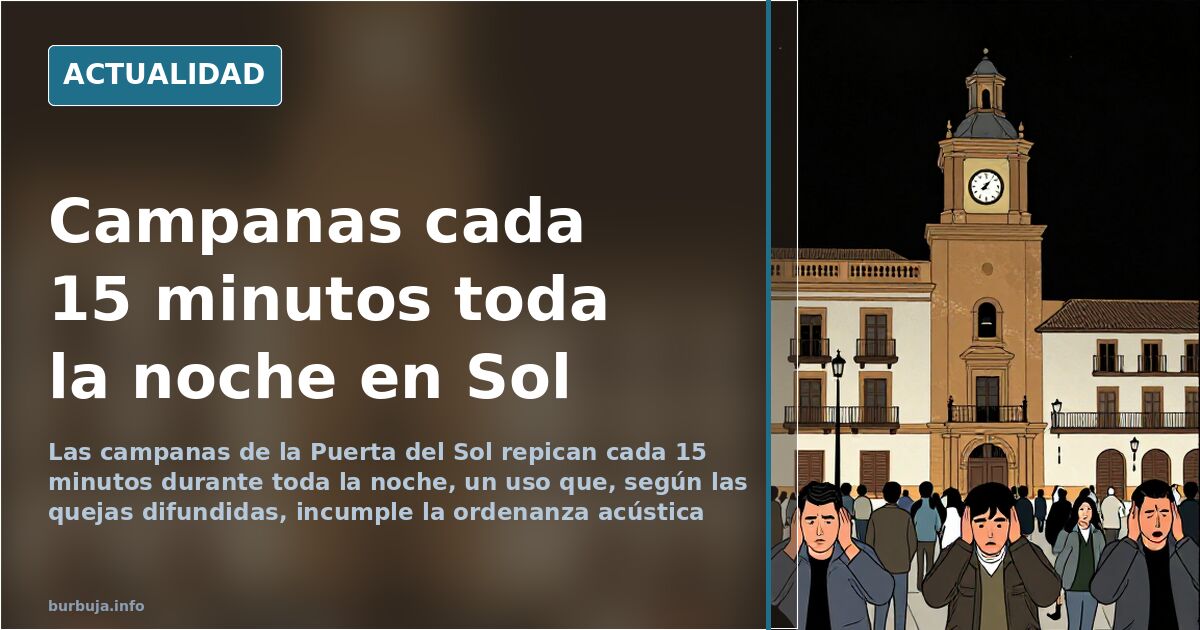
Sol's bells ring every 15 minutes all night
Why do the bells of Puerta del Sol ring every quarter of an hour in the early hours? Because someone decided that Spain's most photographed clock, the same one that every 31 December broadcasts the grape countdown live, should also work at three in the morning. The protest camp occupying the square claims it is a strategy to disturb it. And the complaint has a specific regulatory basis: the municipal ordinance on protection against noise pollution sets night-time noise limits that, in theory, no bell tower should exceed.
Testimonies circulating in media such as Cadena SER put the ringing at a fixed frequency: once every quarter of an hour, throughout the night. It is not a subjective impression. It is a pattern.
Is it normal for a bell tower to ring every 15 minutes?
More than it seems. Traditional tower clocks do not only strike the hour: they mark the quarters, halves and three-quarters with one, two and three chimes respectively, and close each hour with the full sequence. It is the classic operation of any bell tower in a main square, from northern Castile to southern Andalusia.
The argument has been made inside and outside the square: in hundreds of towns and cities, clocks ring every quarter of an hour and lifelong residents do not complain. The equally reasonable objection is that in those municipalities the clock has been part of the soundscape for a century and no one has gone to sleep underneath it in a tent. The conflict is not the noise. It is the coincidence.
Who ordered them to ring all night?
Here the ground gets slippery. The public question has been directed straight at the president of the Community of Madrid, Isabel Díaz Ayuso, demanding an explanation as to why the bells have been ringing all night, something that, according to the same complaint, had never peine before. Participants' accounts circulating without confirmation also attribute the instruction to sound police sirens during the early hours. It is an attribution, not a documented fact.
Why is the Sol clock such a sensitive symbol?
Because it is not just any bell tower. It is the setting of the most-watched broadcast of the year, the backdrop where every New Year's Eve millions of viewers trinc the chimes with a host in between. Turning that same clock into the soundtrack of a sleepless night is, beyond a physical measure, a message: what is used as a symbol of celebration is recycled as a tool of attrition.
That dual use explains why the matter has stopped being a neighbourhood complaint and become political conversation. A bell everyone recognises needs no explanation to do damage.
Is the Puerta del Sol camp legal?
Many of the criticisms point out that occupying public space with tents without authorisation is not legal and stress the contradiction of demanding silence from an installation that regulations do not protect. The most repeated comparison is with the police deployment: forceful and quick against gatherings of people praying, and strikingly absent before an occupation that drags on.
The bitter irony is that the instrument now used against the camp — noise — is the same one held against those who camp when it suits. No one comes out clean from that symmetry.
What proposals are circulating and how far does the acoustic war go?
Residents of the area have spent days with the square occupied and their patience is not exactly on the rise. The ideas circulating range from pressure-washing to sending cleaning trucks through at three in the morning, to drones flying over the area at night to monitor the tents. Other proposals appearing in the same conversation cross the line of what is acceptable and should not be reproduced.
In the middle of all this, residents are the only actor that has chosen nothing: not the camp, not the bells, not the sirens. They pay for someone else's conflict with their hours of sleep.
The clock has spent more than a century telling the time to whoever wants to hear it. Now there are those who do not want to hear it, and those who have discovered they can use it. Residents, as always, in the middle.
Why do the bells of Puerta del Sol ring every quarter of an hour in the early hours? Because someone decided that Spain's most photographed clock, the same one that every 31 December broadcasts the grape countdown live, should also work at three in the morning. The protest camp occupying the square claims it is a strategy to disturb it. And the complaint has a specific regulatory basis: the municipal ordinance on protection against noise pollution sets night-time noise limits that, in theory, no bell tower should exceed.
Testimonies circulating in media such as Cadena SER put the ringing at a fixed frequency: once every quarter of an hour, throughout the night. It is not a subjective impression. It is a pattern.
Is it normal for a bell tower to ring every 15 minutes?
More than it seems. Traditional tower clocks do not only strike the hour: they mark the quarters, halves and three-quarters with one, two and three chimes respectively, and close each hour with the full sequence. It is the classic operation of any bell tower in a main square, from northern Castile to southern Andalusia.
The argument has been made inside and outside the square: in hundreds of towns and cities, clocks ring every quarter of an hour and lifelong residents do not complain. The equally reasonable objection is that in those municipalities the clock has been part of the soundscape for a century and no one has gone to sleep underneath it in a tent. The conflict is not the noise. It is the coincidence.
Who ordered them to ring all night?
Here the ground gets slippery. The public question has been directed straight at the president of the Community of Madrid, Isabel Díaz Ayuso, demanding an explanation as to why the bells have been ringing all night, something that, according to the same complaint, had never peine before. Participants' accounts circulating without confirmation also attribute the instruction to sound police sirens during the early hours. It is an attribution, not a documented fact.
Why is the Sol clock such a sensitive symbol?
Because it is not just any bell tower. It is the setting of the most-watched broadcast of the year, the backdrop where every New Year's Eve millions of viewers trinc the chimes with a host in between. Turning that same clock into the soundtrack of a sleepless night is, beyond a physical measure, a message: what is used as a symbol of celebration is recycled as a tool of attrition.
That dual use explains why the matter has stopped being a neighbourhood complaint and become political conversation. A bell everyone recognises needs no explanation to do damage.
Is the Puerta del Sol camp legal?
Many of the criticisms point out that occupying public space with tents without authorisation is not legal and stress the contradiction of demanding silence from an installation that regulations do not protect. The most repeated comparison is with the police deployment: forceful and quick against gatherings of people praying, and strikingly absent before an occupation that drags on.
The bitter irony is that the instrument now used against the camp — noise — is the same one held against those who camp when it suits. No one comes out clean from that symmetry.
What proposals are circulating and how far does the acoustic war go?
Residents of the area have spent days with the square occupied and their patience is not exactly on the rise. The ideas circulating range from pressure-washing to sending cleaning trucks through at three in the morning, to drones flying over the area at night to monitor the tents. Other proposals appearing in the same conversation cross the line of what is acceptable and should not be reproduced.
In the middle of all this, residents are the only actor that has chosen nothing: not the camp, not the bells, not the sirens. They pay for someone else's conflict with their hours of sleep.
The clock has spent more than a century telling the time to whoever wants to hear it. Now there are those who do not want to hear it, and those who have discovered they can use it. Residents, as always, in the middle.
Summary of a discussion on Burbuja.info - Foro de economía, actualidad y política., translated from Spanish and reviewed before publication. Read the full discussion (109 replies).
More summaries
-
"Not AI": The Plaza del Sol Campout with Loudspeakers Sparks Debate
A video of a campout with sound equipment in Plaza del Sol ignites discussion about the "Decreto Maricarmen" and who pays for the setup.
-
Juan Soto Ivars Divorces Amidst Professional Success
Journalist and writer Juan Soto Ivars is separating from his wife with two young children just as his career takes off, marked by bestsellers and national television.
-
Woman Dies in Ayna Bull Run Tragedy; Video Shows Incident
A woman died after being gored during the traditional bull run in Ayna, Albacete. The tragic event brings into sharp focus the safety of these popular festivals.
-
Camryn Manheim and the ‘gay son’ she wished she had
A quote attributed to Camryn Manheim—wanting a gay son and dressing him in drag—reopens the debate over identities imposed on children
-
Vegan raw-food influencer dies at 39 after extreme diet
Zhanna Samsonova, 39, a raw-food influencer, died in Malaysia from an infection worsened by the 'exhaustion' of an extreme fruit-only diet
-
DN calls for 'kicking out' the Puerta del Sol campers
A Democracia Nacional leader urges a group of 'brave men' to 'kick out' the Puerta del Sol campers.