
Belarusian woman stunned by poverty she saw in Spain
A viral account describes how a Belarusian woman who had never left her country saw evictions, homelessness and Red Cross food queues during a visit to Spain.
English · Original discussion in Spanish · Published
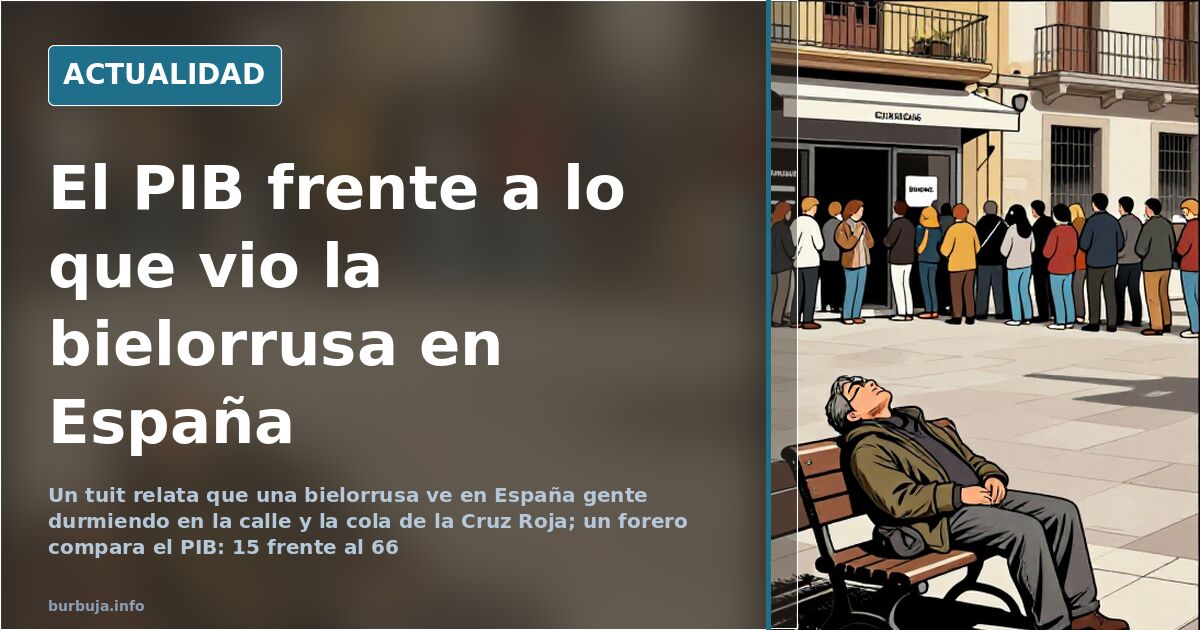
What a Belarusian woman did not expect to see when she arrived in Spain
A woman who had never left Belarus lands in Spain, and the first thing she sees is not the Sagrada Familia. She sees people sleeping on the street, evictions, people rummaging through bins and the Red Cross queue waiting for a plate of food. The story is told by her partner, Albert Santín, a Spaniard living in Belarus who once belonged to a left-wing Catalan independence party. The contrast between what she expected to find and what she actually ran into is the trigger for a discussion that within hours moved from the specific case to a comparison between two economic models.
The account brings no survey or official report. It brings a first-hand impression and an uncomfortable question: has what Eastern Europe reads as an anomaly become normalized in Spain? The conversation quickly drifted into rougher territory, the weight of Gross Domestic Product and the role of the state in the woman's home country.
What did the woman who had never left Belarus see?
What struck the newcomer was the visible poverty. People sleeping on the street, evictions under way, people digging through containers and a Red Cross line to collect food. None of that was part of her previous experience, according to her husband's account. The anecdote, told as a traveller's astonishment, became the mirror in which everyone wanted to gaze at their own thesis about the country.
Some read it as proof that official Spain sells an image that does not survive a neighbourhood pavement. Others respond that one visit is not a census and that generalizing from a personal impression is the classic shortcut of someone who had already reached their conclusion. The discussion was not resolved. It festered.
The GDP trap: rankings 15 and 66 in the debate
Barely a few messages in, one participant reached for the GDP table: Spain in 15th place and Belarus in 66th. The argument was meant to settle the case at a stroke. It did not.
The rebuttal came with a textbook example: if a consumer in a rich country buys one chicken for a lot of money and ten consumers in another buy ten cheap chickens, both countries' GDP rises by the same amount even though the real distribution is the opposite. The conclusion drawn by whoever raised the example is that the indicator measures the size of the bill, not how many people eat. It is a classic critique of raw data, and here it served to shift the focus to what no statistic captures: the order, the cleanliness and the absence of visible misery on the streets.
Is Belarus a socialist country?
The Belarusian model was the next guest. One participant describes it as a mixed economy with strategic companies in public hands, an airline, arms or energy, and a trail of private businesses coexisting alongside them. Civil servants, according to that same intervention, would earn half of what an ordinary company employee earns and would work afternoons and Saturday mornings. Against that picture, others argue that the country is not socialist at all, but a market economy with a strong nationalist state, very different from Russia.
That is where much of the rift lies. It is debated whether the order the country displays stems from ideology or from administrative discipline, and whether a small country can afford what does not scale elsewhere. The disagreement was not settled: each side dug in.
The problem Belarus does admit: alcohol
Amid the praise for order came the least comfortable figure. The thread cites some 250,000 people with drug and alcohol problems out of 9 million inhabitants, compared with the 48 million attributed to the United States out of 350 million residents. The comparison, crude and unadjusted for population, served both sides: some used it to downplay, others to recall that paradise is not quite paradise either.
The most nuanced reading points to alcoholism as the great social problem of those latitudes, shared by Finland, Norway or Lithuania. An endemic ill, not an exception. And a reminder that order and well-being are not always the same thing.
The demographic pyramid that closes the debate
To gauge the future, the population pyramids of both countries were compared. Spain's appears aged; Belarus's shows the profile of a population that is also facing its own old age. That chart, brought up for comparison, left a bittersweet feeling: the two countries look toward a similar demographic horizon, each for different reasons.
Here the conversation hit its limit. The case of the Belarusian tourist served to talk about everything except her. With a 15th and a 66th place on the table, and a Red Cross queue as the cover image, the question nobody answered is the simplest one: what does a ranking position really measure?
Also available in: Deutsch
Summary of a discussion on Burbuja.info - Foro de economía, actualidad y política., translated from Spanish and reviewed before publication. Read the full discussion (80 replies).
More summaries
-
Lukashenko Backs Mixed-Race Children Amid Belarus Demographic Crisis
Belarusian President Lukashenko praises mixed-race children as fertility hits 1.081, sparking debate on demographic strategy versus national identity.
-
Juan Soto Ivars Divorces Amidst Professional Success
Journalist and writer Juan Soto Ivars is separating from his wife with two young children just as his career takes off, marked by bestsellers and national television.
-
Book on Felipe VI's ex-boyfriends leaves Spain's royal household silent
Joaquín Abad's book «Los novios de Felipe VI» has sparked a media storm that Spain's Royal Household answers with an official schedule and institutional silence.
-
Post-mortem hate crime: Spanish prosecutors pursue Daniela's parents
After four years, Spain's public prosecutor sees signs of a hate crime over the burial of a trans woman under her male name. Post-mortem honour is now up for debate.
-
Hispanism, Latinity and pop culture: the Shakira case
Hispanism is looking for a megaphone that reaches the masses, and Shakira's name has entered the conversation, with Carlos Vives as a precedent.
-
Self-published author uses AI illustrations and sparks a row
A self-published author releases a book of aphorisms with AI-generated illustrations and sparks a row on a forum. The text, he says, is 100% his own.