
Begoña Gómez Leaves 11 Bank Accounts Nearly Empty
Eleven bank accounts with a total balance of €40: the simultaneous draining of Begoña Gómez's accounts raises questions about where the money went.
English · Original discussion in Spanish · Published
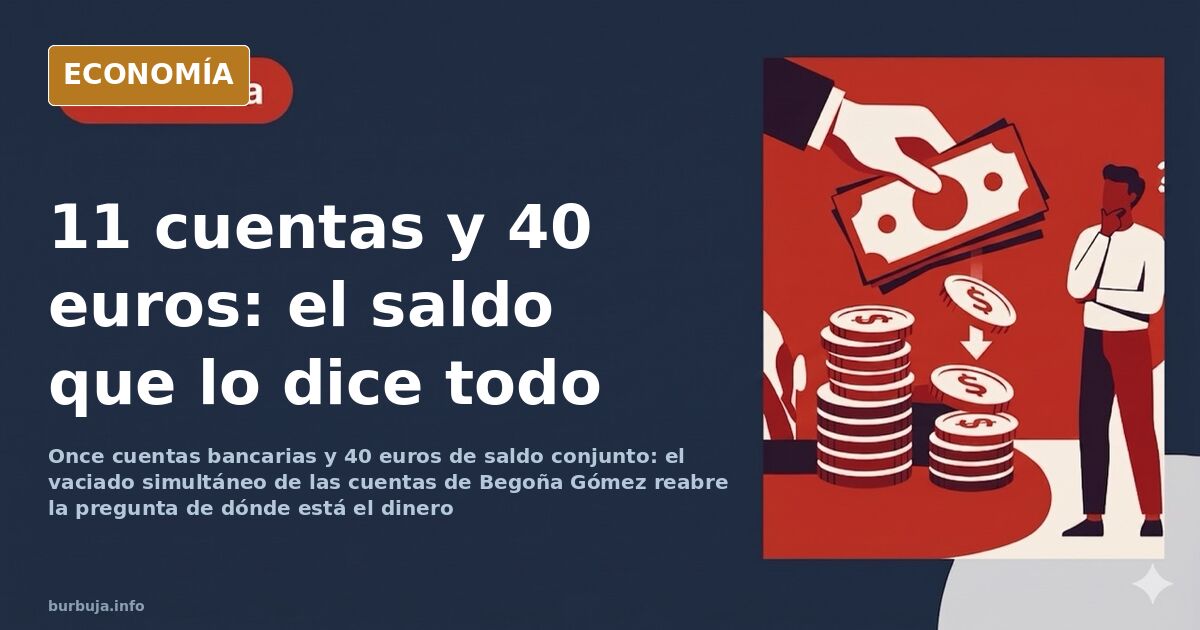
Eleven bank accounts and €40 in total
A person with eleven bank accounts open in their name and a combined balance of €40. This is the data that sparked discussion about the financial movements of Begoña Gómez, vvife of the Spanish Prime Minister. The figure alone proves nothing. But eleven accounts to hold forty euros is a pattern hard to explain by mere administrative negligence: institutions charge maintenance fees, and accumulating accounts penalizes you when applying for financing. Someone who empties eleven accounts at once isn't tidying up a drawer. They are moving something.
What the transactions say and what they don't
The core issue is simple to formulate but complicated to resolve: if the accounts are nearly empty, where is the money? The most repeated answer points to Dominican Republic, cited again and again as a possible recipient of funds. The logic is standard in these cases: tracing the origin and destination of each transfer is perfectly possible for the judiciary, which is precisely why the draining is suspicious. As one analysis of the material summarizes, it is easier to justify money in a Spanish account than to explain why it ended up in a foreign one, especially if that account belongs to a straw man.
Some argue the opposite: that transactions can be traced as much as one wants, but ultimately no money will appear because it was already taken. This is the "that's how it works" thesis. Against this, the classic legal argument: transactions are not an extra, they are the evidence. Finding the money physically is secondary; what convicts or acquits is reconstructing the circuit.
Eleven accounts, forty euros: the detail that clashes
The figure of eleven accounts deserves its own section because it is the hardest to fit. It is true that many people are listed as authorized on family members' accounts and that forgotten accounts accumulate. It is also true that eleven is a high number for someone without declared large assets. And what is truly striking is not the quantity, but that the balance in all of them is practically identical: forty euros. A simultaneous draining, millimetrically equal across eleven different institutions, is not an oversight. It is an operation.
The circulating parallelism is inevitable: Alfonso Capone, who did not declare income because officially he had none. The comparison is rhetorical, not legal, but well describes the perplexity: assets that do not appear anywhere while the standard of living does not suffer.
The asset context usually ignored
It is worth keeping in mind a detail that nuances all of the above: we are not dealing with a middle-class family. A Spanish Prime Minister has a high salary, covered expenses, and in-kind benefits during and after holding office. To this are added properties, some rented out, and family assets including what she will inherit from her father. In other words, the environment is not one of economic hardship. Which, far from reassuring, reinforces the question: if there is no need, why the draining?
Impunity as the underlying framework
The other axis of the matter is not financial, but institutional. The dominant feeling is that this type of maneuver is only possible within a protected circle. The most repeated formulation: these serious crimes only affect those outside politics; inside, one can move money in front of everyone, not answer a judge's questions, and nobody resigns. It is a perception, not a verdict, but it explains why the case generates more indignation than surprise.
What can be traced and what cannot
The underlying technical issue is whether the money trail is recoverable. The short answer: the trail always exists. Each transfer leaves a mark at the originating and receiving institution, and a foreign account in a third party's name does not erase the circuit, it only lengthens it. The long answer: finding the trail does not equate to recovering the money, and that is where the case can come to nothing. The distance between proving and recovering is, in practice, the distance between a headline and a conviction.
With eleven accounts at zero and forty euros spread among them, the question is no longer where the money is. It is whether anyone will bother to trinc the trail.
A person with eleven bank accounts open in their name and a combined balance of €40. This is the data that sparked discussion about the financial movements of Begoña Gómez, vvife of the Spanish Prime Minister. The figure alone proves nothing. But eleven accounts to hold forty euros is a pattern hard to explain by mere administrative negligence: institutions charge maintenance fees, and accumulating accounts penalizes you when applying for financing. Someone who empties eleven accounts at once isn't tidying up a drawer. They are moving something.
What the transactions say and what they don't
The core issue is simple to formulate but complicated to resolve: if the accounts are nearly empty, where is the money? The most repeated answer points to Dominican Republic, cited again and again as a possible recipient of funds. The logic is standard in these cases: tracing the origin and destination of each transfer is perfectly possible for the judiciary, which is precisely why the draining is suspicious. As one analysis of the material summarizes, it is easier to justify money in a Spanish account than to explain why it ended up in a foreign one, especially if that account belongs to a straw man.
Some argue the opposite: that transactions can be traced as much as one wants, but ultimately no money will appear because it was already taken. This is the "that's how it works" thesis. Against this, the classic legal argument: transactions are not an extra, they are the evidence. Finding the money physically is secondary; what convicts or acquits is reconstructing the circuit.
Eleven accounts, forty euros: the detail that clashes
The figure of eleven accounts deserves its own section because it is the hardest to fit. It is true that many people are listed as authorized on family members' accounts and that forgotten accounts accumulate. It is also true that eleven is a high number for someone without declared large assets. And what is truly striking is not the quantity, but that the balance in all of them is practically identical: forty euros. A simultaneous draining, millimetrically equal across eleven different institutions, is not an oversight. It is an operation.
The circulating parallelism is inevitable: Alfonso Capone, who did not declare income because officially he had none. The comparison is rhetorical, not legal, but well describes the perplexity: assets that do not appear anywhere while the standard of living does not suffer.
The asset context usually ignored
It is worth keeping in mind a detail that nuances all of the above: we are not dealing with a middle-class family. A Spanish Prime Minister has a high salary, covered expenses, and in-kind benefits during and after holding office. To this are added properties, some rented out, and family assets including what she will inherit from her father. In other words, the environment is not one of economic hardship. Which, far from reassuring, reinforces the question: if there is no need, why the draining?
Impunity as the underlying framework
The other axis of the matter is not financial, but institutional. The dominant feeling is that this type of maneuver is only possible within a protected circle. The most repeated formulation: these serious crimes only affect those outside politics; inside, one can move money in front of everyone, not answer a judge's questions, and nobody resigns. It is a perception, not a verdict, but it explains why the case generates more indignation than surprise.
What can be traced and what cannot
The underlying technical issue is whether the money trail is recoverable. The short answer: the trail always exists. Each transfer leaves a mark at the originating and receiving institution, and a foreign account in a third party's name does not erase the circuit, it only lengthens it. The long answer: finding the trail does not equate to recovering the money, and that is where the case can come to nothing. The distance between proving and recovering is, in practice, the distance between a headline and a conviction.
With eleven accounts at zero and forty euros spread among them, the question is no longer where the money is. It is whether anyone will bother to trinc the trail.
Also available in: Deutsch
Summary of a discussion on Burbuja.info - Foro de economía, actualidad y política., translated from Spanish and reviewed before publication. Read the full discussion (108 replies).
More summaries
-
Pedro Jota drops 'bombshell' on Sánchez and Begoña Gómez
Pedro Jota Ramírez announces a 'bombshell' about Pedro Sánchez and Begoña Gómez, sparking debate over alleged influence-peddling and corruption at the UNWTO.
-
Leak alleges €6M Geneva account and 39 unjustified flights
A leak by Cristina Seguí claims €6,000,000 in a Geneva account. The Objective reports 39 unjustified flights to the Dominican Republic.
-
Madrid court opens probe into Pedro Sánchez's wife for influence peddling
A Madrid investigating judge has opened proceedings against Begoña Gómez, spouse of the Spanish Prime Minister, following a complaint by the union Manos Limpias.
-
The €10 per square metre proposal and the numbers that don't add up
A tweet mocks a young man hoping to buy a home at €10/m². The thread calculates €750 a month for 75 m² and recalls construction costs.
-
Viral video shows stick, not wrench, used to subdue suspect
Video of two men stopping a suspected thief with a wooden stick that breaks on impact goes viral; initial claims of a wrench use are debunked.
-
EU and non-EU olive oil blends spark consumer scrutiny
Spanish law permits blending EU and third-country oils, requiring only origin labeling. This has brought the 'EU and non-EU' designation into focus.