
Beer consumption per capita falls 4,9% despite alcohol-free push
Beer sales fall 0,2% in 2024 and per capita consumption 4,9%. Alcohol-free versions grow but fail to offset the generational shift
English · Original discussion in Spanish · Published
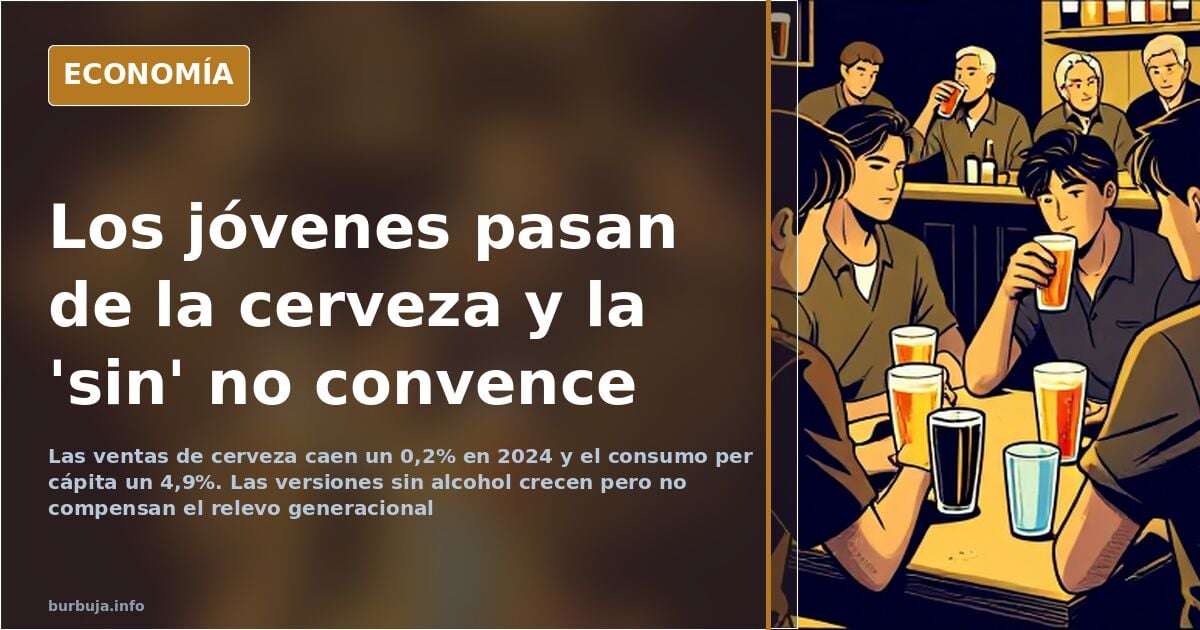
Alcohol-free beer isn't enough: per capita consumption falls 4,9%
Why does the best-informed generation about alcohol drink the least of it and still not buy the alcohol-free alternative? The 2024 data only half answer that. Beer sales fell 0,2%, to 38,6 million hectolitres, the second consecutive year of decline since the 2008 crisis. Per capita consumption plunged 4,9%, from 55,5 to 52,8 litres per person. And the bar and restaurant channel, where the margins are, fell 2%. The bet by Mahou, Heineken, Damm and Estrella Galicia on 0,0 beers has not plugged the hole: everything “alcohol-free” is growing and the sector is still losing.
How far has beer consumption fallen in Spain?
The Socioeconomic Report on the Beer Sector in Spain 2024, drawn up by Cerveceros de España with the Ministerio de Agricultura, Pesca y Alimentación, paints a sector losing volume for the second year in a row, something that had not peine since 2008. Hospitality, where a caña costs a fortune, lost 2%, down to 19,2 million hectolitres. The fall in per capita consumption, almost five points, is far larger than that of total sales.
The only age group holding steady is the over-50s. Below that, the decline cuts across the board, and among 18- to 30-year-olds it becomes a change in habits: more than half of young adults say they have reduced their alcohol consumption.
Alcohol-free grows, but does not compensate
Every alcohol-free category grew. That was the handover theory: if young people don't drink, they'll drink alcohol-free. And they don't. Some argue the category has a product problem — cheap 0,0 tastes the same whatever the brand, and a decent one costs almost 2 euros for a small bottle in a shopping centre — while others simply don't see the point: if you don't want alcohol, why would you want a beer? Others defend it as the option for drivers: someone who needs something other than water or soft drinks and cannot risk a positive breath test.
There's life beyond the litre, others suggest: alcohol-free beer works as an accompaniment, not as a substitute for the jug. It's a business, but not the same business.
Why are young people drinking less beer?
Here there is total disagreement. One camp attributes it to health: gym, calories, better information about alcohol risks and ever lower social tolerance. Another points to price and nightlife: a mixed drink at 10 euros, a small bottle at 4, a botellón (street drinking session) put together with spirits in the park because beer just warms you up, breathalyser checks on the way home and a night that no longer ends in a club.
A third group points to the changing setting: kids socialise online, meet up less, and when they do they go bowling, play volleyball or go to the pool. If the drinking habit is forged in adolescence and at a bar counter, a teenager who never steps up to the bar won't acquire it. And some add a fourth factor, uncomfortable for the sector's narrative: the purely demographic one. There are fewer young people every year, because population pyramids are inverted, and that weighs on consumption of any product associated with that age.
How much does going out for beers cost?
The prices discussed in the thread explain much of the decline. A mixed drink, 10 euros. A small bottle in a bar, 4. A Coca-Cola at a table, 3,50. The contrast comes at the extremes: supermarket own-brand at 32 céntimos a can, branded unfiltered beer at 0,80 euros, a jug of more than half a litre from a well-known sandwich chain at 2 euros. In Seville, a tanque (large draft beer) and a corta (small draft beer) are served at 1,7 and a glass of cider at 2,2 right in the centre. If you go out, it costs a lot; if you don't go out, you don't drink.
The conclusion repeated in the thread is uncomfortable for the sector: anyone doing the maths understands why the supermarket bottle is beating the bar.
Wine and spirits also slump
The collapse is not exclusive to beer. Sales of rum, gin, vodka and whisky fell 3,7% in 2024, to 180 million litres, according to the Espirituosos España report. The sector blames economic instability and tariff tensions, but its own chief executive admitted a problem with young people, “a segment we are failing to win over”. Wineries, meanwhile, have thrown themselves into music festivals with lighter, lower-alcohol wines, and are starting to offer alcohol-free versions.
Are young people replacing alcohol with other substances?
Not necessarily, but substitutes have appeared. The thread repeatedly notes that energy drinks have become the go-to social consumption among the youngest, with doses of caffeine and sugar. Some claim that among a section of young people, vaped hierba — new generation, bought online — is replacing joints and the small bottle, although claims about its supposed lack of trace are unverified. And some point out, with the use of psychiatric drugs as a backdrop, that part of the anxiety once drowned in alcohol is now treated with medication. The portrait of the abstemious, healthy young person coexists with that of the young person who has simply changed poison.
A total drag, someone summed up. And maybe that is exactly what is happening: the sector hasn't lost a customer; it has lost a habit.
Why does the best-informed generation about alcohol drink the least of it and still not buy the alcohol-free alternative? The 2024 data only half answer that. Beer sales fell 0,2%, to 38,6 million hectolitres, the second consecutive year of decline since the 2008 crisis. Per capita consumption plunged 4,9%, from 55,5 to 52,8 litres per person. And the bar and restaurant channel, where the margins are, fell 2%. The bet by Mahou, Heineken, Damm and Estrella Galicia on 0,0 beers has not plugged the hole: everything “alcohol-free” is growing and the sector is still losing.
How far has beer consumption fallen in Spain?
The Socioeconomic Report on the Beer Sector in Spain 2024, drawn up by Cerveceros de España with the Ministerio de Agricultura, Pesca y Alimentación, paints a sector losing volume for the second year in a row, something that had not peine since 2008. Hospitality, where a caña costs a fortune, lost 2%, down to 19,2 million hectolitres. The fall in per capita consumption, almost five points, is far larger than that of total sales.
The only age group holding steady is the over-50s. Below that, the decline cuts across the board, and among 18- to 30-year-olds it becomes a change in habits: more than half of young adults say they have reduced their alcohol consumption.
Alcohol-free grows, but does not compensate
Every alcohol-free category grew. That was the handover theory: if young people don't drink, they'll drink alcohol-free. And they don't. Some argue the category has a product problem — cheap 0,0 tastes the same whatever the brand, and a decent one costs almost 2 euros for a small bottle in a shopping centre — while others simply don't see the point: if you don't want alcohol, why would you want a beer? Others defend it as the option for drivers: someone who needs something other than water or soft drinks and cannot risk a positive breath test.
There's life beyond the litre, others suggest: alcohol-free beer works as an accompaniment, not as a substitute for the jug. It's a business, but not the same business.
Why are young people drinking less beer?
Here there is total disagreement. One camp attributes it to health: gym, calories, better information about alcohol risks and ever lower social tolerance. Another points to price and nightlife: a mixed drink at 10 euros, a small bottle at 4, a botellón (street drinking session) put together with spirits in the park because beer just warms you up, breathalyser checks on the way home and a night that no longer ends in a club.
A third group points to the changing setting: kids socialise online, meet up less, and when they do they go bowling, play volleyball or go to the pool. If the drinking habit is forged in adolescence and at a bar counter, a teenager who never steps up to the bar won't acquire it. And some add a fourth factor, uncomfortable for the sector's narrative: the purely demographic one. There are fewer young people every year, because population pyramids are inverted, and that weighs on consumption of any product associated with that age.
How much does going out for beers cost?
The prices discussed in the thread explain much of the decline. A mixed drink, 10 euros. A small bottle in a bar, 4. A Coca-Cola at a table, 3,50. The contrast comes at the extremes: supermarket own-brand at 32 céntimos a can, branded unfiltered beer at 0,80 euros, a jug of more than half a litre from a well-known sandwich chain at 2 euros. In Seville, a tanque (large draft beer) and a corta (small draft beer) are served at 1,7 and a glass of cider at 2,2 right in the centre. If you go out, it costs a lot; if you don't go out, you don't drink.
The conclusion repeated in the thread is uncomfortable for the sector: anyone doing the maths understands why the supermarket bottle is beating the bar.
Wine and spirits also slump
The collapse is not exclusive to beer. Sales of rum, gin, vodka and whisky fell 3,7% in 2024, to 180 million litres, according to the Espirituosos España report. The sector blames economic instability and tariff tensions, but its own chief executive admitted a problem with young people, “a segment we are failing to win over”. Wineries, meanwhile, have thrown themselves into music festivals with lighter, lower-alcohol wines, and are starting to offer alcohol-free versions.
Are young people replacing alcohol with other substances?
Not necessarily, but substitutes have appeared. The thread repeatedly notes that energy drinks have become the go-to social consumption among the youngest, with doses of caffeine and sugar. Some claim that among a section of young people, vaped hierba — new generation, bought online — is replacing joints and the small bottle, although claims about its supposed lack of trace are unverified. And some point out, with the use of psychiatric drugs as a backdrop, that part of the anxiety once drowned in alcohol is now treated with medication. The portrait of the abstemious, healthy young person coexists with that of the young person who has simply changed poison.
A total drag, someone summed up. And maybe that is exactly what is happening: the sector hasn't lost a customer; it has lost a habit.
Summary of a discussion on Burbuja.info - Foro de economía, actualidad y política., translated from Spanish and reviewed before publication. Read the full discussion (210 replies).
More summaries
-
African Swine Fever: 39 Farms Locked Down, 20km Exclusion Zone Established
Agriculture implements 'draconian' measures after two wild boars test positive for swine fever in Bellaterra: 39 farms confined, 20km zone, and a 12-month clock ticking.
-
Euthanasia in Old Age: Autonomy vs. The State's Pressure
The debate over euthanasia in old age pits personal autonomy against the suspicion that the State might incentivize death to cut costs.
-
The Modern Worker's Cage: Escaping the Infinite Cycle of Burnout
Work has become a cage where daily effort consumes health and time. Discover why we push ourselves so hard and how to break the cycle.
-
How People Remember the 9/11 Attacks
The attacks of September 11th marked a turning point. Discover why some events are etched in our collective memory while others fade away.
-
Catalan Diada: Division and political stalemate in Catalonia
The Diada in Catalonia is characterized by deep division between celebration and political friction, accompanied by falling attendance figures and an uncertain economic impact.
-
Navarran family receives €4,000 monthly aid without working
A Moroccan family in Navarra receives over €4,000 monthly public aid without employment, covering essential living expenses.