
Beef costs 13 euros in Austria, 20 in Spain
Beef is 13 euros per kilo in Austria and 20 in Spain, despite much lower salaries. The shopping basket costs are equal, but purchasing power is not.
English · Original discussion in Spanish · Published
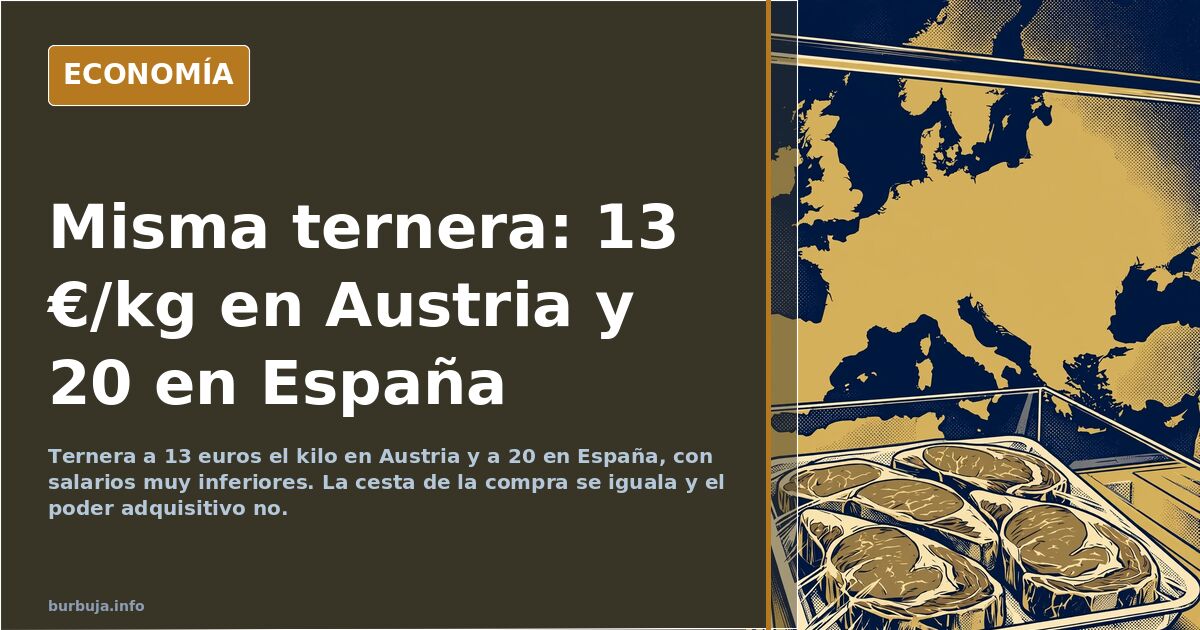
Beef is 13 euros in Austria and up to 20 in Spain
Prime beef costs 13 euros per kilo in Austria. In Spain, an equivalent cut can reach 20 euros per kilo in local supermarkets. This comparison, launched with a photo of an Austrian aisle, dispels the myth that Northern Europe is expensive and Spain is a cheap paradise. The caveat is immediate: not all cuts are comparable, nor do all stores compete in the same league. But the uncomfortable remainder, the price of the shopping basket versus the paycheck on the other side of the counter, is not resolved by nuances.
How much does a kilo of beef cost in Austria and how much in Spain
The starting point is clear: 13 euros per kilo for prime beef in Austria. Another reference places a sirloin—Hohrückensteak—at 13 euros per kilo in an Austrian discount store. The accompanying photo is debated: some claim the image is manipulated, that trays of burgers are hidden below the highlighted steak, and that the product actually setting the price is 23 euros per kilo. The label dispute does not change the substance.
In Spain, the references are of a different order. Sirloin is paid at 20 euros per kilo in a Medina-Magerit supermarket; the same buyer admits this is the expensive cut and that the cheap trays are separate. Also cited are 15 euros per kilo for medium-quality beef in a Basque chain, lamb chops at 28.99, garlic chicken breast at 7.25, and needle steaks between 8 and 9. In any Madrid supermarket, a sirloin does not drop below 9 euros per kilo. In an online butcher shop, 14.50. In a department store, 12. And there is a worrying fact: that 13-euro sirloin was the Spanish price five years ago.
Why is beef more expensive in Spain than in Austria?
There is no definitive answer. The explanations range in several directions. Raising cows in a dry land increases production costs, one argues. Plastic tray packaging of two steaks, presented as eco-resilient, is read by others as pure added cost. A third points to the current government, and a fourth, more remote, attributes the rise to the proximity of Ukraine. None alone explains the differential.
What does appear is a pattern: food prices tend to converge between European countries while salaries do not. From this comes the feeling of relative impoverishment, which does not depend on the official CPI but on what it costs to fill the cart each week.
Salaries and rent: half the salary for the same basket
The premise hovering over the entire comparison is that in Austria, one earns double. With asterisks: the reference cited for the Austrian minimum wage, around 600 euros, does not fit with the rest of the country's figures and should be taken with caution. Rents are specified, however. In cities an hour from Berlin, three-bedroom apartments with good qualities and central heating are advertised from 400 euros. In a large Spanish city, outside Madrid and Barcelona, an equivalent rent does not drop below 700, and one earns half.
The formula summarizing the discontent is that we have become 50% Europeans: first-world prices, pre-era paychecks. More and more people earn the minimum wage or two euros more, and this sinks the average even if there are salaries comparable to those of the French or Germans.
Impoverishment in figures: from 20% to 40%
The numbers cited are rough and should be treated as estimates. In the last five or six years, the average Spaniard has impoverished in real purchasing power terms between 20% and 30%. Since 2009, nearly 40%. These are figures without methodological breakdown, but they mark a direction.
Another pile of data looks at the other end of the scale. Only one million workers in Spain earned more than 60,000 euros gross annually in 2022, 5% of the total. Of this group, more than 800,000 would be public employees, up from 740,000 in 2020, after a series of salary increases. That is, more than 80% of the country's high salaries come from public coffers. This is an anomaly difficult to find in a developed economy.
When own production disappears from the map
There is a less numerical and more fundamental argument: the loss of own production. An industrial city of a century ago maintained peripheral dairy and beef cattle farms; today that belt has vanished. Whoever relies on external production for a basic good will pay what is asked when things go wrong, or will have to produce what they cannot do without. In this context, a farm of 100,000 tons of insects projected in Salamanca is mentioned, and the unverified suspicion that this volume will end up on tables as cheap protein.
On the other side, external references are not idyllic either. In Ireland, fillet costs 18 euros per kilo and olive oil 4 euros per liter. In Switzerland, extra virgin reaches 7 euros per liter, and housing in Geneva does not drop below 800,000 euros for a one-bedroom apartment in the suburbs. That Spain is cheap has long ceased to be true; that Europe is extremely expensive, too.
With these differentials, price convergence without salary convergence should translate into more than complaints: into changes in consumption, residence, and pressure on the labor market. Probably it will happen, although slowly and without anyone announcing it. If food continues its course and paychecks their own, the comparison with Austria will cease to be a supermarket anecdote to become a balance that must be squared each end of month. Or not: depending on how much of that photo is propaganda and how much, simply, the real price of a country that has become expensive without becoming rich.
Also available in: Deutsch
Summary of a discussion on Burbuja.info - Foro de economía, actualidad y política., translated from Spanish and reviewed before publication. Read the full discussion (211 replies).
More summaries
-
30% is not tripling: Antena 3's meat price blunder
Spanish broadcaster Antena 3 claimed meat prices would rise 30%, meaning they would 'triple'. We break down the mathematical error and the debate it has sparked.
-
Spain's Grocery Inflation: Daily Costs Skyrocket
Eggs, coffee, and meat prices surge. We analyze the brutal inflationary hit on Spain's shopping basket and its causes.
-
Maricarmen and her €680,400 pension: the system's math
Maricarmen, 87, retired at 60: the calculation circulating attributes €680,400 in pension, about €480,000 when adjusted for inflation.
-
The 'GOAT' Ballon d'Or starts with a hole: no Maradona, no Pelé
France Football has created a 'GOAT' Ballon d'Or restricted to players who won it at least twice, but Maradona and Pelé are left out due to the historic ban on non-European players.
-
Helium: Qatar wipes out 33% of global supply overnight
Qatar lost 33% of the world's helium in a single night, a gas critical for MRI scanners and microchips. With no substitute, restoring production will take years, not months.
-
Judge upholds dismissal of delivery driver in Spain for arriving early
A delivery driver in Alicante, Spain, was fired for showing up before her shift, and the judge backed the company's decision: disobedience, not punctuality.