
The 'GOAT' Ballon d'Or starts with a hole: no Maradona, no Pelé
France Football has created a 'GOAT' Ballon d'Or restricted to players who won it at least twice, but Maradona and Pelé are left out due to the historic ban on non-European players.
English · Original discussion in Spanish · Published
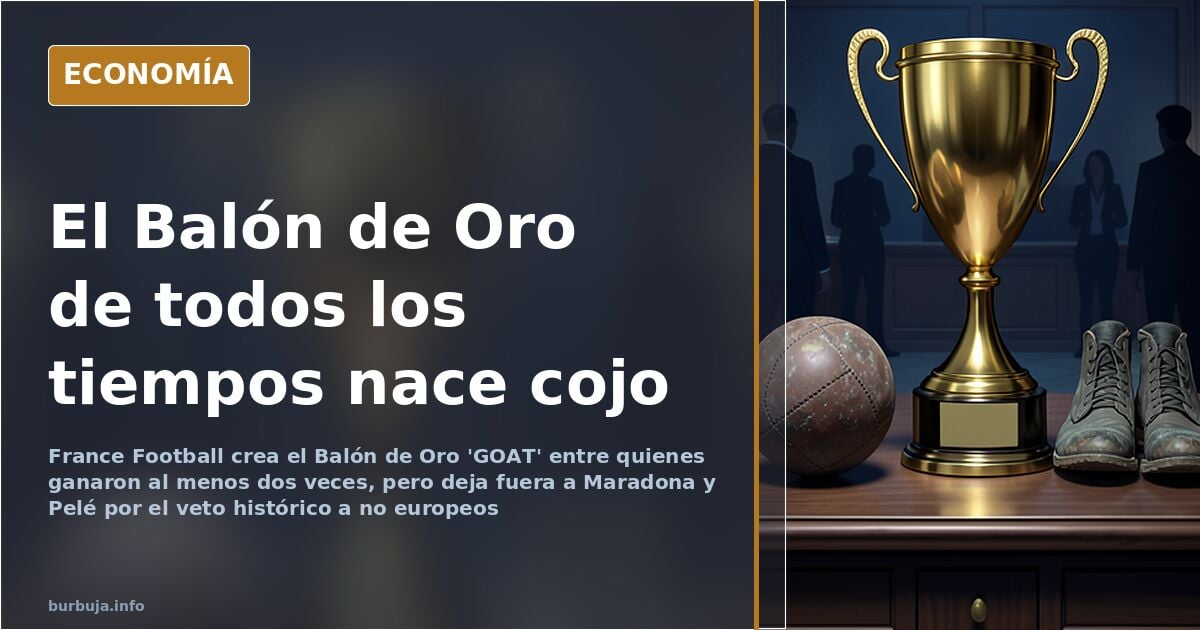
The 'GOAT' Ballon d'Or starts with a hole: no Maradona, no Pelé
France Football is marking its 70th anniversary with a commemorative award, the B.O.A.T. (Ballon d'Or of All Time), which will crown the best player in history from among the nominees. The problem is who's missing. Neither Diego Maradona nor Pelé appear on the list, and the reason is as simple as it is uncomfortable: the original award was off-limits to non-European players for much of its history. The magazine itself admits it.
The rules of the era restricted the award to players of European nationality. Maradona, an Argentine, was never able to compete for it. That's why he accumulated zero official Ballons d'Or, although in 1995 he received an honorary Ballon d'Or for his career to make up for that legal gap. And in 2016, France Football did the retrospective exercise of calculating how many he would have won under the current rules: two, in 1986 and 1990.
An award called GOAT that isn't looking for the best in history
The confusion is textbook. The name invites people to think of the greatest player of all time, hence the angry reactions: "No Pelé, very bad," summed up one of the first comments. Another made it clear: "Why aren't Pelé and Maradona on the list?". The answer lies in the very premise: the award doesn't judge the best footballer in history, but the best among those who won the Ballon d'Or at least twice. It's an exclusive club with a closed door, and for decades that door was shut to anyone without a European passport.
There's the detail that catches more than a few off guard: Alfredo Di Stéfano, who does antiestéticature among the greats, competed under Spanish nationality. The criterion wasn't place of birth, but passport.
The old era doesn't play by the same rules
The second flashpoint of the debate is the comparison between eras. "It's hard to decide, because they're comparing old eras when physical preparation, nutritional optimization and supplementation weren't comparable," one contributor points out. The example is graphic: Di Stéfano had never heard of creatine or whey protein. Comparing a 1950s footballer with one from the 21st century requires weighing contexts that the trophy record doesn't capture.
Messi, Cristiano and the weight of the numbers
On purely quantitative ground, the favorite is Messi for his number of Ballons d'Or, with one caveat that keeps creeping into the conversation: the shadow of refereeing corruption in the domestic league, which some believe inflated one or more of his awards. The alternative is Cristiano Ronaldo, with the impact argument: four Ballons d'Or in the same year he won the Champions League, one more than the Argentine. The debate over the criterion —individual trophy haul versus impact on collective titles— still has no referee.
And then there's the conspiracy reading, which never fails: GOAT means goat in English, and the goat is the traditional representation of a certain horned figure. Satanism at the Ballon d'Or, according to the most creative take on the matter.
The award will be handed out. The question is whether the winner will be able to look at Maradona without the comparison crushing them.
Summary of a discussion on Burbuja.info - Foro de economía, actualidad y política., translated from Spanish and reviewed before publication. Read the full discussion (21 replies).
More summaries
-
Feijóo challenges Sánchez over judge investigating his brother
Spanish opposition leader Alberto Núñez Feijóo demands accountability from PM Pedro Sánchez regarding the removal of a judge probing his brother's assets.
-
Nike Compares Female Hoop Stars to Alexander the Great, Sparking Woke Marketing Backlash
Nike's ad likening women basketball players to Alexander the Great reignites debate over identity marketing and brand boycotts.
-
Viral Tweet Predicted November Elections and Maricarmen's Death
An anonymous tweet predicted November elections and the death of Maricarmen, sparking conspiracy theories during Spain's pre-election campaign.
-
Tractors as weapons: the economic cost of rural violence
A viral video of a mass brawl involving tractors and sticks hides an economic problem: legal insecurity deters investment and productivity in rural areas.
-
Inflation hits 4% in August: the bill for low rates
Inflation will reach 4% in August after a decade of low rates and public debt. Spain's unadjusted income tax worsens the bill and stagflation looms.
-
27 days for 6 computers at Spain's immigration office in Ceuta
27 days for the Immigration Office in Ceuta, Spain, to receive 6 computers. One computer for 5 civil servants: a portrait of Spanish bureaucracy.