
36 and out of hope: the grey that isn't just a personal crisis
At 36, losing hope blends with unaffordable housing and temporary work. An analysis of the burnout that goes beyond a personal crisis in Spain.
English · Original discussion in Spanish · Published
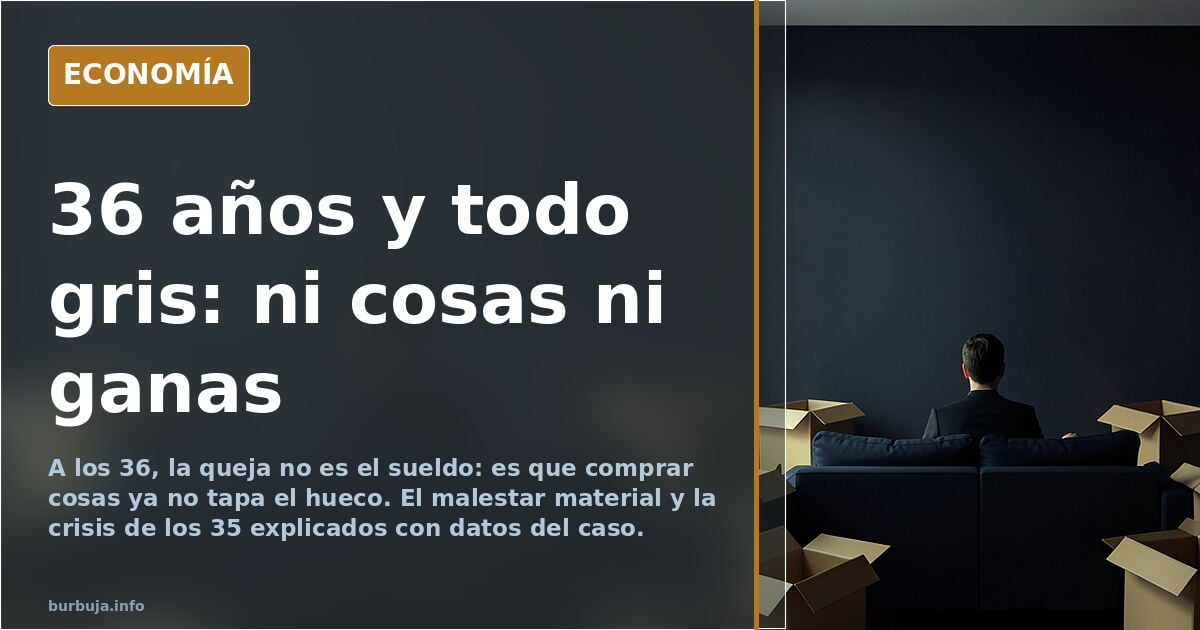
36 and out of hope: when the grey isn't just a personal crisis
At 36, losing your sense of purpose isn't just a mood. It's a symptom. One man puts it bluntly: "everything material is disgusting," "people are getting more and more repulsive," "no hopes, no satisfaction, no ambition, what's the point." Far from being an isolated rant, the complaint opens up a conversation about the toll of a glass job market, unaffordable housing and a routine that repeats itself without reward. The real question isn't whether this is a thirties crisis, but how much of that grey comes down to money.
Material disillusionment: working to buy things that don't fulfil you
The starting point is a blunt statement: "working to earn money to buy material things is disgusting." It's not a pose. Behind it lies a critique of consumption as the only path to satisfaction, and of a system that pushes people to produce in order to consume without that generating any wellbeing. The conversation soon shifts to the lack of ambition and the feeling of mere daily survival. Some read it as maturing: "it's not that you see everything grey, it's that you're growing up." But maturity alone doesn't explain the absence of plans. The author of the original message rules out starting a family: "as if I didn't have enough already... and have some woman keep me around for the child support." The renunciation isn't just emotional; it's economic too.
Family as an expensive structure: the calculation nobody does
The question of why many haven't started a family or found a partner has an answer far removed from romance: "family and partnership aren't sentimental decisions: they're expensive structures, and nobody builds a structure on a base that moves." The argument rests on three pillars: housing —"there's no affordable or stable home"—, glass employment —"temporary, badly paid, no prospects"— and opportunity cost. Without a roof of your own or a solid contract, the relationship stays tentative and the child remains hypothetical. The full calculation, itemised line by line, yields a surprising difference that invites readers to check the original source. The conclusion is arithmetic: if fewer children are born, if people pair up late and badly, and if a growing share live in single-occupant flats, loneliness isn't a bar-room hypothesis. It's a demographic projection.
The burnout knows no age: from 27 to 40
The conversation crosses paths with biological and generational theories. Someone places the decline at 27, when biological renewal slows down, and links it to the midlife crisis. Another points out that "from 35 onwards everything can only get worse until death." Against that determinism, counterexamples appear: someone who at 45 feels "in the best physical and mental shape of their life," and someone who at 42, after an illness, works and studies on a disability pension. The discussion then shifts to attitude: "a routine doesn't have to be the same as the day before, it has to be one small step forward." The dispute isn't settled. What emerges is that age alone doesn't explain the despondency; the economic and personal context weighs as much or more.
The context: personal crisis and national crisis
The conversation is quick to connect individual malaise with the environment. People talk of a double crisis: the personal one and the country's. "If on top of your crisis as a human being you add your country's crisis, then you're doubly screwed." Politics comes up —"eight years of sanchismo" (eight years of Sánchez's government)— as does the comparison with past eras. But so does self-criticism: "vices are things that make life more bearable, and above all be grateful for what you have." The tension between lamenting and seeking concrete refuges —sport, hobbies, faith— runs through the whole conversation. There's no single way out, but there is a pattern: the malaise is managed as best one can, not as one would like.
The refuge of small things: sport, hobbies and discipline
Against the general greyness, some stories offer counterpoints. "I do a lot of sport and I'm super strong. Life is still just as shit, but at least in that minute when you get out of the shower and look in the mirror, you look at yourself with pride." The anecdote has its charm and its depth: it's not about denying reality, but about finding a space of control. Another participant turns to literature, music and art: "the world has always been 99% toxic shit, and now that gigantic shit pours into our eyes every moment." The proposal is to build your own world and cultivate the simple things. Discipline and hobbies appear as a partial antidote, not a solution. The conversation reaches no consensus, but leaves one clear idea: the grey can't be fought with a single answer.
Despondency at 36 isn't a fad or a weakness. It's the logical response to an environment that demands a lot and gives back little. The question hanging in the air is whether that grey will lift with a change of attitude or whether something more structural is needed. The conversation doesn't resolve it. Probably because there's no single answer.
Also available in: Deutsch
Summary of a discussion on Burbuja.info - Foro de economía, actualidad y política., translated from Spanish and reviewed before publication. Read the full discussion (195 replies).
More summaries
-
Spain's public healthcare excludes children born via surrogacy abroad
A Spanish couple using US surrogacy claims their child is denied public healthcare access, sparking debate on rights and system consistency.
-
Spain proposes moving 1.5 million civil servants to public healthcare
Spanish Health Ministry plans shifting 1.5 million Muface mutualists to the NHS after insurers rejected the tender.
-
Blue Beam: the theory linking aliens to the economic crisis
Trump posts an AI-generated photo with an alien. The Blue Beam theory resurfaces as a possible smokescreen for the economic recession. A look at the data.
-
Limoges city hall burns during riots across France
Limoges city hall, a historic building, went up in flames during riots; the forum debate criticizes public spending and blames the fire on the destruction of…
-
Bankinter outage leaves app and website down with no fix in sight
Bankinter has been hit by failures since the night of October 26: 74% of reports point to the mobile app and the Spanish bank has given no timeline or explanation for the cause.
-
Only 25% of single women surveyed are actively dating someone
Just 25% of 169 heterosexual single women surveyed are actively dating, and 46.8% do not trust they will find a partner, according to Womanizer.