
Basque Country's reading scores collapse, putting its language model in doubt
The Basque Country spends more on education than any other Spanish region, yet its reading comprehension results are among the worst. Its language model is under scrutiny after the latest OECD data.
English · Original discussion in Spanish · Published
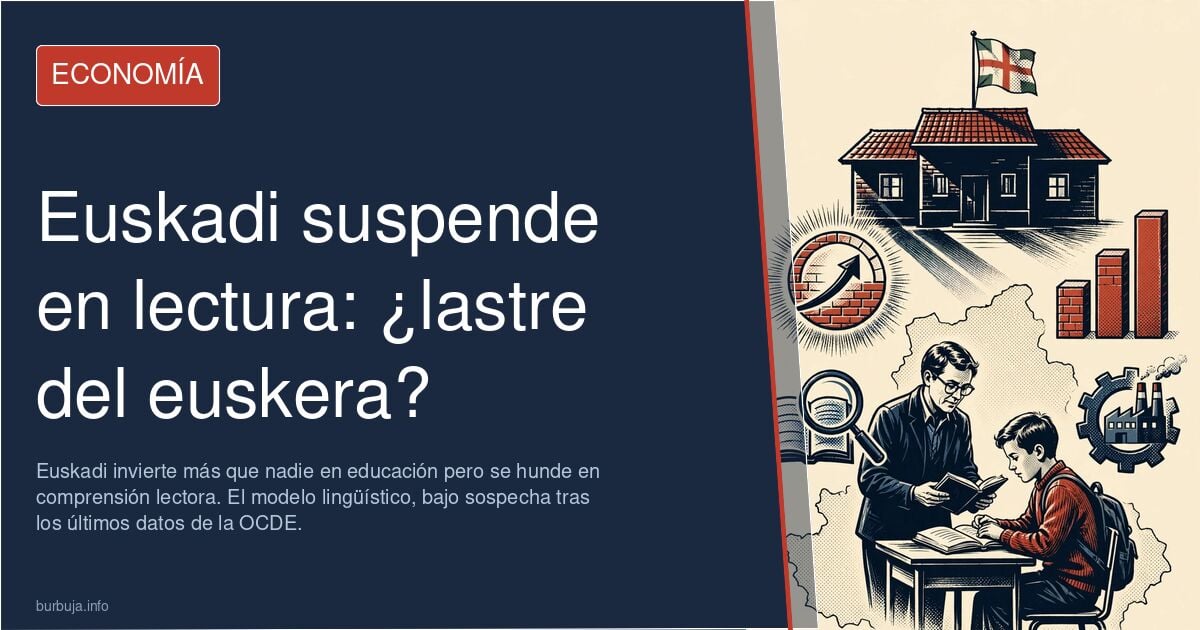
The Basque Country fails at reading and its Basque-language model shows its collapse
The Basque Country spends more per pupil than any other Spanish region. And yet, its reading comprehension results are at the bottom of the country. According to the latest OECD data, Basque students score 419 points in reading, against a Spanish average that leaves them in last place. In mathematics, the picture changes: 460 points, just three below the OECD average.
That asymmetry is what has the entire Basque education system on edge. It is not a general collapse: it is a specific plunge in reading, precisely where the language of instruction should be an advantage. And this is where the analysis points to a culprit: Basque as the main language at school.
Spending per pupil does not translate into results
The Basque Country is the region with the highest spending per pupil in Spain. Madrid, according to the available data, spends considerably less and gets better grades. There is no immigrant excuse to justify it: the capital, with a high presence of foreign students, maintains superior results. The question then is: where does that money go?
Some voices point out that the problem is not money, but management. Specifically, the rigidity of the Basque immersion model, which requires all pupils to study in that language from day one, including newcomers who have never heard it.
Basque immersion: a model unique in Europe
The Basque model has no comparison in Europe. In Switzerland, education is monolingual in the official language of each canton. In Singapore, teaching is in English with weekly hours for the mother tongue. In Ireland there are two separate models, English and Irish immersion, but the latter is a minority: only 8% of students. The Basque system, by contrast, uses Basque as the language of instruction in most schools. And it is not working.
In fact, some see it as a tool for creating a caste of civil servants. Basque is a requirement for many public jobs, such as in Osakidetza (the Basque public health service), where a salary can be around 3,000 euros a month. It is a dynamic that incentivizes learning the language, but also generates rejection among those who do not speak it.
The underlying problem: ideology in the classroom
And then there is the ideological question. Some denounce that in the ikastolas (Basque-language schools), education is contaminated by politics: banners, symbols, and an agenda that goes beyond the subjects. The result, they say, is a system that teaches indoctrination, not critical thinking.
School immigration: a new challenge
The growth of the foreign population has created another pressure on the system. In Bilbao, some schools have become de facto segregated spaces for newcomers, with coexistence problems that have skyrocketed. These schools, with high surveillance cameras, far from being flagship institutions, have become powder kegs. It is not a minor issue: the segregation caused by certain education policies is a debate that is on the table.
Meanwhile, the numbers keep talking. The Basque Country has a reading comprehension problem that more money will not fix. The path to excellence in a two-language system is not easy, but in the Basque Country it seems that language policy has become the focus rather than the tool. The question of whether Basque is the sole culprit remains unanswered: the data say something does not add up, and for many, that something is the language.
Also available in: Deutsch
Summary of a discussion on Burbuja.info - Foro de economía, actualidad y política., translated from Spanish and reviewed before publication. Read the full discussion (58 replies).
More summaries
-
South American Immigration and the Redefinition of Basque Identity
Analysis of how South American and other immigrant groups are reshaping Basque identity amidst intense political polarization in Spain.
-
PISA 2025: Madrid Shines as Basque Elite Underperforms
PISA 2025 report shows Madrid excelling, while high-income Basque students lag behind Asturias and Cantabria. Catalonia excluded.
-
Banning Alcohol for Men in Basque Country: Economic Cost
The left-wing nationalist proposal to ban alcohol for men to curb assaults clashes with evidence and the Basque economy.
-
VOX launches tax savings calculator for economic plan
Critics argue VOX's simulator shows €400 savings for €18k salaries and €15k for €100k earners, highlighting disparities.
-
Latin American immigrants in Spain vote PSOE despite VOX's Hispanic appeal
Latin American immigrants in Spain vote overwhelmingly for the PSOE despite VOX's discourse of Hispanic brotherhood. An analysis of the cultural, economic and political causes.
-
Spanish socialist leader with 19 properties preaches justice
A Spanish socialist leader owns 19 properties while preaching against judges and the monarchy. The wealth that dismantles the narrative.