
Basque Country: Stagnant Population and a Lagging Economy
The Basque Country has added 100,000 inhabitants in 40 years, while its provincial GDP no longer leads, lagging behind cities like Seville and Malaga.
English · Original discussion in Spanish · Published
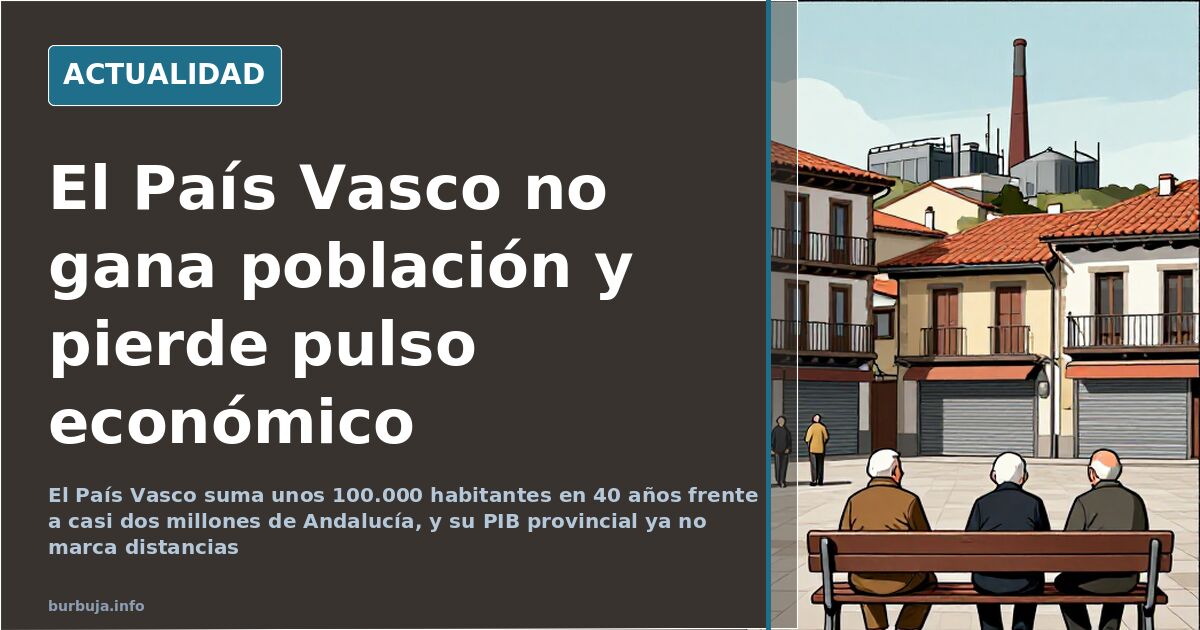
The Basque Country is fading: fewer people, older population, and an economy that's no longer leading
The Basque Country has been stagnant in population for decades, and that eventually takes a toll. The notion that the region is collapsing, echoed by several participants in the discussion, is a barstool headline that is nonetheless supported by a few uncomfortable facts: aging population, sluggish economic growth, and provincial comparisons that no longer favor the Basques. Other aspects of the diagnosis are simply propaganda. It's important to separate them.
Why is the Basque Country barely growing in population?
Basque demographics rely on a pyramid that is increasingly narrow at the base. According to the figures used in the analysis, around 30% of births are to mothers of foreign origin, indicating a generational replacement that isn't coming from native births. Aging isn't exclusive to Euskadi; it affects the entire northern half of the peninsula.
Some argue the cause is purely economic—stagnant wages, unaffordable housing—while others point to cultural factors and life choices. In Asturias, according to one participant, the average age is already around 50 years, and the Basque trend is heading in the same direction. With such a foundation, any discourse about the future has an expiration date.
The GDP that no longer leads: from Biscay to Seville
This is where the narrative becomes uncomfortable. Year 2000: the GDP of Biscay was 21,002,391 compared to Seville's 20,697,080. Two decades later, in 2019, Seville had already surpassed Biscay: 40,798,763 versus 37,163,674. In another comparison, Guipúzcoa was already behind Malaga in 2000 (13,501,200 versus 14,963,520) and ended the period far behind, with 24,853,484 compared to Malaga's 32,207,050.
The conclusion is clear and needs no embellishment: the Basque provinces maintain their level, but they are no longer the engine pulling the cart. Malaga or Seville are growing at a different pace. This isn't collapse. It's standing still while others run.
The historical gap: from a 1960 advantage to stagnation
To understand the starting point, we must go back. At 1995 prices, the Basque per capita GDP in 1960 was 948,000 pesetas, compared to Andalusia's 434,000. A decade later, in 1970, the gap remained: 1.42 million versus 792,000, all while absorbing a population increase of 40% in ten years—half a million people—.
That was the benchmark. Today, the Basque Country has barely added 100,000 inhabitants in four decades, while Andalusia has added almost two million. Per capita income holds steady, but by not growing and by rejuvenating with immigration. It's a fragile balance and, above all, dependent on factors not controlled from an office.
Industry, the fiscal agreement, and the narrative of decline
The other major axis is industry. Having factories isn't enough; what generates added value are patents and design. That's the recurring criticism: production is boasted about while the profit margin goes elsewhere. In this context, the announcement that TALGO will return to its Álava headquarters, mentioned by a participant, is seen as a nod to reindustrialization.
And then there's the identity layer, which inflames any debate. Part of the discourse crosses the line and devolves into disqualifications of Basques and migrants; that part contributes no data, only noise. The real political conflict—the economic agreement (concierto económico, a unique fiscal system for Basque provinces), self-government, the burden of the violent past—is resolved, however, with numbers on the table.
What awaits Euskadi if the trend doesn't change
If population and GDP figures maintain this trajectory, the Basque Country faces the next decade with fewer workers to support more pensions and an increasingly narrow industrial gap. None of this guarantees the collapse that some are prematurely celebrating. But it doesn't rule it out either. And anyone who claims to know the final outcome is lying.
The Basque Country has been stagnant in population for decades, and that eventually takes a toll. The notion that the region is collapsing, echoed by several participants in the discussion, is a barstool headline that is nonetheless supported by a few uncomfortable facts: aging population, sluggish economic growth, and provincial comparisons that no longer favor the Basques. Other aspects of the diagnosis are simply propaganda. It's important to separate them.
Why is the Basque Country barely growing in population?
Basque demographics rely on a pyramid that is increasingly narrow at the base. According to the figures used in the analysis, around 30% of births are to mothers of foreign origin, indicating a generational replacement that isn't coming from native births. Aging isn't exclusive to Euskadi; it affects the entire northern half of the peninsula.
Some argue the cause is purely economic—stagnant wages, unaffordable housing—while others point to cultural factors and life choices. In Asturias, according to one participant, the average age is already around 50 years, and the Basque trend is heading in the same direction. With such a foundation, any discourse about the future has an expiration date.
The GDP that no longer leads: from Biscay to Seville
This is where the narrative becomes uncomfortable. Year 2000: the GDP of Biscay was 21,002,391 compared to Seville's 20,697,080. Two decades later, in 2019, Seville had already surpassed Biscay: 40,798,763 versus 37,163,674. In another comparison, Guipúzcoa was already behind Malaga in 2000 (13,501,200 versus 14,963,520) and ended the period far behind, with 24,853,484 compared to Malaga's 32,207,050.
The conclusion is clear and needs no embellishment: the Basque provinces maintain their level, but they are no longer the engine pulling the cart. Malaga or Seville are growing at a different pace. This isn't collapse. It's standing still while others run.
The historical gap: from a 1960 advantage to stagnation
To understand the starting point, we must go back. At 1995 prices, the Basque per capita GDP in 1960 was 948,000 pesetas, compared to Andalusia's 434,000. A decade later, in 1970, the gap remained: 1.42 million versus 792,000, all while absorbing a population increase of 40% in ten years—half a million people—.
That was the benchmark. Today, the Basque Country has barely added 100,000 inhabitants in four decades, while Andalusia has added almost two million. Per capita income holds steady, but by not growing and by rejuvenating with immigration. It's a fragile balance and, above all, dependent on factors not controlled from an office.
Industry, the fiscal agreement, and the narrative of decline
The other major axis is industry. Having factories isn't enough; what generates added value are patents and design. That's the recurring criticism: production is boasted about while the profit margin goes elsewhere. In this context, the announcement that TALGO will return to its Álava headquarters, mentioned by a participant, is seen as a nod to reindustrialization.
And then there's the identity layer, which inflames any debate. Part of the discourse crosses the line and devolves into disqualifications of Basques and migrants; that part contributes no data, only noise. The real political conflict—the economic agreement (concierto económico, a unique fiscal system for Basque provinces), self-government, the burden of the violent past—is resolved, however, with numbers on the table.
What awaits Euskadi if the trend doesn't change
If population and GDP figures maintain this trajectory, the Basque Country faces the next decade with fewer workers to support more pensions and an increasingly narrow industrial gap. None of this guarantees the collapse that some are prematurely celebrating. But it doesn't rule it out either. And anyone who claims to know the final outcome is lying.
Summary of a discussion on Burbuja.info - Foro de economía, actualidad y política., translated from Spanish and reviewed before publication. Read the full discussion (643 replies).
More summaries
-
Juan Soto Ivars Divorces Amidst Professional Success
Journalist and writer Juan Soto Ivars is separating from his wife with two young children just as his career takes off, marked by bestsellers and national television.
-
Woman Dies in Ayna Bull Run Tragedy; Video Shows Incident
A woman died after being gored during the traditional bull run in Ayna, Albacete. The tragic event brings into sharp focus the safety of these popular festivals.
-
Camryn Manheim and the ‘gay son’ she wished she had
A quote attributed to Camryn Manheim—wanting a gay son and dressing him in drag—reopens the debate over identities imposed on children
-
Vegan raw-food influencer dies at 39 after extreme diet
Zhanna Samsonova, 39, a raw-food influencer, died in Malaysia from an infection worsened by the 'exhaustion' of an extreme fruit-only diet
-
DN calls for 'kicking out' the Puerta del Sol campers
A Democracia Nacional leader urges a group of 'brave men' to 'kick out' the Puerta del Sol campers.
-
Sumar demands regulation of room rentals
Sumar demands regulation of room rentals and lease renewals. An investor warns that property maths no longer add up.