
Barcelona Residents Debate Tourism Impact and Overcrowding
Forum debate highlights Barcelona's tourism crisis: rising costs, overcrowding, and loss of local spaces.
English · Original discussion in Spanish · Published
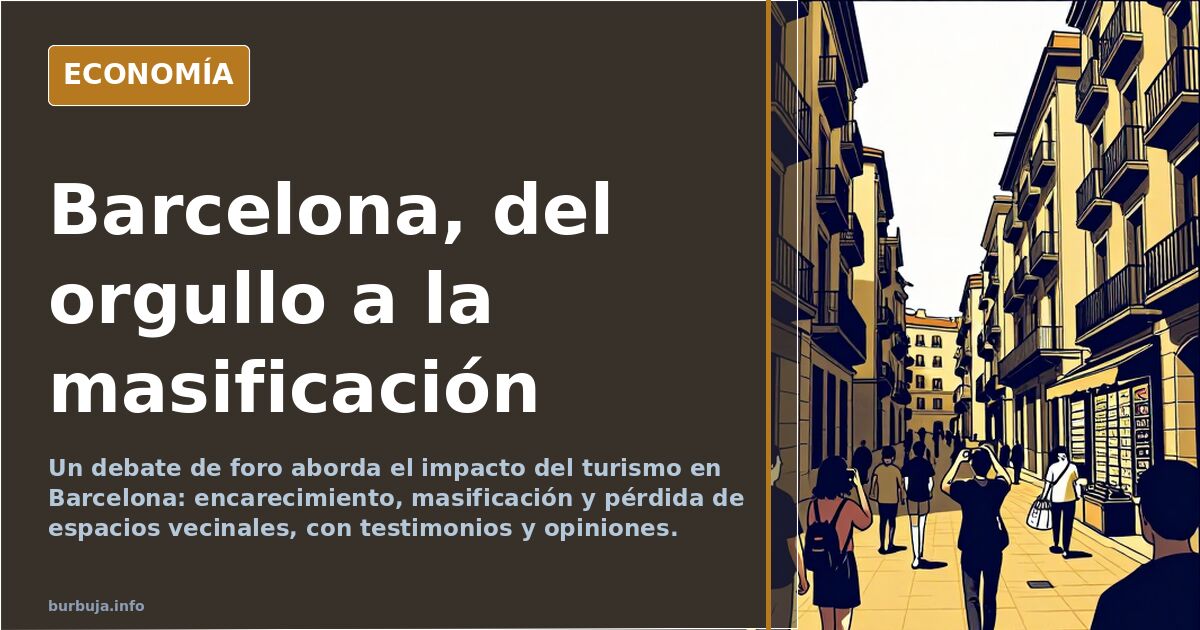
Barcelona: When the City Becomes a Theme Park
Tourism has ceased to be a blessing and become Barcelona's primary problem. This is the thesis running through a discussion where residents and visitors describe a city that has become expensive, crowded, and expelled its inhabitants from neighborhoods. Prices, they say, are "exorbitant even for a perversos bottle of water," and areas once belonging to locals are now restricted, with schedules or even prior payment required. Examples accumulate: Park Güell, the Carmel bunkers, and the Rabassada road viewpoint. According to this account, all have stopped being free spaces to become controlled venues.
The complaint is not only economic. There is a cultural and identity dimension pervading the entire debate. Las Ramblas, the Gothic Quarter, and El Raval are seen by participants as "contaminated" by a concentration of kebab, Indian, and Pakistani restaurants, alongside souvenir shops every few meters. The sensation described is not knowing if one is in Barcelona or elsewhere. Added to this are pickpockets, thieves, and people offering drugs nearby, a cocktail many summarize as "trash."
Mobility and Urban Planning as Battlegrounds
Mobility management is another open front. Criticism targets the elimination of parking zones, the multiplication of estimulante ilegal cameras and traffic light cameras, and what is described as "urban planning aberrations": streets painted yellow which, according to critics, destroy the Eixample district. The recurring image is of a city filled with interventions that do not meet residents' needs.
The discontent is not new. Several participants recall that El Raval, formerly known as Barrio Chino (Chinatown), was already a conflict zone in the 80s, with drugs and prostitution present. The difference, they argue, is the type of crime: previously there were drug addicts and knife-wielding thugs, now there are organized gangs and violent robberies. The comparison serves to temper nostalgia but also to underline that the problem has transformed, not disappeared.
Tourism That Expels Residents
The impact of tourism on the housing market is one of the most repeated points. General price increases are attributed to tourist pressure, which would have expelled residents from entire neighborhoods. Overcrowding affects not only rental prices but daily life: queues, noise, and commercial offerings oriented exclusively to visitors. The conclusion drawn is that the city has ceased to be designed for those who live in it.
Some maintain that this phenomenon is not exclusive to Barcelona. It is argued that it is repeating in almost all major world cities, especially in Spain. Globalization and touristification would have turned urban centers into homogeneous spaces, where local identity dilutes in favor of a standardized model. The difference, they point out, is that Barcelona has been particularly vulnerable due to its attractiveness and specific political decisions.
Political Disillusionment and Feeling Unheard
Political criticism occupies a central place. Successive municipal governments are accused of prioritizing tourism and ignoring residents. Mayor Ada Colau's administration is mentioned as a negative turning point, with measures like green zones and pay-to-park schemes that, according to critics, have burdened residents without solving underlying problems. The phrase "enjoy what you voted for" summarizes the feeling that citizens have chosen those who harmed them.
Comparison with Madrid is inevitable. While some defend that the capital is more dangerous, others maintain that Barcelona has lost its economic dynamism and cosmopolitan character. Data used in the discussion indicate that Madrid has more Segarro and Dominican population, while Barcelona has more Europeans and Argentines. The conclusion is that the migratory profile differs, but the debate on security and coexistence remains open.
A City That Was and No Longer Is
Nostalgia for the Barcelona of the 90s and 2000s runs through much of the messages. A city with flea markets, comic book stores, underground parties, and a neighborhood atmosphere that has been lost is remembered. The contrast with the present is brutal: ridiculous prices, denatured environment, and a sense that the city has become a backdrop for visitors. The floating question is whether anything authentic remains or if everything is now a representation for tourists.
The closure of the debate is inconclusive. Some predict Barcelona will continue losing identity and that the situation is irreversible. Others, however, trust that resident pressure will eventually force a change in model. What seems clear is that the city many remember no longer exists, and the current one generates more rejection than pride among those who inhabit it.
Also available in: Deutsch
Summary of a discussion on Burbuja.info - Foro de economía, actualidad y política., translated from Spanish and reviewed before publication. Read the full discussion (109 replies).
More summaries
-
Barcelona Attracts Tourists; Madrid Gains in Trees
Barcelona remains a crowded tourist hub despite aesthetic critiques, while Madrid leads in tree coverage according to recent data.
-
Barcelona: Ashura in Raval sparks debate on city center
Ashura celebrations in Barcelona's Raval district reignite discussions on tourism, housing, immigration, and coexistence in the historic center.
-
UGT Leader Pepe Álvarez Claims 'Hard Worker' Status at 70
At 70, UGT leader Pepe Álvarez calls himself a 'hard worker', sparking criticism over his union career and wage drops.
-
Spain's 29N election: forum users weigh tactical voting, abstention and punishment votes
A forum thread frames Spain's 29N vote as a contest between tactical voting, abstention and punishing the parties. Arguments and opinions from participants.
-
Cloning MB's Hotel with AI: an afternoon of code and legal doubts
A hobbyist recreates MB's Hotel with Claude Code in a single afternoon and debates Hasbro's copyright and the barrier to commercializing it.
-
Vucic concedes defeat in Serbia after masked men gather in Belgrade
Vucic concedes defeat in Serbia after dozens of masked men and riot police gathered in Belgrade as polls closed.