
Barcelona Night Commute: Running Home From Bus Stops
Running from bus stops to home becomes a normalized routine in Barcelona amid unresolved debates on safety and city management.
English · Original discussion in Spanish · Published
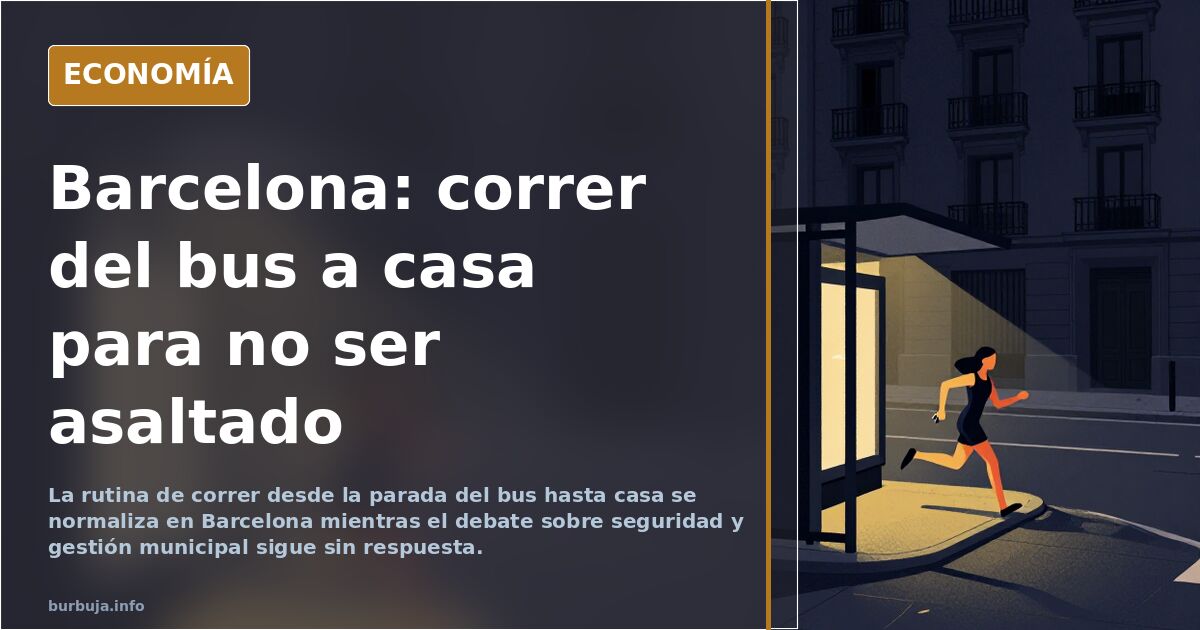
Barcelona: Get off the bus, run home
How long does it take you to get from the bus stop to your front door? In Barcelona, according to accounts spreading among night-time public transport users, the answer is no longer measured in minutes but in strides. The scene describing the issue is always the same: the traveler gets off the bus, looks both ways, and starts running until they reach their building entrance. It isn't sport. It's precaution. The discussion generated by this phenomenon mixes citizen security, public transport, and an uncomfortable question: why has such a basic routine as returning home become a race?
The matter begins with a report from Okdiario about that nighttime habit among the city's youth. From there, the exchange derives into three fronts: real safety on the streets, political management by the City Council (Ayuntamiento), and comparison with other eras. And in all of them, the same pattern appears: the feeling that the problem is not named for what it is.
What is known about the routine of running from the stop
The starting point is news describing how young people in Barcelona, upon getting off the bus at night, cover the stretch to their home at a sprint. The practice has become so normalized that it is no longer commented on: it is simply executed. Running from the stop to the entrance is, for a part of the population, the safest way to cover the last few meters.
Two competing explanations appear in the exchange. One points to a real increase in insecurity in certain areas and times. Another argues that it is a perception amplified by available information. What is striking is that neither clearly prevails, and both coexist in the same conversation without resolution.
Some add an economic nuance: taking a taxi home is not always an alternative. Finding one at certain hours, and having the alucinación be affordable, is described as little less than a lottery. The result is that the bus becomes the only viable option, and the run, the mandatory complement.
Public transport as the final leg of an unsafe journey
The discussion on taxis deserves its own section. It is argued that, depending on the time and area, locating an available vehicle can take half an hour. And that the price, split among several occupants, does not always compensate compared to the bus. The conclusion drawn is uncomfortable: public transport covers the route, but not the last stage.
That last stage is precisely the one that is run. It is not a minor detail. It means that the bus network functions as mobility infrastructure but leaves a gap that the user fills with their own legs. And that this gap concentrates in night hours and in certain neighborhoods.
Against this, another current of opinion holds that the city remains walkable and that the perception of danger does not correspond with the data. The discrepancy is not closed. What is clear is that the conversation has stopped being about transport and has shifted to being about security.
Comparison with the eighties and the nostalgia argument
A part of the exchange appeals to memory. It is stated that in past decades one could go out at night and return on foot without a sense of risk, even in then-degraded neighborhoods. Those who hold this position describe nighttime journeys by bus and on foot as normal, contrasting that experience with the current scene of running from the stop.
The response to that argument comes via another route: nostalgia is not data. It is recalled that the perception of security depends on the area, the profile of the person walking, and the available information. A neighborhood unattractive for theft does not generate the same experience as an affluent residential zone, hence why testimonies differ so much.
The exchange also gets tangled in a historical discussion on public order legislation and its validity, with references to norms from the thirties and their subsequent application. This is the point where the conversation loses focus on Barcelona and turns into a settling of scores over security models. For the reader seeking to understand the nighttime routine, that segment adds little: it confirms that the matter has been completely politicized.
Who manages the city and what is demanded of them
The third front is political. The municipal government and the forces supporting it are pointed to as responsible for the situation, arguing that applied policies have not solved the problem. Criticism is formulated in terms of management: police presence, cleaning of certain areas, and response to incidents.
The rebuttal is not articulated in the material. What does appear is a current attributing the phenomenon to broader dynamics, difficult to solve with local measures. And a third position, minority but persistent, asking to stop discussing acronyms and start talking about results: if people run to get home, something isn't working, whoever governs.
The exchange also slips in comparisons with other cities, with the idea that the problem is not exclusive to Barcelona. That line is noted but not developed. It remains as an open hypothesis: if the phenomenon repeats in other capitals, the local explanation falls short.
The detail nobody disputes: the run is real
Amid so much disagreement, there is a tacit point of agreement. Nobody denies that the practice exists. Its cause, scope, and culprit are debated, but not the fact itself. And that fact has a practical consequence that does appear in the material: returning home has become an unwanted physical activity.
There are even those who look for the bright side, with irony: more sport, more cardiovascular health. The joke works because the underlying reality is not funny. A nighttime routine consisting of sprinting to the entrance is not a training plan, it is an adaptation to the environment.
The conversation reaches no operational conclusion. There are no concrete proposals, nor official data to settle the dispute, nor a date when the matter will be resolved. Only the confirmation that, when returning home, a part of Barcelona's youth no longer walks. They run. And that nobody has yet explained why that seems normal to them.
Also available in: Deutsch
Summary of a discussion on Burbuja.info - Foro de economía, actualidad y política., translated from Spanish and reviewed before publication. Read the full discussion (140 replies).
More summaries
-
Why is public transport immune to inflation? Spain shows the hidden cost
Public transport fares aren't rising because they're subsidized with taxes. Data from Madrid and Barcelona show that you're the one actually paying the real cost.
-
Sánchez targets wealth tax, criticizes Lamborghini sales
Sánchez proposes taxing the wealthy and criticizing Lamborghinis: only 46 sold annually in Spain, with a rich threshold of €30,000 gross.
-
Car status symbol vs degraded public transport in Spain
In Spain, public transport is increasingly seen as a service for those who cannot afford cars, highlighting a social divide.
-
Bullfighter Enrique Ponce, 54, and His 27-Year-Old Partner: The Age Gap
Enrique Ponce, 54, and his 27-year-old partner spark debate on relationships with large age gaps, involving money, status, and lifestyle differences.
-
From Nordic noir to Pradera: the canon that really hooks readers
From the noir of Lapidus and Larsson to Víctor Pradera's doctrine: the canon sought by readers who have already devoured every bestseller.
-
The collapse narrative: riots, megaprisons and the shadow of Bukele
Riots in France, protests in Italy and a general strike in Spain: the collapse narrative spreads as megaprisons advance across Europe.