
The collapse narrative: riots, megaprisons and the shadow of Bukele
Riots in France, protests in Italy and a general strike in Spain: the collapse narrative spreads as megaprisons advance across Europe.
English · Original discussion in Spanish · Published
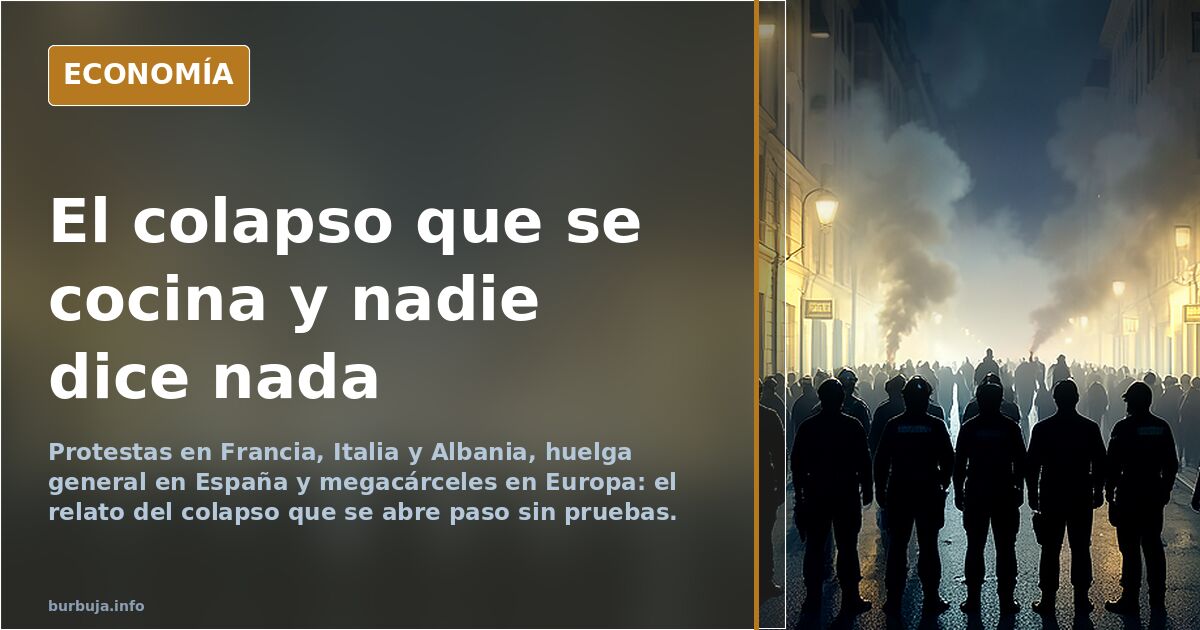
The collapse narrative: riots, megaprisons and the shadow of Bukele
The wave of riots in France, the surge in protests in Italy and the general strike called in Spain are no longer isolated phenomena but have become the new European political landscape. Over the past five days, an analysis circulating in economic forums has argued that these outbreaks are not spontaneous, but part of a choreography designed to erode governments and prepare the ground for a tougher state. The thesis, which mixes real data with suspicions that are hard to verify, points to a pattern: first chaos, then the social demand for order, and finally the perfect excuse to deploy the state's monopoly on violence.
The diagnosis is not new, but the context gives it a fresh coat of paint. European public debt, cuts to healthcare and education, and the feeling that national governments cannot manage simultaneous crises feed a narrative that finds an echo at both ends of the spectrum. The megaprison appears in the conversation as the flagship infrastructure of that future: Belgium and France are already building large-capacity prison complexes, and in Spain there is speculation that the model may end up in the hands of investment funds. The example of El Salvador, with its state of emergency and its mass prisons, creeps into the discussion as an uncomfortable mirror: some see it as a solution, others as a warning.
El Salvador has become the dialectical battleground. While part of the forum argues that Bukele's model has drastically reduced crime, another warns that it is a recidivism factory: if the private operator is paid per occupied cell, the incentive is to fill the prisons, not to empty them. The discussion drifts toward the role of companies that run prisons and their business logic, an issue that remains taboo in Europe.
The conversation has also drifted toward the loudspeakers amplifying the narrative. Names like Iker Jiménez or Rubén Gisbert appear as examples of communicators who, according to this reading, turn frustration into disinformation. Distrust of traditional media mixes with suspicion of foreign interference, and the result is a cocktail that is hard to untangle.
What lies behind the wave of protests in Europe?
The riots in France are not a new phenomenon, but their coincidence with the protests in Italy and the general strike in Spain has set off the alarms. In the analysis that has taken hold in certain circles, these episodes would be part of a coordinated strategy to destabilize governments and force a change of cycle. The available evidence is fragmentary: there is no proof of a central command, but there is a pattern of social discontent that feeds on itself. The housing crisis, inflation and the deterioration of public services are the breeding ground. The question is whether the unrest is spontaneous or engineered.
The megaprison business and the Bukele model
The construction of megaprisons in Europe is already underway. Belgium and France have announced large-capacity projects, and in Spain there is speculation about private capital entering prison management. The model creates a perverse incentive: if the state pays per occupied cell, the private operator earns more the more prisoners there are. The case of El Salvador, with its state of emergency and its maximum-security megaprison, has become the recurring example. For some, it is proof that the iron fist works; for others, it is a recidivism factory that perpetuates the business.
Who is behind the disinformation?
The conversation about collapse is accompanied by growing distrust of the media. Names like Iker Jiménez or Rubén Gisbert are singled out as loudspeakers amplifying antiestéticar and frustration. Suspicion of foreign interference mixes with criticism of national governments, and the result is a narrative that feeds on itself. The line between information and propaganda blurs, and citizens are left trapped in a labyrinth of contradictory versions.
The analysis gets stuck at one point: if the chaos is orchestrated, who has the capacity to orchestrate it? The answer lies not in the data, but in how it is interpreted. And there, everyone picks their side.
Also available in: Deutsch
Summary of a discussion on Burbuja.info - Foro de economía, actualidad y política., translated from Spanish and reviewed before publication. Read the full discussion (161 replies).
More summaries
-
Riots hit Marseille, Paris, Nice and Grenoble on October 24
Videos on social media show police charges in Marseille and Paris, clashes in Nice and looting in Grenoble. There are no official figures on arrests or injuries.
-
Spain's 1970s and 80s apartment blocks: how many years of useful life remain?
Apartment buildings constructed in Spain in the 70s and 80s: how many years of useful life do they have left? We analyse construction quality and the problems.
-
Trump claims angry migrants are invading Spain, without any data
Trump said "hundreds of thousands" of "angry" people had entered Spain and tied it to a problem. We examine the quote, its context and its economic reading.
-
Chaos breaks out in Prague as protesters storm Parliament
A post on X shows protests in Prague with demonstrators trying to enter the Parliament building. What is known about the Czech context.
-
October ends without the expected crash: riots in several capitals
October ends without the announced crash: riots in Paris, Milan and Barcelona, early elections and terraces full at 27 degrees. The collapse will have to wait.
-
Franco turned Spain's renters into owners, but the PSOE has reversed it
The Obra Sindical del Hogar built much of Spain's pre-1980 housing stock. How many affordable homes are there today, and who builds them?