
Barbate: 'Fire in the air' order and rubber boat
Footage before Barbate guard killings shows 'fire in the air' order and lack of resources against drug traffickers.
English · Original discussion in Spanish · Published
Barbate: 'Fire in the air' order and rubber boat
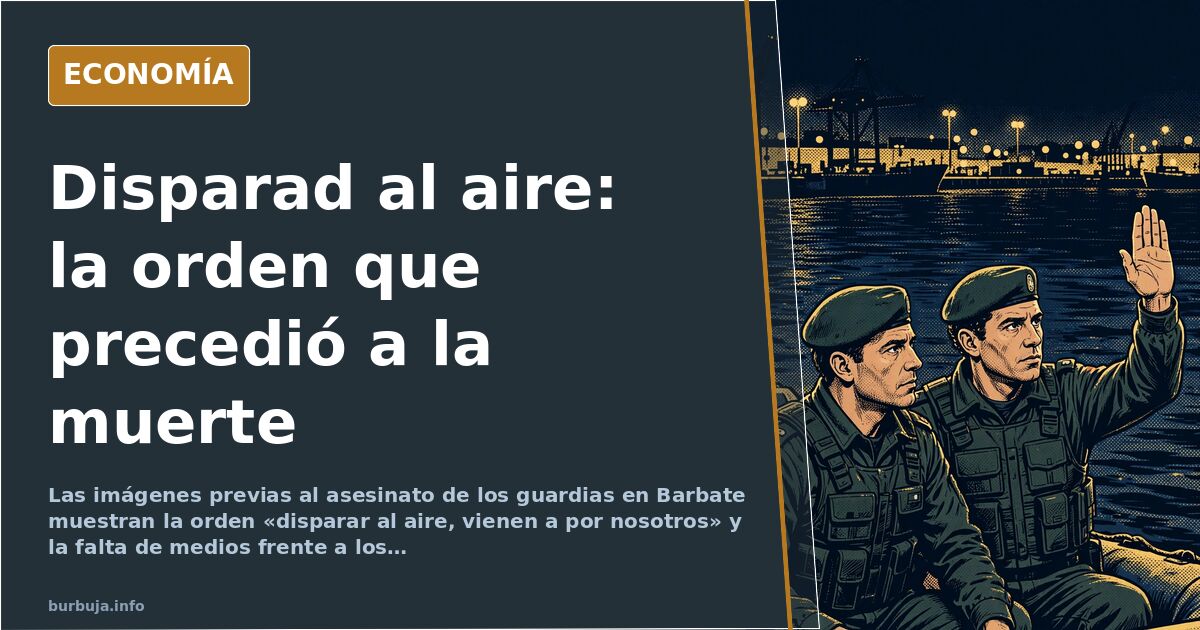
Images preceding the murder of Civil Guards in Barbate highlight a phrase that sums it all up: someone orders "fire in the air, they are coming for us." The sequence, released by Vozpópuli, shows agents in an inflatable boat facing a drug trafficker's vessel with multiple engines. In eight or ten seconds, according to reports on the footage, no one draws their weapon. The result is known: two officers dead and a third injured.
The timeline is set by the material itself: debate opens on images prior to the killing. What remains is a pattern repeated every anniversary: tribute, posthumous medal, and no operational explanation.
What do the pre-killing images from Barbate show?
The original report, signed by Vozpópuli, relies on body cameras worn by the agents. Audio captures the order to fire into the air as the traficante boat approaches. The disparity in means is key: a six-meter vessel versus another with three or four engines. It is not a chase; it is a trap.
Some argue firing into the air was the only regulatory option. Counterarguments state that warning shots do not deter those already intent on ramming. Debate shifted quickly to incentives: the agent who fires faces disciplinary proceedings; the one who does not, risks death. This system, critics say, rewards the latter.
Why did agents not shoot at the traffickers?
The dominant answer involves professional calculation. A Civil Guard using their weapon against a suspect enters a procedure that could lead to suspension or worse, while the trafficker who rams them faces no immediate equivalent consequences. This asymmetry is the core issue.
This calculation appears in various testimonies: salary, mortgage, car payments. It is not cowardice, but exposure. The order to fire into the air turns weapons into decorative objects. Consequently, the trafficker's boat becomes a battering ram.
Rubber boat deployment: who ordered it and who took responsibility?
Criticism targets not the agents, but whoever ordered intervention with such inadequate means. The chain of command is implicated without naming individuals: references are made to command heads, offices, and medals. No one resigns. The third injured guard recovers, as hoped, but the structure remains unchanged.
Comparisons with other forces and eras appear frequently. The underlying idea is that the authority backing older agents no longer exists, at least against incivil. Without this support, the uniform only intimidates law-abiding citizens.
Traficante-state: debate on who protects whom
Hardest accusations circulating involve institutional collusion. Some claim drug trafficking goes unchecked because officials profit, leaving enforcement for small-time dealers. This thesis appears as suspicion rather than proven fact, supported by perceived impunity of fast boats.
Conversely, others warn against confusing criticism with conspiracy: the problem lies in resources, doctrine, and incentives, not necessarily complicity. Calls for Navy intervention, reported by Okdiario, point this way: if the Civil Guard cannot act, let those with ships do so.
Marlaska resignation and vacancies for fallen agents
Questions persist unanswered: after the uproar, no resignations or legal changes occurred. Vacancies for deceased agents are filled quickly, according to bitter accounts, while danger pay claims are processed while bodies are still warm. Criticism of politicians mixes with criticism of the force itself.
No final resolution arrives. What remains is the scene: a rubber boat, an order to fire into the air, and a question no one answers aloud. If the State does not back those who shoot, who boards the next boat?
Images preceding the murder of Civil Guards in Barbate highlight a phrase that sums it all up: someone orders "fire in the air, they are coming for us." The sequence, released by Vozpópuli, shows agents in an inflatable boat facing a drug trafficker's vessel with multiple engines. In eight or ten seconds, according to reports on the footage, no one draws their weapon. The result is known: two officers dead and a third injured.
The timeline is set by the material itself: debate opens on images prior to the killing. What remains is a pattern repeated every anniversary: tribute, posthumous medal, and no operational explanation.
What do the pre-killing images from Barbate show?
The original report, signed by Vozpópuli, relies on body cameras worn by the agents. Audio captures the order to fire into the air as the traficante boat approaches. The disparity in means is key: a six-meter vessel versus another with three or four engines. It is not a chase; it is a trap.
Some argue firing into the air was the only regulatory option. Counterarguments state that warning shots do not deter those already intent on ramming. Debate shifted quickly to incentives: the agent who fires faces disciplinary proceedings; the one who does not, risks death. This system, critics say, rewards the latter.
Why did agents not shoot at the traffickers?
The dominant answer involves professional calculation. A Civil Guard using their weapon against a suspect enters a procedure that could lead to suspension or worse, while the trafficker who rams them faces no immediate equivalent consequences. This asymmetry is the core issue.
This calculation appears in various testimonies: salary, mortgage, car payments. It is not cowardice, but exposure. The order to fire into the air turns weapons into decorative objects. Consequently, the trafficker's boat becomes a battering ram.
Rubber boat deployment: who ordered it and who took responsibility?
Criticism targets not the agents, but whoever ordered intervention with such inadequate means. The chain of command is implicated without naming individuals: references are made to command heads, offices, and medals. No one resigns. The third injured guard recovers, as hoped, but the structure remains unchanged.
Comparisons with other forces and eras appear frequently. The underlying idea is that the authority backing older agents no longer exists, at least against incivil. Without this support, the uniform only intimidates law-abiding citizens.
Traficante-state: debate on who protects whom
Hardest accusations circulating involve institutional collusion. Some claim drug trafficking goes unchecked because officials profit, leaving enforcement for small-time dealers. This thesis appears as suspicion rather than proven fact, supported by perceived impunity of fast boats.
Conversely, others warn against confusing criticism with conspiracy: the problem lies in resources, doctrine, and incentives, not necessarily complicity. Calls for Navy intervention, reported by Okdiario, point this way: if the Civil Guard cannot act, let those with ships do so.
Marlaska resignation and vacancies for fallen agents
Questions persist unanswered: after the uproar, no resignations or legal changes occurred. Vacancies for deceased agents are filled quickly, according to bitter accounts, while danger pay claims are processed while bodies are still warm. Criticism of politicians mixes with criticism of the force itself.
No final resolution arrives. What remains is the scene: a rubber boat, an order to fire into the air, and a question no one answers aloud. If the State does not back those who shoot, who boards the next boat?
Also available in: Deutsch
Summary of a discussion on Burbuja.info - Foro de economía, actualidad y política., translated from Spanish and reviewed before publication. Read the full discussion (112 replies).
More summaries
-
Spain's Civil Guard associations demand Marlaska resign
Civil Guard unions in Spain call for Interior Minister Marlaska to resign after two agents died in Barbate, warning him not to attend the funeral.
-
Viral video falsely attributed to widow of Spanish Civil Guard officer
A video claimed to be from the widow of a Civil Guard killed in Barbate lacks identity proof, and the original tweet has been deleted.
-
Darwin Case in Barbate: Negligence No One Accepts
A circulating calculation claims the Civil Guard boat weighed ten times less than the rigid inflatable it hit. Analysis points to negligence.
-
Barbate reignites debate on using lethal force against drug smugglers
After two civil guards were killed by a drug boat, Spain reopens the debate on authorizing lethal force against smugglers in the Strait of Gibraltar.
-
Hollywood Walk of Fame Becomes Fentanyl Crisis Symbol
Viral images of Hollywood Boulevard described as a horror film fuel US debates on fentanyl and urban policy.
-
Reheated Oil Causes Liver and Brain Damage in Rats
Study on rats fed reheated sesame and sunflower oil reveals liver inflammation, colon damage, and neurodegeneration in offspring.