
Spain's Civil Guard associations demand Marlaska resign
Civil Guard unions in Spain call for Interior Minister Marlaska to resign after two agents died in Barbate, warning him not to attend the funeral.
English · Original discussion in Spanish · Published
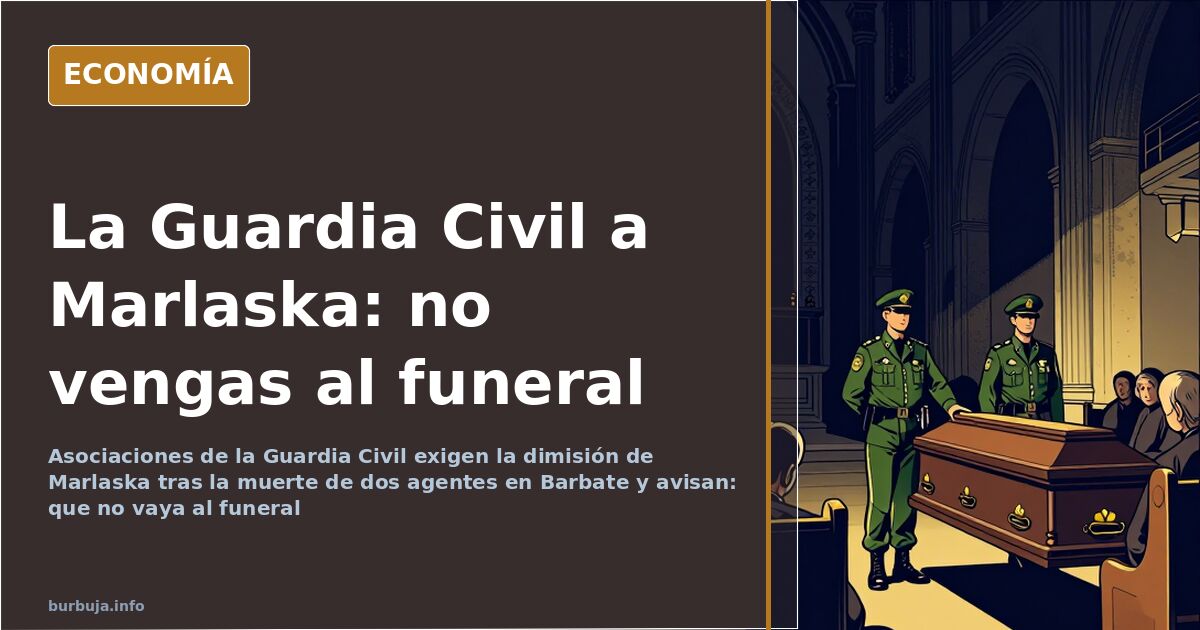
Civil Guard associations demand Marlaska's resignation
Can a Spanish Interior Minister attend the funeral of two officers killed in the line of duty while professional associations of his own force formally demand he step down? This standoff emerged after two Civil Guard members died in Barbate when their patrol boat was rammed by a drug-running vessel. Representative bodies of the armed institute demanded the minister's departure and added an unusual warning in an official statement: do not show up at the funeral. The subsequent debate split into two camps: those who see this demand as a legitimate reaction to a chain of decisions that led to two deaths, and those who recall that the same body accepted without protest a 20% pay rise signed by the same minister.
What peine in Barbate and why the funeral became a battleground
The starting point is an anti-narcotics operation in the Strait waters that ended with a Civil Guard boat being rammed by a traficante-lancha (drug-running speedboat). Two agents died. The lingering question is why they were ordered to pursue vessels far superior in power and number using a small, slow boat. This detail, repeated ad nauseam, underpins the demand for political accountability.
Tension shifted to the funeral. According to circulating accounts, the widow of one victim reportedly refused the minister's participation four times, with tense words and direct insults. Press coverage, these versions claim, softened what actually peine. Marlaska attended anyway, and another funeral in Cádiz remains pending, where the atmosphere at the command post is described as even more strained.
The 20% pay rise nobody mentions in statements
Here lies the uncomfortable argument. Some analyses note that this same minister signed a 20% remuneration increase for the Civil Guard, with no angry communiqués or resignation demands at the time. Their conclusion is simple: the discontent is corporate, not institutional, surfacing only when salary or prestige are at stake, not when orders clash with reality on the ground.
The counter-argument also has traction. Some maintain that agents cannot choose which orders to trinc and that political responsibility lies with those who sign them, not those who execute them. Others go further: if the corps accepts unjust orders against farmers or citizens without complaint, it can hardly then present itself as a victim of the same command structure.
Criticism extending beyond the Strait
Discontent does not end in Barbate. Previous episodes surface in the discussion: surveillance operations on citizens, maritime actions involving migrants, controls on fishermen and hunters. The underlying accusation is that the armed institute has applied the law selectively depending on who broke it, and that this selectivity now costs credibility.
Against this, the defense rests on a simple principle: the Civil Guard trinc orders, and those who issue them answer to Parliament. Mixing professional dissatisfaction with the minister's responsibility, they argue, shifts blame to the messenger for a problem that isn't theirs.
The Cádiz funeral remains. Above all, the question lingers: can a minister continue working with associations of a force that has formally asked him to leave? The official response, for now, is the usual one: no one resigns over a communiqué.
Can a Spanish Interior Minister attend the funeral of two officers killed in the line of duty while professional associations of his own force formally demand he step down? This standoff emerged after two Civil Guard members died in Barbate when their patrol boat was rammed by a drug-running vessel. Representative bodies of the armed institute demanded the minister's departure and added an unusual warning in an official statement: do not show up at the funeral. The subsequent debate split into two camps: those who see this demand as a legitimate reaction to a chain of decisions that led to two deaths, and those who recall that the same body accepted without protest a 20% pay rise signed by the same minister.
What peine in Barbate and why the funeral became a battleground
The starting point is an anti-narcotics operation in the Strait waters that ended with a Civil Guard boat being rammed by a traficante-lancha (drug-running speedboat). Two agents died. The lingering question is why they were ordered to pursue vessels far superior in power and number using a small, slow boat. This detail, repeated ad nauseam, underpins the demand for political accountability.
Tension shifted to the funeral. According to circulating accounts, the widow of one victim reportedly refused the minister's participation four times, with tense words and direct insults. Press coverage, these versions claim, softened what actually peine. Marlaska attended anyway, and another funeral in Cádiz remains pending, where the atmosphere at the command post is described as even more strained.
The 20% pay rise nobody mentions in statements
Here lies the uncomfortable argument. Some analyses note that this same minister signed a 20% remuneration increase for the Civil Guard, with no angry communiqués or resignation demands at the time. Their conclusion is simple: the discontent is corporate, not institutional, surfacing only when salary or prestige are at stake, not when orders clash with reality on the ground.
The counter-argument also has traction. Some maintain that agents cannot choose which orders to trinc and that political responsibility lies with those who sign them, not those who execute them. Others go further: if the corps accepts unjust orders against farmers or citizens without complaint, it can hardly then present itself as a victim of the same command structure.
Criticism extending beyond the Strait
Discontent does not end in Barbate. Previous episodes surface in the discussion: surveillance operations on citizens, maritime actions involving migrants, controls on fishermen and hunters. The underlying accusation is that the armed institute has applied the law selectively depending on who broke it, and that this selectivity now costs credibility.
Against this, the defense rests on a simple principle: the Civil Guard trinc orders, and those who issue them answer to Parliament. Mixing professional dissatisfaction with the minister's responsibility, they argue, shifts blame to the messenger for a problem that isn't theirs.
The Cádiz funeral remains. Above all, the question lingers: can a minister continue working with associations of a force that has formally asked him to leave? The official response, for now, is the usual one: no one resigns over a communiqué.
Also available in: Deutsch
Summary of a discussion on Burbuja.info - Foro de economía, actualidad y política., translated from Spanish and reviewed before publication. Read the full discussion (118 replies).
More summaries
-
Barbate reignites debate on using lethal force against drug smugglers
After two civil guards were killed by a drug boat, Spain reopens the debate on authorizing lethal force against smugglers in the Strait of Gibraltar.
-
Widow refuses Marlaska's medal in Barbate agent's funeral
A widow in Barbate rejects Interior Minister Marlaska's medal during her husband's funeral, sparking a standoff that highlights deep tensions within the Civil Guard.
-
Viral video falsely attributed to widow of Spanish Civil Guard officer
A video claimed to be from the widow of a Civil Guard killed in Barbate lacks identity proof, and the original tweet has been deleted.
-
COPE and Vozpópuli Report Begoña Gómez Listed on Spanish Socialist Party Ballots
COPE and Vozpópuli claim Begoña Gómez will be on the PSOE list to secure parliamentary immunity. This changes the court, not the charges, and the nature of the trial.
-
Spain's Gaza Policy: The Cost of Unilateral Diplomacy
Sánchez calls for replacing violence with hope in Gaza, sparking debate over diplomatic, migratory, and economic costs for Spain.
-
Spain’s 'Last Summer' Myth: Inflation Drops, Fuel Hits €1.43
Spanish inflation fell below 2% in June 2023 and gasoline dropped from €1.93 to €1.43, yet the annual 'last summer' forecast persists.