
Banco de Spain hires tech experts for the crypto era
Brussels publishes the MiCA draft as the Banco de España creates new departments and recruits tech profiles to monitor crypto-assets.
English · Original discussion in Spanish · Published
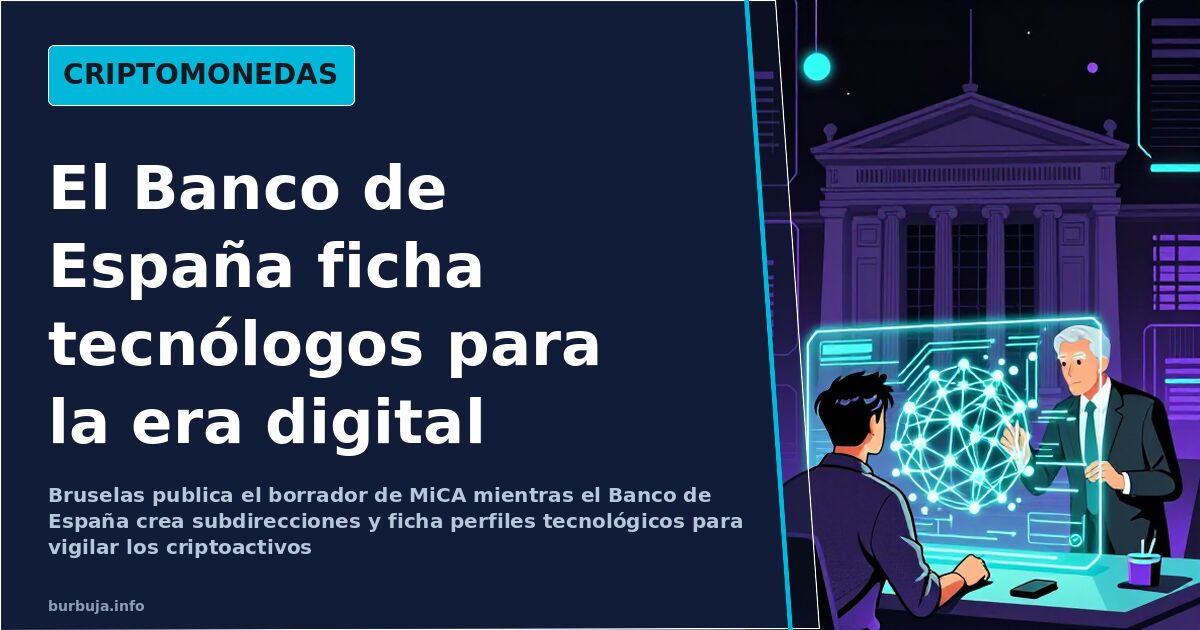
Banco de España hires technologists to monitor crypto-assets
Anyone warning that crypto-assets can create parallel channels for transferring value first needs people capable of reading them. The Banco de España (Spain's central bank) has created new departments, renamed others and brought tech profiles into its workforce — IT, infrastructure design, information and communication technologies — under its 2024 Strategic Plan. In parallel, Brussels has already published the draft of MiCA (Markets in Crypto Assets), the first regulation aimed at bringing order to a market that today falls outside European law.
The contradiction is the news. The same supervisor that warns of the risk is hiring technicians so as not to lose track of it; the same market presumed to be decentralised depends on someone translating it into rules. And it is no minor detail: crypto-assets are neither issued nor guaranteed by a central bank or a public authority, so no one answers for them when things go wrong.
What does the MiCA draft regulate?
MiCA defines which crypto-assets are subject to regulation and sets the minimum transparency and solvency conditions that providers of such services must meet. The planned division of labour leaves supervision of asset-referenced tokens, the so-called stablecoins, in the hands of the European Securities and Markets Authority (ESMA), while the European Banking Authority (EBA) would handle e-money tokens.
The diagnosis accompanying the text is the usual one: with no identifiable issuer and no public guarantee, these instruments sit outside EU law, which in the view of European authorities opens the door to risks for consumer protection and financial stability, while also facilitating market manipulation and financial crime. The catalogue is broad: cryptocurrencies, investment tokens and NFTs (non-fungible tokens), the latest twist on the same invention.
The governor's warning: 'bitcoinisation' and parallel channels
The governor of the Banco de España, Pablo Hernández de Cos, has put a name to the antiestéticar: the growth of banks' direct and indirect exposure to these assets. "Bitcoinisation or cryptonisation threatens to create parallel channels for transferring value which, being outside the control of central banks, limit the ability to contain the materialisation of potential systemic risks," he warned. Along the same lines, the European Central Bank has urged that the market be regulated as soon as possible because of the "insecurity" that, in the words of Fabio Panetta, a member of its executive board, these instruments can pose for financial stability.
The Banco de España's own report stresses the mechanics of the risk: the current value of a crypto-asset depends on buyers' and sellers' expectations about its future value, which generates significant market and liquidity risks. In unbacked assets, any shift in mood is immediately reflected in the price, because there is no mechanism to stabilise it. And stablecoins, which do have physical backing, are not exempt either: their degree of interconnection with traditional financial markets makes them a transmission belt if confidence in the ability to convert these instruments into their reference assets fails.
Why part of the market believes the rule is useless
The most repeated argument is technical impotence: a protocol does not ask for permission. The claim is that digital money turns anyone capable of programming something attack-proof into a potential bank, and that legislating on decentralisation reveals a very poor understanding of what the word means. The comparison circulating is domestic: if films travel over decentralised networks and are pursued across the planet, moving capital through those same channels is no historical exception.
There is a more acid reading. Regulation is not meant to protect anyone, according to this camp, but to guarantee the stability of tax revenues; freedoms are fenced off only to be handed back later as privileges for a fee, and anyone competing outside the system is a nuisance because they stop paying the toll. From the other side, some respond that fences always end up going up around the commons, and the cost of ignoring it is paid in courtrooms.
While some debate whether code can be fenced in, the supervisor keeps hiring computer scientists to understand it.
What is at stake for the Banco de España
The institution currently has no regulatory powers over the authorisation of providers, but it performs a supervisory function it considers non-negotiable because it is responsible for safeguarding financial stability. That is why digital transformation, the arrival of new players such as fintechs and Big Tech, and the growing weight of digital assets have become analytical priorities: understanding what is changing in the system before deciding how to regulate it.
The awkward question remains. If code knows no borders and rules do, what exactly is being regulated: the asset, the provider, or the slice of the market someone wants to leave outside?
Anyone warning that crypto-assets can create parallel channels for transferring value first needs people capable of reading them. The Banco de España (Spain's central bank) has created new departments, renamed others and brought tech profiles into its workforce — IT, infrastructure design, information and communication technologies — under its 2024 Strategic Plan. In parallel, Brussels has already published the draft of MiCA (Markets in Crypto Assets), the first regulation aimed at bringing order to a market that today falls outside European law.
The contradiction is the news. The same supervisor that warns of the risk is hiring technicians so as not to lose track of it; the same market presumed to be decentralised depends on someone translating it into rules. And it is no minor detail: crypto-assets are neither issued nor guaranteed by a central bank or a public authority, so no one answers for them when things go wrong.
What does the MiCA draft regulate?
MiCA defines which crypto-assets are subject to regulation and sets the minimum transparency and solvency conditions that providers of such services must meet. The planned division of labour leaves supervision of asset-referenced tokens, the so-called stablecoins, in the hands of the European Securities and Markets Authority (ESMA), while the European Banking Authority (EBA) would handle e-money tokens.
The diagnosis accompanying the text is the usual one: with no identifiable issuer and no public guarantee, these instruments sit outside EU law, which in the view of European authorities opens the door to risks for consumer protection and financial stability, while also facilitating market manipulation and financial crime. The catalogue is broad: cryptocurrencies, investment tokens and NFTs (non-fungible tokens), the latest twist on the same invention.
The governor's warning: 'bitcoinisation' and parallel channels
The governor of the Banco de España, Pablo Hernández de Cos, has put a name to the antiestéticar: the growth of banks' direct and indirect exposure to these assets. "Bitcoinisation or cryptonisation threatens to create parallel channels for transferring value which, being outside the control of central banks, limit the ability to contain the materialisation of potential systemic risks," he warned. Along the same lines, the European Central Bank has urged that the market be regulated as soon as possible because of the "insecurity" that, in the words of Fabio Panetta, a member of its executive board, these instruments can pose for financial stability.
The Banco de España's own report stresses the mechanics of the risk: the current value of a crypto-asset depends on buyers' and sellers' expectations about its future value, which generates significant market and liquidity risks. In unbacked assets, any shift in mood is immediately reflected in the price, because there is no mechanism to stabilise it. And stablecoins, which do have physical backing, are not exempt either: their degree of interconnection with traditional financial markets makes them a transmission belt if confidence in the ability to convert these instruments into their reference assets fails.
Why part of the market believes the rule is useless
The most repeated argument is technical impotence: a protocol does not ask for permission. The claim is that digital money turns anyone capable of programming something attack-proof into a potential bank, and that legislating on decentralisation reveals a very poor understanding of what the word means. The comparison circulating is domestic: if films travel over decentralised networks and are pursued across the planet, moving capital through those same channels is no historical exception.
There is a more acid reading. Regulation is not meant to protect anyone, according to this camp, but to guarantee the stability of tax revenues; freedoms are fenced off only to be handed back later as privileges for a fee, and anyone competing outside the system is a nuisance because they stop paying the toll. From the other side, some respond that fences always end up going up around the commons, and the cost of ignoring it is paid in courtrooms.
While some debate whether code can be fenced in, the supervisor keeps hiring computer scientists to understand it.
What is at stake for the Banco de España
The institution currently has no regulatory powers over the authorisation of providers, but it performs a supervisory function it considers non-negotiable because it is responsible for safeguarding financial stability. That is why digital transformation, the arrival of new players such as fintechs and Big Tech, and the growing weight of digital assets have become analytical priorities: understanding what is changing in the system before deciding how to regulate it.
The awkward question remains. If code knows no borders and rules do, what exactly is being regulated: the asset, the provider, or the slice of the market someone wants to leave outside?
Also available in: Deutsch
Summary of a discussion on Burbuja.info - Foro de economía, actualidad y política., translated from Spanish and reviewed before publication. Read the full discussion (15 replies).
More summaries
-
Europe trials financial tokenization with DLT
The EU activates the DLT Pilot Regime to tokenize financial assets, while MiCA and the digital euro reshape the crypto rulebook. Is Europe ready?
-
Bisq, the P2P Bitcoin Exchange Without KYC, Loses Liquidity
Bisq allows buying Bitcoin without KYC via Tor, but liquidity is plummeting: activity is migrating to HodlHodl and Lightning exchanges.
-
Advcash: The virtual bank promising to dodge tax authorities
Advcash aims to convert crypto to euros discreetly from tax authorities, but user reports suggest Belize shares data with Spain and its cards fail on payment terminals.
-
Bitcoin Without KYC: 1% Fee, But Your Bank Sees the Receipt
Buying bitcoin without email, phone, or name costs 1% and has daily limits. The real issue isn't buying anonymously, but selling later.
-
ScorpBonk ($SCORPBONK) offers 100% extra tokens for purchases over 0.25 BNB
ScorpBonk memecoin launches a 15-day 100% token bonus for buys above 0.25 BNB on BNB Chain, with a fixed supply of 1 billion.
-
US House Committee Advances Crypto Tax Amnesty Step
The US Ways and Means Committee approved a 0% penalty on the first $25,000 of unpaid annual crypto taxes. Here is what it means.