
Advcash: The virtual bank promising to dodge tax authorities
Advcash aims to convert crypto to euros discreetly from tax authorities, but user reports suggest Belize shares data with Spain and its cards fail on payment terminals.
English · Original discussion in Spanish · Published
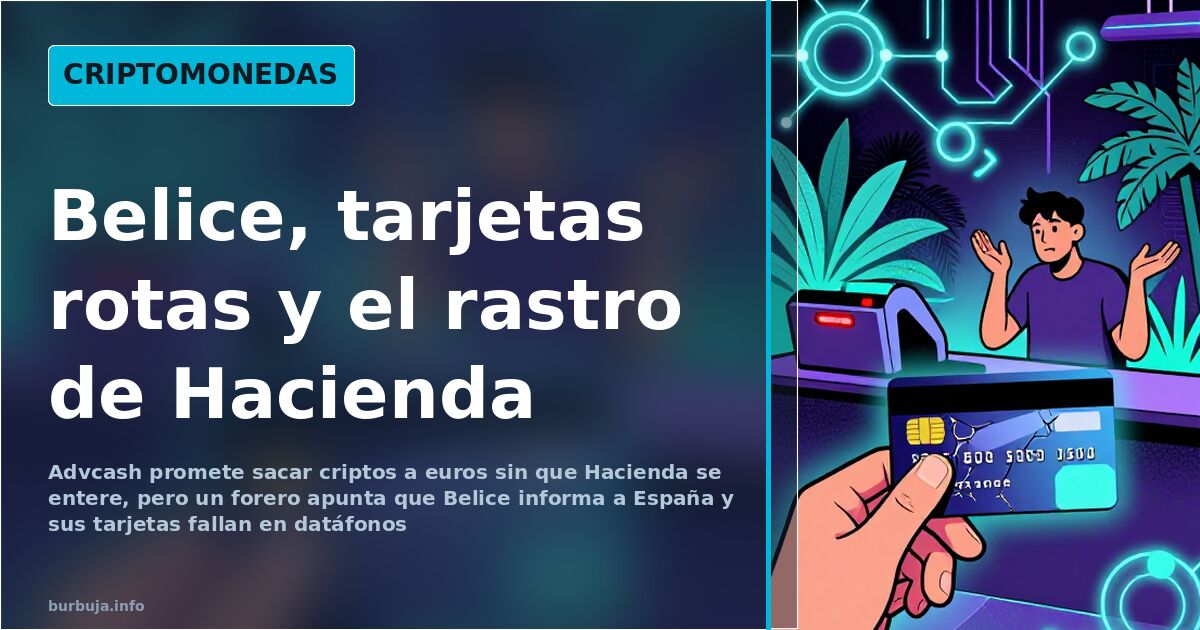
Advcash, the virtual bank promising to dodge tax authorities
A forum user presents a virtual bank in the same old guise: an electronic money institution licensed in Belize and Gibraltar, capable of converting cryptocurrencies into euros and withdrawing them via SEPA or SWIFT transfer without the Spanish Tax Agency noticing. This is how Advcash is presented, a tool for cashing out outside the taxman's reach. On paper, the approach sounds legitimate. In practice, the first to try it encounters a card that isn't even useful for buying bread.
What is Advcash and why was it registered in Belize
Advcash is not a bank in the classic sense. It operates as an electronic money institution, with a financial services license in Belize and another in Gibraltar, two jurisdictions that the service's own promotion openly describes as tax havens. Its utility, they say, lies in converting a wide variety of cryptocurrencies into fiat money, as well as offering transfers and prepaid cards.
The appeal of Belize has a catch. A bank based in a small territory faces challenges in obtaining correspondent accounts: it needs a large institution behind it to accept its transfers, which increases commissions, as another forum user points out. The version from those promoting the service insists that the firm works with Gibraltarian banks, which in theory would give it a European financial passport.
The CRS: Is Belize informing Spain since 2018?
Here's where the real problem begins. The theory that the money remains invisible clashes with what one participant points out: Belize has participated in the CRS automatic information exchange system since 2018, meaning it shares tax data with Spain. Those looking for truly opaque jurisdictions would need to look elsewhere: Georgia or Paraguay, or directly to the United States and its territories, which have not signed the treaty and do not appear likely to do so.
Andorra serves as an example of why such protection is fragile. A territory can be opaque in year X and cease to be so three years later; then the Tax Agency has room to claim previous tax years, and the Spanish tax resident who thought they were safe discovers they were not.
Revolut, N26, and Verse: the report that always arrives
Precedent carries more weight than any promise. A forum user recalls that Revolut, N26, and Verse shared information with the Tax Agency retroactively, after operating for years under the label of a modern and carefree platform. The lesson is simple: a change in an entity's policy is enough to make something that seemed off the radar traceable.
Advcash cards don't work on Spanish payment terminals
The other front is everyday use, and there, things fall apart. Several user tests of those who have ordered them coincide on the same result: Advcash cards, both Visa and Mastercard in euros, work online—Amazon, mobile top-ups—but cannot find a payment terminal in Spain that accepts them. Neither shops, restaurants, nor supermarkets. Those who issue them attribute the failure to the merchants; those who use them, the opposite.
Does the Tax Agency find out, or does it only go after those who don't defend themselves?
Here the ground divides. Some argue that the Tax Agency has less power than it claims and mainly pursues the self-employed and the weak link, because it's quick and profitable. The counter-argument is that it's not about capability, but priorities: systems cross-reference data instantly, and the case is passed from hand to hand until someone decides to act. A forum user adds that tax evasion prescribes after five tax years, and that clock works in favor of those who know how to wait.
With cards blocked in local shops and the doubt about data exchange since 2018, the question is no longer whether the Tax Agency finds out. It's how long it takes for them to want to find out.
A forum user presents a virtual bank in the same old guise: an electronic money institution licensed in Belize and Gibraltar, capable of converting cryptocurrencies into euros and withdrawing them via SEPA or SWIFT transfer without the Spanish Tax Agency noticing. This is how Advcash is presented, a tool for cashing out outside the taxman's reach. On paper, the approach sounds legitimate. In practice, the first to try it encounters a card that isn't even useful for buying bread.
What is Advcash and why was it registered in Belize
Advcash is not a bank in the classic sense. It operates as an electronic money institution, with a financial services license in Belize and another in Gibraltar, two jurisdictions that the service's own promotion openly describes as tax havens. Its utility, they say, lies in converting a wide variety of cryptocurrencies into fiat money, as well as offering transfers and prepaid cards.
The appeal of Belize has a catch. A bank based in a small territory faces challenges in obtaining correspondent accounts: it needs a large institution behind it to accept its transfers, which increases commissions, as another forum user points out. The version from those promoting the service insists that the firm works with Gibraltarian banks, which in theory would give it a European financial passport.
The CRS: Is Belize informing Spain since 2018?
Here's where the real problem begins. The theory that the money remains invisible clashes with what one participant points out: Belize has participated in the CRS automatic information exchange system since 2018, meaning it shares tax data with Spain. Those looking for truly opaque jurisdictions would need to look elsewhere: Georgia or Paraguay, or directly to the United States and its territories, which have not signed the treaty and do not appear likely to do so.
Andorra serves as an example of why such protection is fragile. A territory can be opaque in year X and cease to be so three years later; then the Tax Agency has room to claim previous tax years, and the Spanish tax resident who thought they were safe discovers they were not.
Revolut, N26, and Verse: the report that always arrives
Precedent carries more weight than any promise. A forum user recalls that Revolut, N26, and Verse shared information with the Tax Agency retroactively, after operating for years under the label of a modern and carefree platform. The lesson is simple: a change in an entity's policy is enough to make something that seemed off the radar traceable.
Advcash cards don't work on Spanish payment terminals
The other front is everyday use, and there, things fall apart. Several user tests of those who have ordered them coincide on the same result: Advcash cards, both Visa and Mastercard in euros, work online—Amazon, mobile top-ups—but cannot find a payment terminal in Spain that accepts them. Neither shops, restaurants, nor supermarkets. Those who issue them attribute the failure to the merchants; those who use them, the opposite.
Does the Tax Agency find out, or does it only go after those who don't defend themselves?
Here the ground divides. Some argue that the Tax Agency has less power than it claims and mainly pursues the self-employed and the weak link, because it's quick and profitable. The counter-argument is that it's not about capability, but priorities: systems cross-reference data instantly, and the case is passed from hand to hand until someone decides to act. A forum user adds that tax evasion prescribes after five tax years, and that clock works in favor of those who know how to wait.
With cards blocked in local shops and the doubt about data exchange since 2018, the question is no longer whether the Tax Agency finds out. It's how long it takes for them to want to find out.
Summary of a discussion on Burbuja.info - Foro de economía, actualidad y política., translated from Spanish and reviewed before publication. Read the full discussion (110 replies).
More summaries
-
Ethereum falls back to $1,570 and the safe-haven narrative cracks
Ethereum is back at its 2018 level of $1,570 and daily losses reach 9%: the crypto safe-haven narrative is cracking.
-
Bitcoin vs. gold: what a decade of data reveals
Mt. Gox's bankruptcy with 18.6 million in debt sparked the debate over whether bitcoin or gold is the better savings vehicle
-
A fake Chrome extension empties a €100 wallet
A fake plugin posing as the official wallet was enough to lose just over €100. Google Play only removed the app after the victim reported it.
-
The Economist and the 4 cryptocurrencies on its cover
The Economist puts Bitcoin, Ethereum, Litecoin and Cardano on its cover, a reading some see as a 2022 prediction. According to one participant…
-
Solana goes 20 hours without producing blocks and restarts its network
Solana goes 20 hours without blocks, restarts its mainnet and faces 18,77 million SOL unlocked and 75% failed transactions
-
Pi Network burns coins from unverified accounts
Pi Network closed its grace period on March 14: those who did not verify their accounts lost their mined coins, with losses of thousands of dollars.