
Baking soda and 96% alcohol: Spain's remedies for foot odor
Paper in shoes fails, but baking soda and high-proof alcohol have supporters. An analysis of the causes and treatments for smelly feet.
English · Original discussion in Spanish · Published
96% Alcohol, Baking Soda, and Vaseline: The War Against Foot Odor
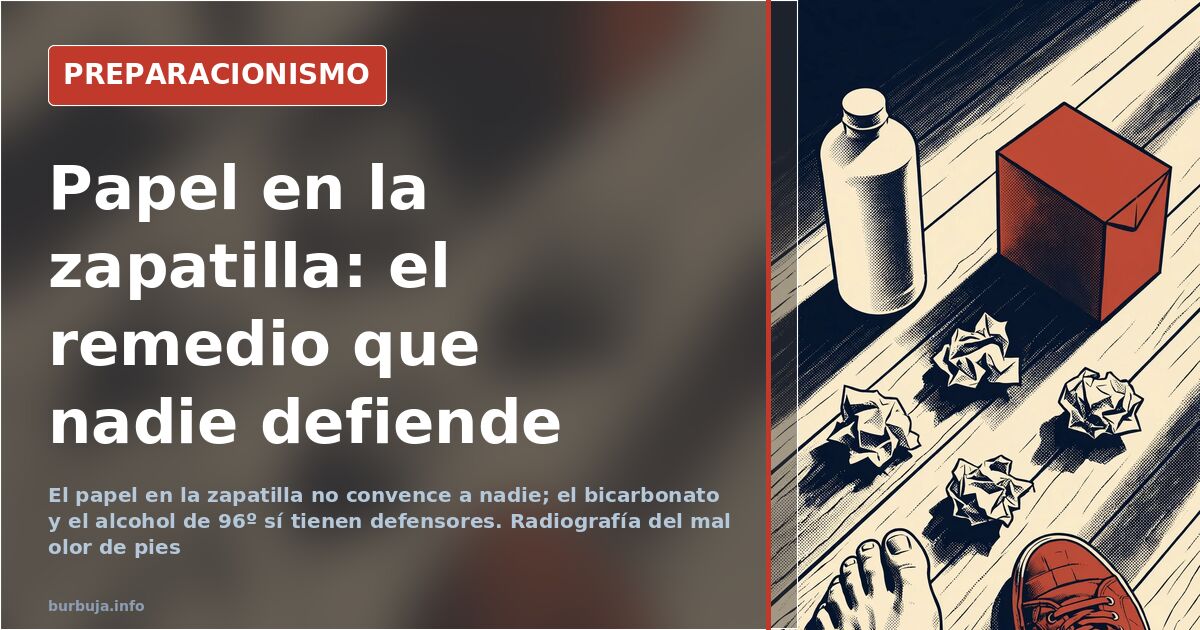
Putting paper inside a shoe, letting it absorb the smell, and throwing it away every few minutes. This proposal, presented as a home experiment, starts from simple logic: if the paper traps the stench and ends up in the trash, the footwear should remain clean. It was impossible to defend this method. The first response was the most basic, almost a surrender: take a shower.
Foot odor is an old problem, theoretically cheap to solve but surprisingly difficult to fix in practice. That is why the discussion shifted toward baking soda, 96-degree alcohol, boric acid, vaseline, and some methods best not tried even out of curiosity.
Why do feet smell? The clue lies in pH
The most repeated explanation points to gases emitted by bacteria feeding on secretions, always in an acidic environment. If the medium is acidic, any base corrects it. Hence, sodium bicarbonate appears again and again as a domestic solution: applied after showering on feet and armpits, left to act.
It is a reasonable and widely cited explanation, not a diagnosis. The primary factor remains another: washing properly, which is not the same as just getting wet.
Soap between toes and cotton socks (80-100%)
"When you shower, falling water isn't enough; you must soap your feet, especially between the toes." This phrase summarizes the most common mistake: believing water does the work alone. Between the toes and under the nails accumulates what later ferments.
From there, a protocol rarely disputed: socks of 80% or 100% cotton, never synthetic fibers, which absorb poorly and retain bad odors; never reuse them; take them off upon arriving home. And if the shoes already stink, use the washing machine or throw them away. Some add anti-humidity powders inside the shoe, while others recommend airing them out thoroughly.
Baking soda, boric acid, talcum powder, and vaseline
Baking soda even has a protocol: one tablespoon inside each shoe, let it sit for two or three days, shake out excess over the bathtub, and finish with a clean cloth. Cheap, slow, and with no known side effects.
Boric acid generates more enthusiasm: a white powder attributed almost miraculous efficacy. Here, caution is needed. The conversation itself recalls that it has been banned since 1982 as a preservative for certain foods due to toxicity if ingested. Mixing enthusiasm with a toxic product is a bad combination, and any use on the skin should first be approved by a healthcare professional.
Those who recommend talcum powder argue it works while used, but leaves the interior whitish, and washing it to recover the shoe ruins its lifespan. Pure vaseline after showering has a different profile: more oriented towards preventing blisters than odor, with the Camino de Santiago often cited as evidence. Coconut oil slips into the list due to its claimed fungicidal effect.
96% Alcohol: 96% ethanol and 4% water
96-degree ethyl alcohol is the most repeated recommendation for a quick attack. Where you buy it doesn't matter, insists one of the most vocal proponents. A few rubs and the stench disappears instantly. The doubt about what that 96% represents has an answer: nearly pure ethanol, with 4% water as the only remainder. The reason given is that it wipes out bacteria, just as it disinfects.
Then there are methods that shouldn't leave the bar counter. Diluted chlorine dioxide is advertised as a selective germ killer and, while at it, a cure for ELbichito. There is no evidence supporting any of that: the claim itself is a known hoax. Cyclon-B with a gas mask is a joke; cutting off your feet is another. Their repetition indicates how little the issue is resolved.
Cases that don't fit the theory
Not everything is explained by lack of hygiene. Some recount that a pair of leather shoes started smelling isolatedly—the rest were clean—until leaving them outside with a spray solved the problem. The forum user described it as if the shoe had become infected internally.
Harder is the account of a forum user about an acquaintance who lived on the street for almost a year and ended up in a shelter. Showered, with new una manola and slippers, he still stank. Second shower. Same stench. The person attending him thought he was mocking her. It is a testimony without further data, but it dismantles the idea that everything is fixed with soap.
With this material, the conclusion is uncomfortable: foot odor is controlled almost always, not always. What if the problem isn't dirt, but something that stays inside and cannot be seen?
Putting paper inside a shoe, letting it absorb the smell, and throwing it away every few minutes. This proposal, presented as a home experiment, starts from simple logic: if the paper traps the stench and ends up in the trash, the footwear should remain clean. It was impossible to defend this method. The first response was the most basic, almost a surrender: take a shower.
Foot odor is an old problem, theoretically cheap to solve but surprisingly difficult to fix in practice. That is why the discussion shifted toward baking soda, 96-degree alcohol, boric acid, vaseline, and some methods best not tried even out of curiosity.
Why do feet smell? The clue lies in pH
The most repeated explanation points to gases emitted by bacteria feeding on secretions, always in an acidic environment. If the medium is acidic, any base corrects it. Hence, sodium bicarbonate appears again and again as a domestic solution: applied after showering on feet and armpits, left to act.
It is a reasonable and widely cited explanation, not a diagnosis. The primary factor remains another: washing properly, which is not the same as just getting wet.
Soap between toes and cotton socks (80-100%)
"When you shower, falling water isn't enough; you must soap your feet, especially between the toes." This phrase summarizes the most common mistake: believing water does the work alone. Between the toes and under the nails accumulates what later ferments.
From there, a protocol rarely disputed: socks of 80% or 100% cotton, never synthetic fibers, which absorb poorly and retain bad odors; never reuse them; take them off upon arriving home. And if the shoes already stink, use the washing machine or throw them away. Some add anti-humidity powders inside the shoe, while others recommend airing them out thoroughly.
Baking soda, boric acid, talcum powder, and vaseline
Baking soda even has a protocol: one tablespoon inside each shoe, let it sit for two or three days, shake out excess over the bathtub, and finish with a clean cloth. Cheap, slow, and with no known side effects.
Boric acid generates more enthusiasm: a white powder attributed almost miraculous efficacy. Here, caution is needed. The conversation itself recalls that it has been banned since 1982 as a preservative for certain foods due to toxicity if ingested. Mixing enthusiasm with a toxic product is a bad combination, and any use on the skin should first be approved by a healthcare professional.
Those who recommend talcum powder argue it works while used, but leaves the interior whitish, and washing it to recover the shoe ruins its lifespan. Pure vaseline after showering has a different profile: more oriented towards preventing blisters than odor, with the Camino de Santiago often cited as evidence. Coconut oil slips into the list due to its claimed fungicidal effect.
96% Alcohol: 96% ethanol and 4% water
96-degree ethyl alcohol is the most repeated recommendation for a quick attack. Where you buy it doesn't matter, insists one of the most vocal proponents. A few rubs and the stench disappears instantly. The doubt about what that 96% represents has an answer: nearly pure ethanol, with 4% water as the only remainder. The reason given is that it wipes out bacteria, just as it disinfects.
Then there are methods that shouldn't leave the bar counter. Diluted chlorine dioxide is advertised as a selective germ killer and, while at it, a cure for ELbichito. There is no evidence supporting any of that: the claim itself is a known hoax. Cyclon-B with a gas mask is a joke; cutting off your feet is another. Their repetition indicates how little the issue is resolved.
Cases that don't fit the theory
Not everything is explained by lack of hygiene. Some recount that a pair of leather shoes started smelling isolatedly—the rest were clean—until leaving them outside with a spray solved the problem. The forum user described it as if the shoe had become infected internally.
Harder is the account of a forum user about an acquaintance who lived on the street for almost a year and ended up in a shelter. Showered, with new una manola and slippers, he still stank. Second shower. Same stench. The person attending him thought he was mocking her. It is a testimony without further data, but it dismantles the idea that everything is fixed with soap.
With this material, the conclusion is uncomfortable: foot odor is controlled almost always, not always. What if the problem isn't dirt, but something that stays inside and cannot be seen?
Also available in: Deutsch
Summary of a discussion on Burbuja.info - Foro de economía, actualidad y política., translated from Spanish and reviewed before publication. Read the full discussion (116 replies).
More summaries
-
2021 Holiday Alcohol Shortage Alert: What Actually Happened
A forum warning about a 2021 holiday alcohol shortage triggered pantry stocking, yet shelves remained full.
-
Utopia 2013: Where to Download the British Series on P2P
The British series Utopia (2013), with two subtitled seasons, is still available on eMule, torrent and direct download
-
Tick Infestations Rise in Spain, Sparking Public Health Debate
Spanish forums discuss rising tick populations and associated risks like Lyme disease and Crimean-Congo hemorrhagic fever.
-
Local AI for survival: Reality or tech mirage?
Uncensored offline AI models are being tested on laptops and phones for preppers. Are they truly useful or just expensive toys?
-
Blood Donation: Grifols Business vs. Health Claims
Is blood donation healthy or just a business? We analyze the arguments and data circulating about plasma collection in Spain.
-
Security for Isolated Homes in Spain: Dogs, Alarms, and Legal Limits
Living 10 km from the nearest bar in rural Spain requires choosing defense methods: guard dogs, sirens, firearms, and legal boundaries.