
Blood Donation: Grifols Business vs. Health Claims
Is blood donation healthy or just a business? We analyze the arguments and data circulating about plasma collection in Spain.
English · Original discussion in Spanish · Published
Blood Donation: Grifols Business vs. Health Claims
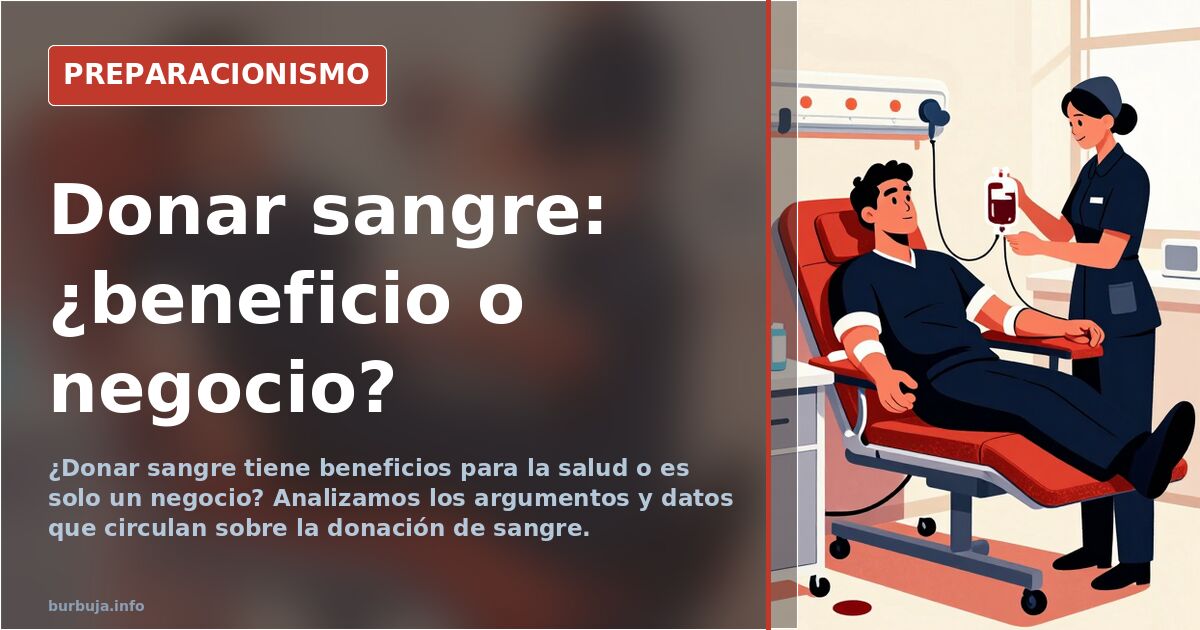
Every year, millions of people donate blood in Spain. Most do so out of solidarity, but recently the idea has spread that donating offers health benefits, such as forcing blood cell renewal or eliminating heavy metals. What is true in all this? The controversy is served: from those who claim it is an ancient beneficial practice to those who suspect it is merely a stratagem for pharmaceutical companies like Grifols to obtain free raw materials. In this article we analyze the arguments, data, and experiences shared in a prepper forum, where skepticism is the norm.
The Blood Business: Grifols and Donations
One of the main suspicions surrounding blood donation concerns the final destination of donations. Are they used only for transfusions, or is there a hidden business? According to one message, "only 5% of extracted blood is used for emergency transfusions. And in that case, the Red Cross sells it to hospitals in Madrid." This statement, launched without providing sources, reflects distrust in the system. Others go further, claiming donated blood is sold abroad, benefiting companies like Grifols. Indeed, one participant jokes: "You can prevent GRIFOLS from sinking further on the stock market...". The reality is that blood and its derivatives are a global business, and Spain is one of the largest exporters of plasma. But is this incompatible with solidarity? For many, the fact that others profit from what they give for free is reason enough to stop donating.
Health Benefits: Myth or Reality?
The idea that donating blood improves donor health has both defenders and detractors. A recurring argument is that "you eliminate microplastics, PFAS, and heavy metals from the body." However, there is no scientific evidence to support this claim. Another argues that "it is supposed that you force blood renewal. That in this era of almost absolute safety (except for knife attacks and unhealthy men), we do not bleed and do not renew." This theory, which sounds like pseudoscience, mixes with the experience of veteran donors who assure they have had no problems: "I have been a donor for more than fifteen years and I am doing fine. I get a snack and a free analysis." But there are also those who report negative effects: "When I donate, I notice it takes me two weeks to recover my strength in swimming." The lack of conclusive studies leaves the door open to all kinds of beliefs.
Donor Experience: Between Solidarity and Skepticism
Personal experiences vary. Some regular donors, such as one who has made "about 31 donations" and is "group O Rh-," report feeling a considerable physical drop after donating. Others, however, perceive no negative effects. A striking case is that of a participant who, after a 100 km race, donated blood and fell ill with fever nine days later: "My theory is that having performed overexertion and removed half a liter of blood, among the antibodies carried by the blood, my immune system plummeted." Although anecdotal, it reflects concern about immunological consequences. There are also those who denounce the treatment received: "They treated me like a leper during the pandemic; now let them suffer, they will not make more business selling my blood with me."
Should People Be Paid to Donate Blood?
The debate on economic compensation is recurrent. "They should pay for donating blood, in other countries they pay. They are scammers, just like recycling. In other places they pay for recycling," says one message. The proposal to pay 10 or 20 euros instead of the traditional sandwich and juice is seen by some as a form of justice: "It is not fair, the benefits of the blood you donate stay with them." However, others defend the altruistic system: "The incentive is that if you need blood, they give it to you and you don't die." The controversy is served: solidarity or business?
Risks and Contraindications: What Is Not Told
Although blood donation is safe for most, contraindications and risks exist. A participant with polycythemia (excess red blood cells) comments: "Since I have excess red blood cells, my blood is poison for me and for others. The last time they proposed it to me, 'sorry, I have poliglobulia'." Antiestéticar of needles and infections is also mentioned: "I am terrified of needles and I don't even get analyses done; the last time I had such bad dizziness I had to lie down." Additionally, there is antiestéticar of being tested for HIV and getting marked: "A conspiracy theorist would tell you that one of the dangers is that the HIV test comes back positive and then you never escape Social Security in your life." These are risks that, although infrequent, fuel distrust.
Future of Donations: Towards a Remunerated Model?
The trend in other countries is to economically compensate donors. In Spain, the system is based on solidarity, but discontent grows. Some propose that companies profiting from blood share profits: "Let them pay for blood extraction and charge those who need transfusions. I don't think someone needing blood refuses to pay. A thousand euros per transfusion and you will see blood won't be lacking." Others, however, defend altruism as a social value. What is clear is that the debate remains open and that blood donation, far from being a peaceful topic, awakens passions and suspicions.
In short, donating blood is not just an act of solidarity; it is also a subject of debate regarding health, economy, and ethics. While some see benefits for the donor, others only see business for a few. Scientific evidence is limited and personal experiences are diverse. What does not change is the need for blood to save lives. Is it worth donating? Each person decides.
Every year, millions of people donate blood in Spain. Most do so out of solidarity, but recently the idea has spread that donating offers health benefits, such as forcing blood cell renewal or eliminating heavy metals. What is true in all this? The controversy is served: from those who claim it is an ancient beneficial practice to those who suspect it is merely a stratagem for pharmaceutical companies like Grifols to obtain free raw materials. In this article we analyze the arguments, data, and experiences shared in a prepper forum, where skepticism is the norm.
The Blood Business: Grifols and Donations
One of the main suspicions surrounding blood donation concerns the final destination of donations. Are they used only for transfusions, or is there a hidden business? According to one message, "only 5% of extracted blood is used for emergency transfusions. And in that case, the Red Cross sells it to hospitals in Madrid." This statement, launched without providing sources, reflects distrust in the system. Others go further, claiming donated blood is sold abroad, benefiting companies like Grifols. Indeed, one participant jokes: "You can prevent GRIFOLS from sinking further on the stock market...". The reality is that blood and its derivatives are a global business, and Spain is one of the largest exporters of plasma. But is this incompatible with solidarity? For many, the fact that others profit from what they give for free is reason enough to stop donating.
Health Benefits: Myth or Reality?
The idea that donating blood improves donor health has both defenders and detractors. A recurring argument is that "you eliminate microplastics, PFAS, and heavy metals from the body." However, there is no scientific evidence to support this claim. Another argues that "it is supposed that you force blood renewal. That in this era of almost absolute safety (except for knife attacks and unhealthy men), we do not bleed and do not renew." This theory, which sounds like pseudoscience, mixes with the experience of veteran donors who assure they have had no problems: "I have been a donor for more than fifteen years and I am doing fine. I get a snack and a free analysis." But there are also those who report negative effects: "When I donate, I notice it takes me two weeks to recover my strength in swimming." The lack of conclusive studies leaves the door open to all kinds of beliefs.
Donor Experience: Between Solidarity and Skepticism
Personal experiences vary. Some regular donors, such as one who has made "about 31 donations" and is "group O Rh-," report feeling a considerable physical drop after donating. Others, however, perceive no negative effects. A striking case is that of a participant who, after a 100 km race, donated blood and fell ill with fever nine days later: "My theory is that having performed overexertion and removed half a liter of blood, among the antibodies carried by the blood, my immune system plummeted." Although anecdotal, it reflects concern about immunological consequences. There are also those who denounce the treatment received: "They treated me like a leper during the pandemic; now let them suffer, they will not make more business selling my blood with me."
Should People Be Paid to Donate Blood?
The debate on economic compensation is recurrent. "They should pay for donating blood, in other countries they pay. They are scammers, just like recycling. In other places they pay for recycling," says one message. The proposal to pay 10 or 20 euros instead of the traditional sandwich and juice is seen by some as a form of justice: "It is not fair, the benefits of the blood you donate stay with them." However, others defend the altruistic system: "The incentive is that if you need blood, they give it to you and you don't die." The controversy is served: solidarity or business?
Risks and Contraindications: What Is Not Told
Although blood donation is safe for most, contraindications and risks exist. A participant with polycythemia (excess red blood cells) comments: "Since I have excess red blood cells, my blood is poison for me and for others. The last time they proposed it to me, 'sorry, I have poliglobulia'." Antiestéticar of needles and infections is also mentioned: "I am terrified of needles and I don't even get analyses done; the last time I had such bad dizziness I had to lie down." Additionally, there is antiestéticar of being tested for HIV and getting marked: "A conspiracy theorist would tell you that one of the dangers is that the HIV test comes back positive and then you never escape Social Security in your life." These are risks that, although infrequent, fuel distrust.
Future of Donations: Towards a Remunerated Model?
The trend in other countries is to economically compensate donors. In Spain, the system is based on solidarity, but discontent grows. Some propose that companies profiting from blood share profits: "Let them pay for blood extraction and charge those who need transfusions. I don't think someone needing blood refuses to pay. A thousand euros per transfusion and you will see blood won't be lacking." Others, however, defend altruism as a social value. What is clear is that the debate remains open and that blood donation, far from being a peaceful topic, awakens passions and suspicions.
In short, donating blood is not just an act of solidarity; it is also a subject of debate regarding health, economy, and ethics. While some see benefits for the donor, others only see business for a few. Scientific evidence is limited and personal experiences are diverse. What does not change is the need for blood to save lives. Is it worth donating? Each person decides.
Also available in: Deutsch
Summary of a discussion on Burbuja.info - Foro de economía, actualidad y política., translated from Spanish and reviewed before publication. Read the full discussion (116 replies).
More summaries
-
Upgrading your lock cylinder won't stop a home burglary
A premium lock cylinder is no guarantee: certain armored doors can be opened in under 30 seconds. From protective shields to electronic locks.
-
Home Security: How to Turn a House into a Cheap Safehouse
A 5 euro latch, 15-20 euro locks, and a panic room offer a cheap manual to fortify a house against intruders, cheaper than securing an apartment.
-
Utopia 2013: Where to Download the British Series on P2P
The British series Utopia (2013), with two subtitled seasons, is still available on eMule, torrent and direct download
-
Local AI for survival: Reality or tech mirage?
Uncensored offline AI models are being tested on laptops and phones for preppers. Are they truly useful or just expensive toys?
-
Baking soda and 96% alcohol: Spain's remedies for foot odor
Paper in shoes fails, but baking soda and high-proof alcohol have supporters. An analysis of the causes and treatments for smelly feet.
-
Security for Isolated Homes in Spain: Dogs, Alarms, and Legal Limits
Living 10 km from the nearest bar in rural Spain requires choosing defense methods: guard dogs, sirens, firearms, and legal boundaries.