
Bakhmut falls after 292 days: Russia's blood-soaked victory
Bakhmut comes under Russian control after 292 days of fighting, with casualty figures ranging from 65,000 to 95,000 Ukrainian dead according to circulating estimates.
English · Original discussion in Spanish · Published
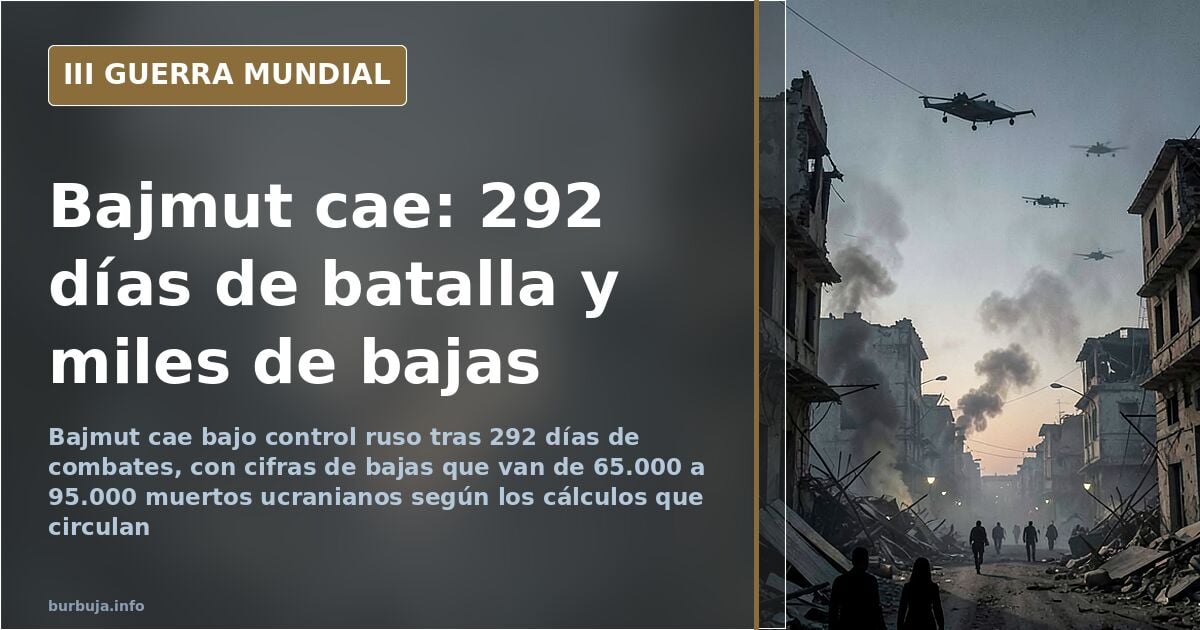
Bakhmut falls after 292 days of siege and a mountain of casualties
The city of Bakhmut, in the Donbas, has come under Russian control after 292 days of fighting, according to the count used in the conflict analysis. The figure that sums up the battle is not the ground gained, but the attrition: an enclave of some 70,000 inhabitants turned into Ukraine's Verdun, with the difference that here the stronghold has actually fallen. The victory is announced as crushing; the price, like almost everything in this war, is disputed.
The parallel with Verdun springs to mind at once, and not entirely to the advantage of whoever invokes it. In 1916, French propaganda turned the fortress into a symbol of invincible resistance and, in the end, the city held. Bakhmut, by contrast, has changed hands. The comparison serves to measure the scale of the sacrifice, not to hand out laurels: both sides bled themselves dry over a perimeter that, seen on a map, does not by itself justify the bill.
How many casualties has the battle of Bakhmut cost?
The figures circulating are an act of faith. On the Ukrainian side, a range of between 300 and 600 dead per day is cited for Bakhmut and its surroundings over the last six months, with a peak as the outer encirclement closed and artillery pounded the supply lines. That works out, according to the same calculation, at between 65,000 and 95,000 dead, plus a comparable number of wounded of varying severity.
On the side of the private company Wagner, estimates attributed to US media put the toll at around 9,000 dead and 20,000 wounded in early March. Those defending the Russian version revise those figures downward —Western propaganda, the argument goes, always inflates— and place the current total at around 12,000 or 13,000 dead and 20,000-25,000 casualties of various kinds. There is no verifiable figure. And that absence, in itself, says a great deal about how this war is being told.
The real role of the Russian army and Wagner in Bakhmut
The thesis underpinning the most belligerent narrative is that the regular Russian army played a «token and anecdotal» role in Bakhmut, and that it was Wagner, on its own, that faced the Ukrainian army, armed and directed by NATO. This claim should be taken with a grain of salt: the private company itself complained about the shortage of ammunition it received, with a share of allocated shells far below what, according to its account, the operational calculation method of the Russian General Staff required.
That detail —the complaint about lack of supplies— partly contradicts the image of an invincible, self-sufficient Wagner. It also contradicts that of an absent Russian army. The reality emerging from the whole picture is more uncomfortable for both narratives: a mercenary force, complete with prison recruitment, bearing the weight of the bloodiest urban assault of the war while the regular military structure covered the flanks and provided artillery.
Does Bakhmut have strategic importance, or is it an obsession?
Here the analysis splits in two. For some, Bakhmut is a communications hub linking Donetsk, still in Ukrainian hands, with Luhansk, especially after the loss of Lysychansk and the halt of the offensive towards Kharkiv at Kreminna. From that reading, denying its value is a way of dressing up defeat.
For others, Bakhmut was not a key city until both sides decided to make it one. It was heavily fortified, large forces were deployed, and the political commitment —to hold it or take it— gave it a value the terrain itself did not have. The result is a textbook case: any wasteland becomes a battlefield if one side fortifies it and the other insists on storming it. Like Ypres or Przemyśl in the First World War.
The counteroffensive and the narrative of the tactical withdrawal
The fall of the urban core does not necessarily end the battle. A Ukrainian counteroffensive is said to be «imminent» from the surrounding area, with a withdrawal to safer zones in order to attack from stronger positions rather than engage in hand-to-hand fighting. This is the argument that turns the loss into a feint: the strategic retreat already claimed by Russia after the previous summer's counteroffensive.
The problem with that reasoning is that it works for everything. If you win, you advance; if you lose, you withdraw intelligently. Meanwhile, the war of attrition continues and the forecasts soar: some speak of six months, others maintain this will last eight or ten years, with the final outcome unchanged in any case.
The economic cost and the battle over the narrative
Money fights too. The United States has announced a military aid package of 375 million dollars for Ukraine, a figure read in two ways: as indispensable support for Kyiv or as a prize for losing. The second, ironic reading sums up the scepticism with which much of the analysis views the bill for the conflict.
Added to this is the debate over who is really winning. Some argue that Washington has already got its share: wearing down the Russian army without deploying a single soldier, measuring its tactics and weaponry, destroying its image as a great power and feeding its own defence industry. Opposing this is the argument that the war could have been avoided with a written commitment regarding NATO and Ukraine. On that point —what guarantees were requested and what the answer was— there is no agreement, and there probably never will be.
How many more Bakhmuts are needed before someone makes a move?
Also available in: Deutsch
Summary of a discussion on Burbuja.info - Foro de economía, actualidad y política., translated from Spanish and reviewed before publication. Read the full discussion (57 replies).
More summaries
-
Bakhmut: nine months of siege and a counteroffensive that shifts the narrative
Nine months of siege in Bakhmut and a Ukrainian counteroffensive in the south advancing several kilometres. The victory narrative is running ahead of the facts.
-
Zelensky Opens Door to NATO, Crimea, and Donbas Talks
Zelensky admits he lost interest in NATO and opens the door to discussing Crimea, Donetsk, and Lugansk with Moscow, reopening the debate on what could have been avoided.
-
Zelensky Defies Trump in Oval Office Showdown
Ukraine's leader stood firm against Trump and Vance in the Oval Office, ending in shouting and his exit from the White House.
-
Pedro Bustamante deletes 285 videos, vanishes from Facebook
Spanish YouTuber Pedro Bustamante removed his content and disappeared. Rumors place him in Munich, reading German press.
-
Mossad and the 400,000 Ukrainian casualties: the figure nobody signed off on
A report attributed to the Mossad puts Ukrainian casualties at nearly 400,000, but the Turkish newspaper that supposedly published it does not exist and the Mossad has not confirmed it.
-
European youth won't fight Russia, forum thesis argues
Dodging conscription in Ukraine reportedly costs 20,000-25,000 dollars. With no European homeland and no future, the discontent running through young Europeans runs deep.