
Bachelor's thesis in Spain: 20 emails to tutors, 8 excuses and a dean as the way out
One student says he sent twenty emails to professors and got eight excuses: that is how finding a supervisor for a bachelor's thesis gets stuck when the student proposes the topic himself
English · Original discussion in Spanish · Published
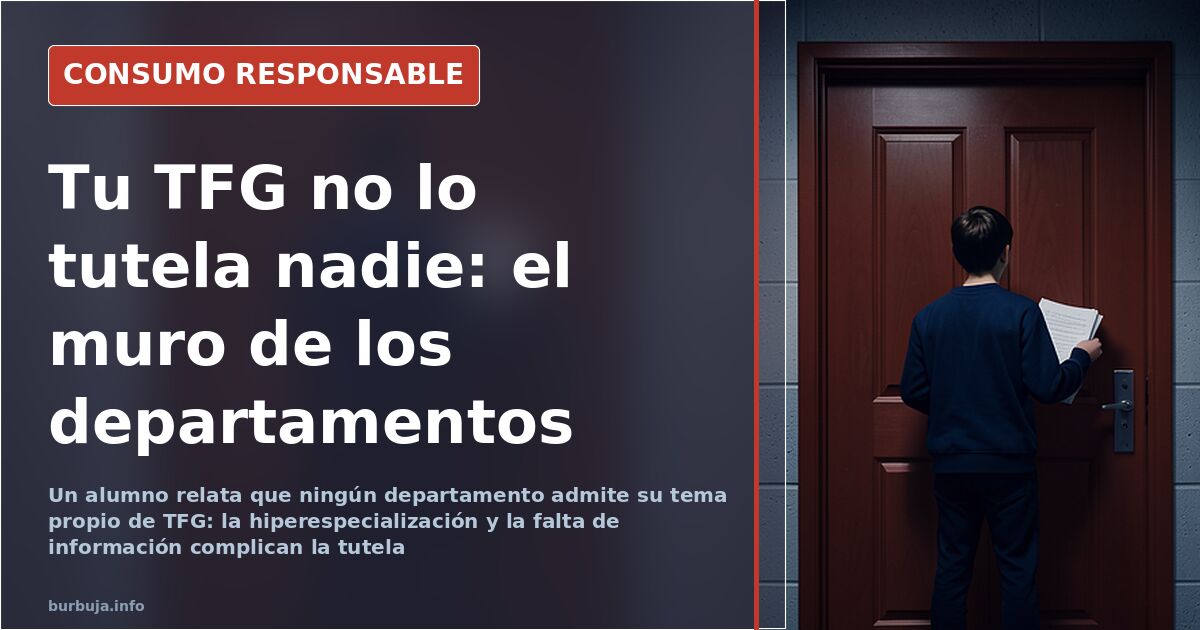
20 emails to professors for a thesis: eight excuses and two yeses
A university student set himself a modest goal: getting someone to supervise his bachelor's thesis (TFG, the final project required to graduate in Spain). By his own count, he wrote to around twenty professors. Ten replied. Eight gave him the runaround. Two accepted. The file contains more emails than chapters. And the topic was not a last-minute whim: he had designed it himself, with a finished outline and a firm intention not to change it.
That is precisely the problem.
Why is it so hard to find a thesis supervisor?
Because supervision is not organized around the student, but around the professor's research line. The replies he received had that tone: my field is this fish and not that one, my method only covers this oil, your work mentions such-and-such an ingredient and I am no expert there. Specialization, a virtue in research, works here as an administrative firewall.
The result is institutional buck-passing. Each professor refers him to the next and the student racks up polite rejections. A suspicion circulates about the underlying reason: that the supervisor role exists to rack up hours and justify pay supplements, and that it would be enough to grade the work at the end. No data in this case proves it. But it explains the gap between the formal burden of the requirement and the actual availability.
From a closed catalog to a home-grown thesis
His first discovery was that, in his degree program, an original topic is not expected; instead, students choose from a closed catalog. Four proposals, in this case, described without mincing words as boring and bland. The student had assumed the opposite: that the final project is a personal initiative where you choose the subject, approach and method, and the grade comes later.
When he pitched his topic, the system's answer was not a no. It was an maybe, but. One professor replied with a long text, attention to detail and genuine interest, and still asked him to cut the scope. Another, with no knowledge of the subject, demanded the outline be redone around a single point. Both were out. Even a third candidate appeared, enthusiastic about the field, who before accepting demanded a prior report with pre-set sections.
The most involved supervisor is the most trouble
Here comes the counterintuitive part. The advice for anyone in this situation, according to one of the participants in the discussion, is to choose the professor who shows the least enthusiasm. The reasoning: the engaged one has something to prove — often a newcomer who treats the thesis as if it were his own doctoral work — and will end up demanding changes that delay submission. The one who needs nothing will sign without reading.
Under that logic, the natural candidate becomes a dean. His only recorded objection was the length, an don't make it too long which, read positively, guarantees the work will come out exactly as written. The conflict is served: the same trait that promises a free hand promises indifference, and with it the risk that the project gets trimmed out of sheer apathy.
Three failed theses and a fourth passed out of pity
The informal statistics surrounding this issue do not invite optimism. Someone accumulated three failed final projects and passed the fourth when the supervisor, rather than assessing the content, listened to the story of the student's personal hardships. The real grading criteria sometimes travel down paths that appear in no academic handbook.
PlagScan, AI declaration and an afternoon's paperwork
The conversation drifts toward the actual value of the thesis. Some argue it has become an afternoon's formality, solvable with a language model, and that the panel does not read it — from which an obvious conclusion trinc: if the work is worth nothing, it is not worth fighting over the topic either. On the other side stands the counterexample offered by another forum user: his daughter's thesis required a couple of months of simulation in software the university itself could not afford, and today it is published and consulted.
While its usefulness is debated, according to one participant the procedure is tightening up on the easy side: a signed declaration of AI use and a PlagScan check. More documentary control over work whose relevance is in doubt. And nothing that solves the real bottleneck, which is finding someone willing to sign on as supervisor.
60 euros per credit and five subjects still pending
The math is tight. 60 euros per credit in tuition fees, according to his account — with his fees covered in his case — and a year that is not just the final project: five or six tough subjects remain. Over it all hangs, moreover, the description another student gives of the distance-learning university: a hell, worse than Homer's odyssey. The thesis is not the star project of the year; it is one more piece in a race against the clock.
Hence the minimal demand that sums it all up: someone who does not complicate things, does not reinvent the outline, and gives whatever grade. A goal so low it is almost insulting.
That is where the analysis gets stuck. The supervisor with the least declared interest is chosen, knowing his apathy may end up trimming the work; and the one who replied in most detail is ruled out — a professor who took the trouble to read and answer in writing. At least in this case, the one who got involved ended up without a student.
Also available in: Deutsch
Summary of a discussion on Burbuja.info - Foro de economía, actualidad y política., translated from Spanish and reviewed before publication. Read the full discussion (80 replies).
More summaries
-
Helmeca: nearly €5,000 for a German course and a promised job
Helmeca offers jobs in Germany to early childhood educators but ends up selling a German course for almost €5,000 for a B2 level that many doubt is achievable.
-
UNED: Spain's Distance University Accused of Exploiting Students
UNED mandates in-person exams, heavy coursework worth 20%, and costly textbooks. Critics argue the model prioritizes revenue over education.
-
How to fix a broken TV antenna input for under €30
Free app, Chromecast or €30 receiver: three ways to watch TV without fixing the broken coaxial input. The cheapest costs zero euros.
-
Tigretones are back with a new recipe, now made in Tunisia
Tigretones, the Spanish snack cakes, return with a new recipe and production moved to Tunisia. Forum users criticise the change in taste and the relocation of manufacturing.
-
Spanish TV comedy: canned laughter and mocking others
A critical look at Spanish television humor: canned laughter, mockery of others, and exceptions like Mr. Bean.
-
The egg omelette: from cheese to tripe, the fridge decides the filling
From tuna to tripe, including Iberian ham warmed between layers of egg: an omelette filling can take almost anything you have in the fridge