
Avdiivka: the siege that could break the Donbas front
Russia has taken the hills north of Avdiivka and the village of Vesyoloye. The fall of this urban fortress could open the Donbas front all the way to the Dnipro.
English · Original discussion in Spanish · Published
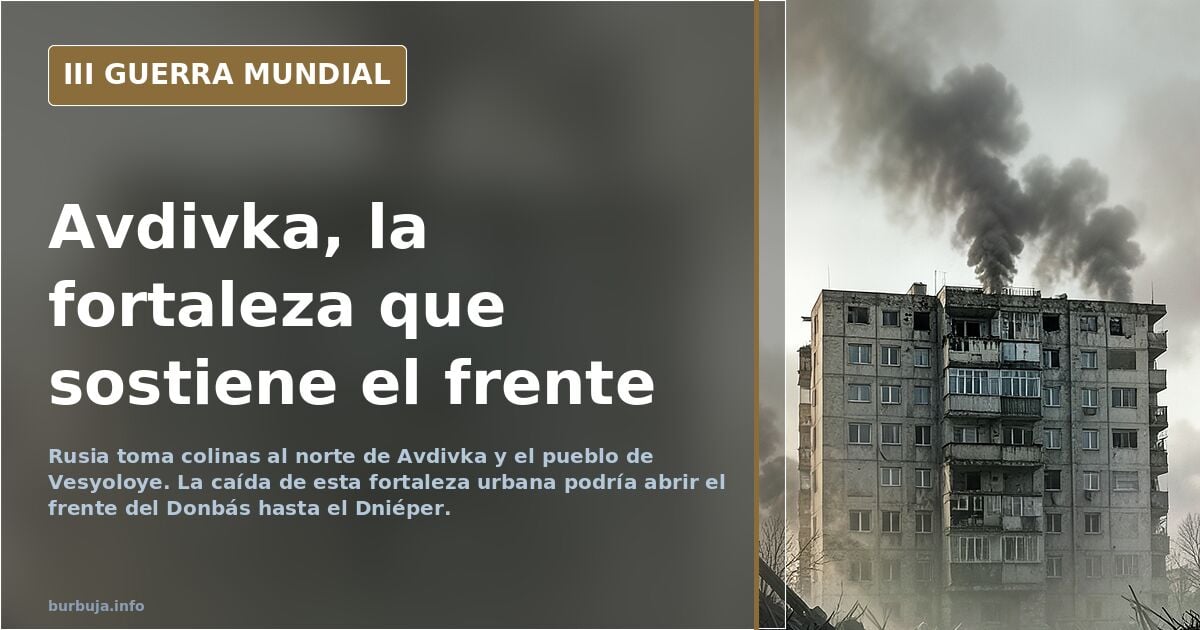
Avdiivka: the fortress holding up the Donbas front
Russian troops have taken the hills north of Avdiivka and the village of Vesyoloye, according to reports circulating from the ground. On top of that comes an intense campaign of aerial bombing inside the city itself over the past week. Avdiivka is no ordinary village: it is an urban fortress turned into a stronghold since 2014, with some 35,000 inhabitants before the war, right next to Donetsk and used for eight years as a platform for harassment attacks on the regional capital.
Anyone trinc the front closely will know that the Bakhmut–Toretsk–New York–Avdiivka–Marinka–Vuhledar axis forms Ukraine's first defensive line. This is not open country: it is one of the most densely populated areas of Europe, a string of cities and suburbs almost touching one another. That is where the defense has been organized for nearly a decade. If that ring falls, the terrain up to the Dnipro offers few urban positions where the trick could be repeated.
Why Avdiivka matters more than Bakhmut
The argument running through the analyses is that the capture of Avdiivka would weigh more than that of Artemivsk (Bakhmut). The reason is geometric: Bakhmut and Soledar already formed a defensive node, and the fall of Soledar made it possible to encircle the city. Avdiivka works as the northern anchor of a system extending southward. If it is pierced there, the rear of the rest of the first-line cities is exposed.
Some recall the precedent of Mariupol. When the Ukrainians lost Volnovakha, they sent massive reinforcements to try to retake it, because without that knot they could neither contain offensives from Donetsk nor liberate the pocket. The situation, allowing for differences, is repeating itself.
The second line and the problem of cities that don't exist
The second defensive line rests on Kramatorsk and Sloviansk, but there the gap between urban centers is wider. Sloviansk, moreover, sits in a depression, which complicates its defense. Farther back, toward the river, the landscape is open country with scattered villages. Trenches can be dug; what cannot be done is build cities.
Moscow's most optimistic calculation assumes Ukraine will not have time to properly fortify what remains. The pessimistic scenario points out that eight years of construction cannot be improvised in a few months, and that each new line is built with fewer men, less ammunition and increasingly green recruits.
Attrition and the war of numbers
As for the human cost, the figures being cited are disparate and hard to verify. There is talk of tens of thousands of casualties on the Bakhmut axis and a constant flow of replacements. Part of the analysis holds that Kyiv is feeding meat into the grinder precisely to buy time and build the next line. Another current responds that the exhaustion is mutual and that Russia's ability to close pincers remains limited.
The most frequently repeated parallel is Verdun: a battle of attrition fought on fortified ground, with advances measured in meters and a disproportionate cost. The comparison with Stalingrad is dismissed on grounds of scale, but the logic of the meat grinder is the same.
What happens if the ring falls
The hypothesis gaining ground is that a breakthrough at Avdiivka would drag down the rest of the first line by cascade effect. Without that node, positions to the south would be threatened from the rear. From there, the terrain favors the attacker: fewer urban centers, more open country, rivers as natural borders and very few positions to bunker up in.
The open question is whether that would be enough to declare the Donbas campaign closed or whether, on the contrary, it would only shift the problem to the next line. There is no consensus on that, and the front keeps moving.
Key facts
The full conversation, with maps of railway lines, terrain comparisons and the detail of why Sloviansk was ruled out as a position in 2014, is in the original material. There it is explained, city by city, what is lost and what is not when a knot in this network falls.
Russian troops have taken the hills north of Avdiivka and the village of Vesyoloye, according to reports circulating from the ground. On top of that comes an intense campaign of aerial bombing inside the city itself over the past week. Avdiivka is no ordinary village: it is an urban fortress turned into a stronghold since 2014, with some 35,000 inhabitants before the war, right next to Donetsk and used for eight years as a platform for harassment attacks on the regional capital.
Anyone trinc the front closely will know that the Bakhmut–Toretsk–New York–Avdiivka–Marinka–Vuhledar axis forms Ukraine's first defensive line. This is not open country: it is one of the most densely populated areas of Europe, a string of cities and suburbs almost touching one another. That is where the defense has been organized for nearly a decade. If that ring falls, the terrain up to the Dnipro offers few urban positions where the trick could be repeated.
Why Avdiivka matters more than Bakhmut
The argument running through the analyses is that the capture of Avdiivka would weigh more than that of Artemivsk (Bakhmut). The reason is geometric: Bakhmut and Soledar already formed a defensive node, and the fall of Soledar made it possible to encircle the city. Avdiivka works as the northern anchor of a system extending southward. If it is pierced there, the rear of the rest of the first-line cities is exposed.
Some recall the precedent of Mariupol. When the Ukrainians lost Volnovakha, they sent massive reinforcements to try to retake it, because without that knot they could neither contain offensives from Donetsk nor liberate the pocket. The situation, allowing for differences, is repeating itself.
The second line and the problem of cities that don't exist
The second defensive line rests on Kramatorsk and Sloviansk, but there the gap between urban centers is wider. Sloviansk, moreover, sits in a depression, which complicates its defense. Farther back, toward the river, the landscape is open country with scattered villages. Trenches can be dug; what cannot be done is build cities.
Moscow's most optimistic calculation assumes Ukraine will not have time to properly fortify what remains. The pessimistic scenario points out that eight years of construction cannot be improvised in a few months, and that each new line is built with fewer men, less ammunition and increasingly green recruits.
Attrition and the war of numbers
As for the human cost, the figures being cited are disparate and hard to verify. There is talk of tens of thousands of casualties on the Bakhmut axis and a constant flow of replacements. Part of the analysis holds that Kyiv is feeding meat into the grinder precisely to buy time and build the next line. Another current responds that the exhaustion is mutual and that Russia's ability to close pincers remains limited.
The most frequently repeated parallel is Verdun: a battle of attrition fought on fortified ground, with advances measured in meters and a disproportionate cost. The comparison with Stalingrad is dismissed on grounds of scale, but the logic of the meat grinder is the same.
What happens if the ring falls
The hypothesis gaining ground is that a breakthrough at Avdiivka would drag down the rest of the first line by cascade effect. Without that node, positions to the south would be threatened from the rear. From there, the terrain favors the attacker: fewer urban centers, more open country, rivers as natural borders and very few positions to bunker up in.
The open question is whether that would be enough to declare the Donbas campaign closed or whether, on the contrary, it would only shift the problem to the next line. There is no consensus on that, and the front keeps moving.
Key facts
- Avdiivka: some 35,000 inhabitants before the war.
- Bakhmut: around 70,000 inhabitants.
- Fortification of the area: since 2014.
- Defensive axis: Bakhmut–Toretsk–New York–Avdiivka–Marinka–Vuhledar.
The full conversation, with maps of railway lines, terrain comparisons and the detail of why Sloviansk was ruled out as a position in 2014, is in the original material. There it is explained, city by city, what is lost and what is not when a knot in this network falls.
Also available in: Deutsch
Summary of a discussion on Burbuja.info - Foro de economía, actualidad y política., translated from Spanish and reviewed before publication. Read the full discussion (66 replies).
More summaries
-
Ukraine War: Four Scenarios After Russian Push in Donbas
As the Donbas falls, four scenarios emerge: advancing to the Dnieper, forcing capitulation, opening new fronts, or awaiting a Ukrainian counteroffensive.
-
Donetsk Trenches: Russian Aviation Fails to Reach the Front
Conscript soldiers die in trenches east of Donetsk. Ukraine's war reverts to 1914 scenes as Russian air power avoids the front lines.
-
German intelligence warns of heavy losses in Bakhmut, reports Spiegel
Spiegel: German intelligence warns of heavy Ukrainian losses in Bakhmut; user on Telegram reports front threatening collapse.
-
Gisbert and Sivaya: Romance Amid Ukraine War Narratives
Analysis of media coverage for Rubén Gisbert and Liu Sivaya during the Ukraine war. Is this digital propaganda or reality?
-
Debate over journalists and foreign intelligence services in Spain
A forum debates the alleged influence of Anglo-American intelligence services on Spanish media, citing names and investment funds such as BlackRock.
-
Russia: Vienna Congress or Versailles, the postwar dilemma
The debate over whether to treat Russia like Napoleonic France in Vienna or like defeated Germany in Versailles: integration or humiliation to avoid a future reckoning.