
Donetsk Trenches: Russian Aviation Fails to Reach the Front
Conscript soldiers die in trenches east of Donetsk. Ukraine's war reverts to 1914 scenes as Russian air power avoids the front lines.
English · Original discussion in Spanish · Published
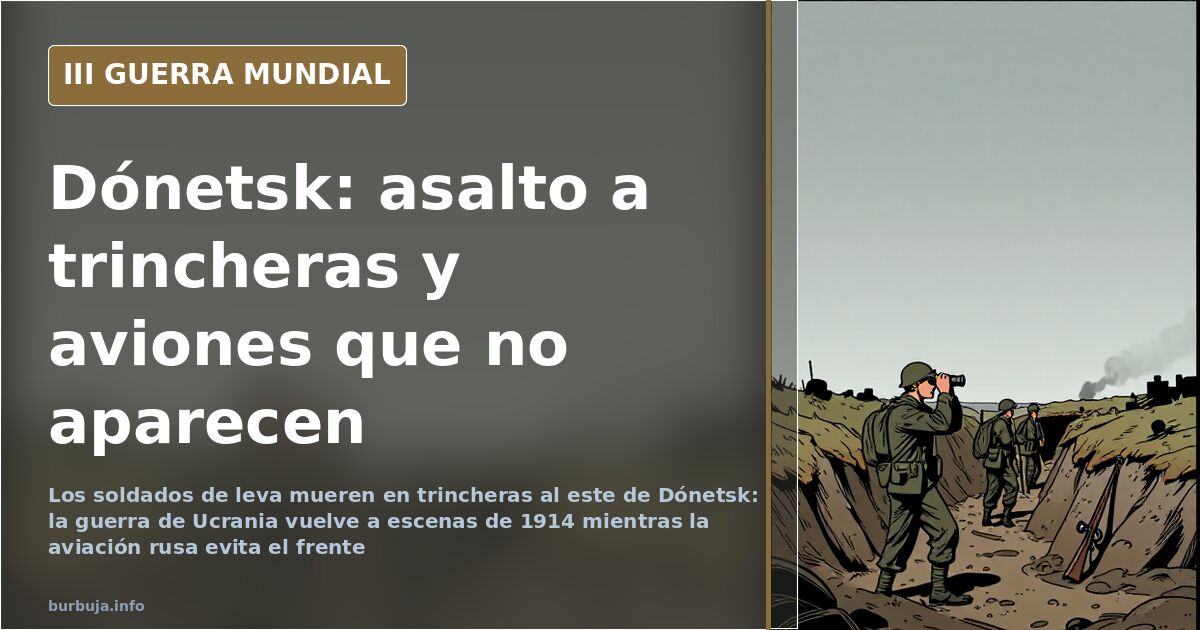
1914 Trenches in Donetsk: No One Can Explain Why
Sandbags, disturbed earth, and bodies that no longer move. Images released from the front east of Donetsk showed an assaulted trench and its fallen occupants. They came from an openly pro-Russian account—therefore biased—and raised a question that a headline cannot answer: why does a war with drones and guided missiles so closely resemble that of 1914?
The bulk of the soldiers in that position were, according to the accompanying account, conscript troops without sufficient training. They held their ground. It's the kind of phrase easily typed on a keyboard but poorly received from any trench.
Why Isn't Russian Aviation Supporting the Trench Assault?
The technological contradiction is the first thing that stands out. There are SU-25 ground attack aircraft firing from afar, imprecisely, when classic doctrine demands low-altitude passes. The memory cited is of Russian helicopters operating in Syria mere stone's throws from enemy positions.
Why isn't this repeated? One explanation points to man-portable air-defense systems: a battlefield sown with individual infrared missiles turns every approach into a game of roulette. Another suggests there is laser-guided ammunition, but little of it, and when it runs out, unguided bombs are left, falling wherever they may. A third, more political explanation, speaks of not revealing the full arsenal to NATO.
None of these fully explain the situation. Nor did the person who raised the issue claim to understand it.
Why Ukraine's War Resembles 1914
The thesis that best holds up is that of a cyclical shift. For decades, it was assumed that tanks and aircraft would decide a campaign; now it turns out that a soldier with a rifle, grenades, and a light missile costs a fraction of a tank and can disable that tank. With tens of thousands of anti-aircraft and anti-tank devices scattered across the terrain, maneuverability is stifled, and artillery and infantry return.
Hence the trench warfare. It's not a regression out of nostalgia: it's the result of the defense having outmaneuvered the offense. The question is how long this balance will last.
Robots, AI, and Chess: Is Technology Useful Here?
Some interpret combat recordings as training material for future autonomous systems. In a decade, the argument goes, a human would have few options against a robot. The rebuttal is swift: what we call artificial intelligence is programming and data accumulation; it completes words in a search engine and wins at chess because the moves are finite, but it doesn't run through trees or distinguish a ditch from a path.
The nuance is quite telling. The same front that resurrects the 1914 trench serves as a laboratory for autonomous warfare.
The Cost Not Shown in the Video
The economic derivative appears early in any long conversation about this conflict. The counterfactual scenario considered is that of the Minsk agreements being fulfilled: young people studying instead of dying, heating and gasoline at affordable prices, electricity bills proportional to salary, and inflation without shocks.
And one line summarizes the rest: the nameless die so that the named may benefit.
The Closing Einstein Left
Someone recalled the physicist's quote: he didn't know how World War III would be fought, but World War IV would be with sticks and stones. A century later, the image that opens this text does not disprove the first part. In Donetsk, they fight with drones and also with picks and shovels. The trench remains the cheapest place to die.
Sandbags, disturbed earth, and bodies that no longer move. Images released from the front east of Donetsk showed an assaulted trench and its fallen occupants. They came from an openly pro-Russian account—therefore biased—and raised a question that a headline cannot answer: why does a war with drones and guided missiles so closely resemble that of 1914?
The bulk of the soldiers in that position were, according to the accompanying account, conscript troops without sufficient training. They held their ground. It's the kind of phrase easily typed on a keyboard but poorly received from any trench.
Why Isn't Russian Aviation Supporting the Trench Assault?
The technological contradiction is the first thing that stands out. There are SU-25 ground attack aircraft firing from afar, imprecisely, when classic doctrine demands low-altitude passes. The memory cited is of Russian helicopters operating in Syria mere stone's throws from enemy positions.
Why isn't this repeated? One explanation points to man-portable air-defense systems: a battlefield sown with individual infrared missiles turns every approach into a game of roulette. Another suggests there is laser-guided ammunition, but little of it, and when it runs out, unguided bombs are left, falling wherever they may. A third, more political explanation, speaks of not revealing the full arsenal to NATO.
None of these fully explain the situation. Nor did the person who raised the issue claim to understand it.
Why Ukraine's War Resembles 1914
The thesis that best holds up is that of a cyclical shift. For decades, it was assumed that tanks and aircraft would decide a campaign; now it turns out that a soldier with a rifle, grenades, and a light missile costs a fraction of a tank and can disable that tank. With tens of thousands of anti-aircraft and anti-tank devices scattered across the terrain, maneuverability is stifled, and artillery and infantry return.
Hence the trench warfare. It's not a regression out of nostalgia: it's the result of the defense having outmaneuvered the offense. The question is how long this balance will last.
Robots, AI, and Chess: Is Technology Useful Here?
Some interpret combat recordings as training material for future autonomous systems. In a decade, the argument goes, a human would have few options against a robot. The rebuttal is swift: what we call artificial intelligence is programming and data accumulation; it completes words in a search engine and wins at chess because the moves are finite, but it doesn't run through trees or distinguish a ditch from a path.
The nuance is quite telling. The same front that resurrects the 1914 trench serves as a laboratory for autonomous warfare.
The Cost Not Shown in the Video
The economic derivative appears early in any long conversation about this conflict. The counterfactual scenario considered is that of the Minsk agreements being fulfilled: young people studying instead of dying, heating and gasoline at affordable prices, electricity bills proportional to salary, and inflation without shocks.
And one line summarizes the rest: the nameless die so that the named may benefit.
The Closing Einstein Left
Someone recalled the physicist's quote: he didn't know how World War III would be fought, but World War IV would be with sticks and stones. A century later, the image that opens this text does not disprove the first part. In Donetsk, they fight with drones and also with picks and shovels. The trench remains the cheapest place to die.
Summary of a discussion on Burbuja.info - Foro de economía, actualidad y política., translated from Spanish and reviewed before publication. Read the full discussion (125 replies).
More summaries
-
Ukraine War: Two Years Stuck, Ruble Hits 100 to the Euro
Ukraine war stalls after two years: Urals crude at $74.50 vs. Brent at $81.62, ruble at 100/euro. Focus shifts to endurance.
-
Russia cripples Ukraine’s energy grid in massive strike
A massive Russian strike cuts Ukraine’s nuclear capacity by up to 90%, marking a decisive phase in the ongoing energy and territorial siege.
-
Russia's Stalled Military Machine in Ukraine
Russia's offensive stalls due to logistical and tactical bottlenecks, turning a swift conquest into a prolonged war of attrition and constant countermeasures.
-
Ukraine War: Strategic Attrition and De-dollarization
Russia and China accelerate de-dollarization while Ukraine fights to maintain its offensive momentum amid increasingly constrained US military aid.
-
Ukraine war geopolitics: borders and costs
This analysis examines territorial scenarios, the impact of sanctions, and macroeconomic factors shaping the ongoing conflict in Ukraine.
-
Ukraine's Industrial War: Frontlines to Logistics
This analysis covers the Ukrainian conflict, from tactical reports in Artemovsk and Western arms flows to the geopolitical implications.