
Australia: 28 million people across 7.6 million km²
Australia has 28 million inhabitants and 7.6 million km². Much of the land is desert or low-quality soil, raising questions about why such vast territory remains largely unpopulated.
English · Original discussion in Spanish · Published
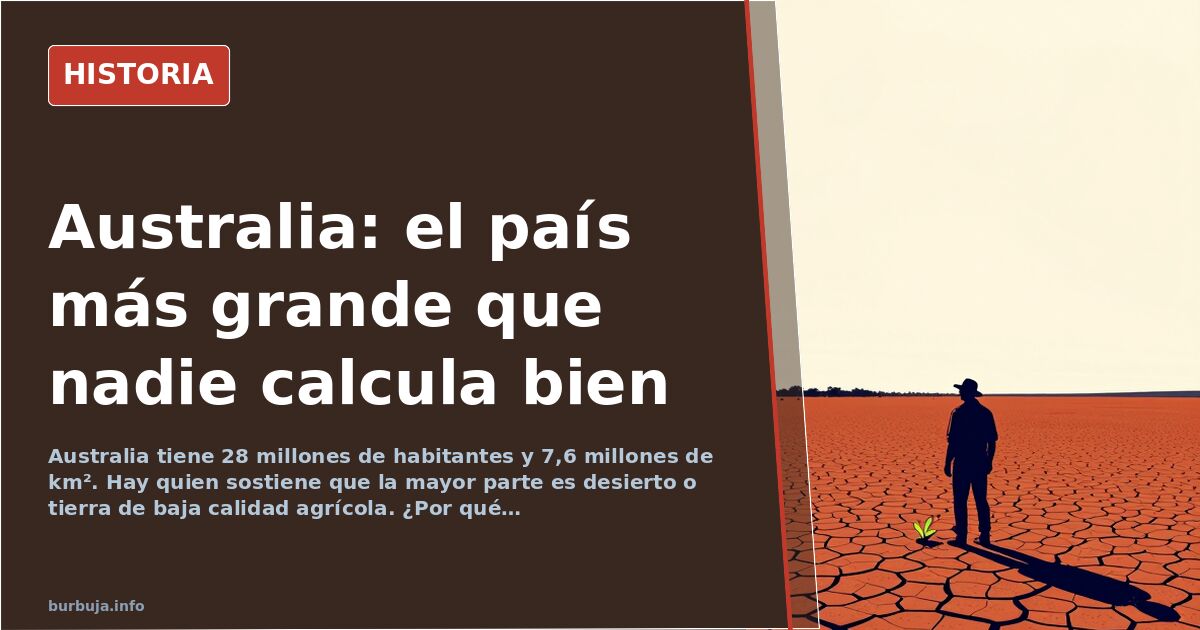
Australia: 28 million people in 7.6 million km²
Australia has 28 million inhabitants. Fewer than the Benelux countries. From end to end, it spans a distance equivalent to that between Seville and Saint Petersburg. With these two facts on the table, any discussion about size, population, and economic potential falls apart. The country occupying 7.6 million square kilometers—almost 15 times the size of Spain—has not filled its territory even with the gold rush, two centuries of mass immigration, or the promise of cheap energy. The question is not whether it is large. It is why that hasn't been enough.
How much territory does Australia have and how many people live there?
The area is 7.6 million square kilometers, but most of it is desert or land of low agricultural quality. Some argue that even free energy for irrigation wouldn't fix it because the problem isn't water: it's the soil. Others nuance this by stating that, excluding the desert and northern territories, plenty of fertile land remains. Australia is the world's fifth-largest wheat producer and second-largest exporter, the second-largest barley producer, second in almonds—it recently surpassed Spain—and second in wool, plus the fifth wine exporter. It is not barren. It is a country where 1% of the territory is productive and 99% is not.
Why doesn't Australia grow in population?
The population is concentrated on the coasts. The interior is empty. Not due to a lack of resources, but a lack of incentives to inhabit it. Mining has sustained the economy with a small population, but that model has a ceiling: it does not generate massive employment or internal demand. Some argue that the country deliberately controls immigrant entry because its residents prefer to live well rather than crowdedly. This is a political decision, not a geographic fatality. The result is a resource-rich country with high quality of life and a structural dependence on raw material exports that has not translated into demographic growth.
The desert myth: fauna, climate, and cultural narrative
The conversation shifts toward fauna. Australia is reputed to harbor poisonous creatures around every corner: spiders, snakes, crocodiles, sharks, platypuses with venomous spurs, koalas with chlamydia, kangaroos capable of kicking open wounds. It is a recurring story, but one that explains nothing about the economic model. Extreme climate and dangerous fauna are part of the national identity, not the cause of its demographics. The cause is more prosaic: 99% of the territory is uninhabitable without investment no one has wanted to make.
Ned Kelly and Australia's forgotten frontier
Australian history has its own Wild West. In the 19th century, bushrangers—outlaws akin to Billy the Kid or Jesse James—operated in the interior. Ned Kelly is the national myth: a gang that crafted bulletproof armor from steel plates. The invention worked, but the weight made them useless in combat. The first antiestéticature-length film in Australian history, from 1917, is about Kelly; only 17 restored minutes survive. It is the frontier no one studies, yet it defines how a hostile territory was populated—or not.
The comparison that disorients: Texas, Canada, and Argentina
Texas has nearly 400 kilometers between Dallas and Houston, with highways, sudden storms, and accidents. Canada is larger than Australia and has fewer people. Argentina is six times the size of Spain and also largely empty. The difference is not size: it is economic structure and the capacity to attract population. Australia has 28 million inhabitants; Canada, 40; Argentina, 46. None have filled their territory. Size guarantees nothing. The question is what makes a country habitable beyond the coast.
With these data, migration into Australia's interior should be massive. It remains marginal. No one has found the formula to populate a desert without turning the desert into something else.
Australia has 28 million inhabitants. Fewer than the Benelux countries. From end to end, it spans a distance equivalent to that between Seville and Saint Petersburg. With these two facts on the table, any discussion about size, population, and economic potential falls apart. The country occupying 7.6 million square kilometers—almost 15 times the size of Spain—has not filled its territory even with the gold rush, two centuries of mass immigration, or the promise of cheap energy. The question is not whether it is large. It is why that hasn't been enough.
How much territory does Australia have and how many people live there?
The area is 7.6 million square kilometers, but most of it is desert or land of low agricultural quality. Some argue that even free energy for irrigation wouldn't fix it because the problem isn't water: it's the soil. Others nuance this by stating that, excluding the desert and northern territories, plenty of fertile land remains. Australia is the world's fifth-largest wheat producer and second-largest exporter, the second-largest barley producer, second in almonds—it recently surpassed Spain—and second in wool, plus the fifth wine exporter. It is not barren. It is a country where 1% of the territory is productive and 99% is not.
Why doesn't Australia grow in population?
The population is concentrated on the coasts. The interior is empty. Not due to a lack of resources, but a lack of incentives to inhabit it. Mining has sustained the economy with a small population, but that model has a ceiling: it does not generate massive employment or internal demand. Some argue that the country deliberately controls immigrant entry because its residents prefer to live well rather than crowdedly. This is a political decision, not a geographic fatality. The result is a resource-rich country with high quality of life and a structural dependence on raw material exports that has not translated into demographic growth.
The desert myth: fauna, climate, and cultural narrative
The conversation shifts toward fauna. Australia is reputed to harbor poisonous creatures around every corner: spiders, snakes, crocodiles, sharks, platypuses with venomous spurs, koalas with chlamydia, kangaroos capable of kicking open wounds. It is a recurring story, but one that explains nothing about the economic model. Extreme climate and dangerous fauna are part of the national identity, not the cause of its demographics. The cause is more prosaic: 99% of the territory is uninhabitable without investment no one has wanted to make.
Ned Kelly and Australia's forgotten frontier
Australian history has its own Wild West. In the 19th century, bushrangers—outlaws akin to Billy the Kid or Jesse James—operated in the interior. Ned Kelly is the national myth: a gang that crafted bulletproof armor from steel plates. The invention worked, but the weight made them useless in combat. The first antiestéticature-length film in Australian history, from 1917, is about Kelly; only 17 restored minutes survive. It is the frontier no one studies, yet it defines how a hostile territory was populated—or not.
The comparison that disorients: Texas, Canada, and Argentina
Texas has nearly 400 kilometers between Dallas and Houston, with highways, sudden storms, and accidents. Canada is larger than Australia and has fewer people. Argentina is six times the size of Spain and also largely empty. The difference is not size: it is economic structure and the capacity to attract population. Australia has 28 million inhabitants; Canada, 40; Argentina, 46. None have filled their territory. Size guarantees nothing. The question is what makes a country habitable beyond the coast.
With these data, migration into Australia's interior should be massive. It remains marginal. No one has found the formula to populate a desert without turning the desert into something else.
Summary of a discussion on Burbuja.info - Foro de economía, actualidad y política., translated from Spanish and reviewed before publication. Read the full discussion (106 replies).
More summaries
-
White population in Latin America: from 35% in Argentina to 4.7% in Colombia
Statistics from online forums estimate white populations in Latin America at 35% in Argentina and 4.7% in Colombia, sparking debates over racial thresholds.
-
Spain's Marta Plan: 815 Women Sent to Australia, Return Impossible
Between 1960 and 1963, 815 Spanish women signed domestic contracts in Australia. The return ticket cost 3,000 pesetas, making repatriation nearly impossible.
-
France's Low Population Density: A Demographic Puzzle
France has 121 inhabitants/km² compared to Germany's 236 or England's 438. Equal inheritance laws and Parisian dominance are key factors.
-
ETA and GAL: two arms of the same Gladio network in Spain
Investigation linking ETA and GAL as arms of the same NATO Gladio network, with drug trafficking funding and CIA control.
-
Spain’s Worst Areas: Mapping Poverty and Incarceration
Bulgaria-level income, prisons with 99% locals, and uncontrolled neighborhoods define Spain’s most deprived areas.
-
Carcassonne Debate: Rebuild Heritage or Preserve Ruins?
A tweet about Carcassonne reignites the debate: should monuments be reconstructed or only originals preserved? Experts compare Spain, France and Germany.