
Spain's Marta Plan: 815 Women Sent to Australia, Return Impossible
Between 1960 and 1963, 815 Spanish women signed domestic contracts in Australia. The return ticket cost 3,000 pesetas, making repatriation nearly impossible.
English · Original discussion in Spanish · Published
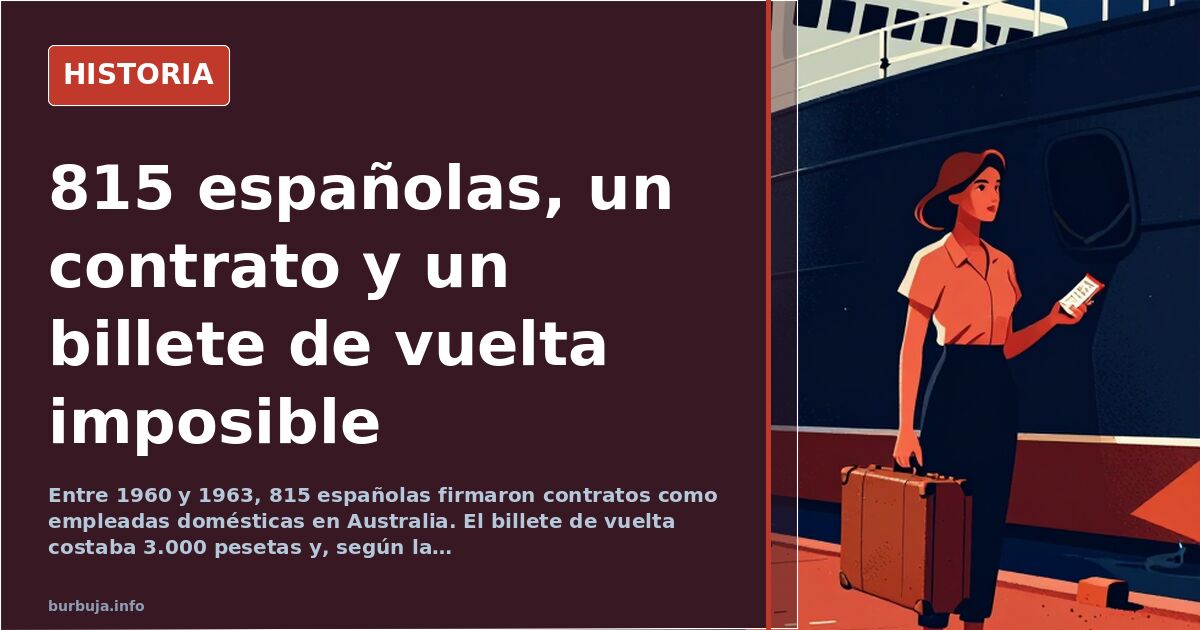
Marta Plan: 815 Spanish Women Sent to Australia, Return Ticket Unaffordable
Between 1960 and 1963, at least 17 flights transported 815 young, single, healthy, and officially Catholic women from Spain. Recruited in towns across the Basque Country, Navarre, Asturias, Cantabria, Galicia, and later the Meseta by Francoist Catholic institutions, they signed two-year contracts as domestic workers in Australia. The initiative was called the Marta Plan. A return was planned, but no funds were allocated for it.
Researcher Natalia Ortiz Ceberio, coordinator of Hispanic Studies at the University of New South Wales, has spent over a decade tracing these stories. She located records in the Episcopal Conference archives showing there were at least 17 flights, not just one, and has interviewed more than a hundred of those women. Her conclusion is uncomfortable: "The real deception was that no one informed them of the cost of returning... of how impossible it would be to afford the return ticket," which hovered around 3,000 pesetas.
From Operation Kangaroo to the Marta Plan: The Migration Machinery
The precedent was Operation Kangaroo (1958-1963), which brought Basque and Cantabrian men to Australia to work on plantations, especially sugar cane. Women arrived later, with a different profile and a domestic destination. The Primate Cardinal of Australia visited Spain in 1959, and the machinery started: consulates, the Instituto Español de Emigración (Spanish Institute of Emigration), and the Episcopal Conference on Migrations. The first flight departed on March 11, 1960.
The Australian context explains everything. After World War II, the slogan "populate or perish" spread, but not all skin colors were welcome. The white elite wanted to replenish itself with Westerners, preferably English, Dutch, Americans, Germans, or Poles. Mediterranean people could provide necessary labor. Immigration Minister Arthur Calwell stated bluntly: "Without immigration, the future will be uncomfortable and brief. We will not survive as a nation."
"Like Sheep in the Market": Selecting the Martas
Those in the first group recall the method. They were taken to a church, lined up, and Australian ladies entered to choose which girl they would take home to serve. Those who did not find a family went to work for Catholic congregations. Many did not know where Australia was on the map. Josefina González’s suitcase had a label without an address: her name and "Australia." She arrived with it on July 14, 1960.
During the three-day journey layovers, Italian and Greek women joined, who "were going to get married, or had already been married by proxy," describes Ortiz Ceberio. The documentary El avión de las novias (The Brides' Plane), by Javier Castro and Ortiz Ceberio herself, captures this episode. In Australian newspapers of the time, Spaniards were advertised as a "cultured and proud people."
The Return That Cost Years of Work
The contract was for two years. After that, they were free to return. This freedom was theoretical: the ticket cost what they earned in years of work. Loneliness did the rest. Many accepted marriage proposals from men who had arrived earlier under Operation Kangaroo. They settled in Sydney, Melbourne, Adelaide, and Brisbane. They founded Spanish clubs, Basque bowling courts, gure txokos (Basque social centers), Galician centers, parties with paella and sangria, football tournaments, and even Rocío pilgrimages in Oceania. For six decades, Spanish women continued to meet on Saturdays in Sydney’s Centennial Park.
The discussion about that episode quickly shifts to another issue: whether those women were considered "white" in 1960s Australia. The White Australia policy, in force from 1901 until the early 1970s, aimed to maintain a predominantly Anglo-Saxon and Protestant society. The fact that the Australian government itself encouraged the arrival of Spanish women is, for some, proof that they fit into the category. For others, the category admitted Mediterraneans as labor, not as equals.
Debate on Period Racism and Current Projections
The discussion intensifies when it intersects with current migration policy. One side argues that the world then was deeply racist and projecting contemporary categories onto that context is a methodological error. The other responds that precisely because of this, the episode deserves unvarnished analysis. Some recall that in the United States, the Spanish passport fell into the white category, just like the Italian one, and that "Hispanic" never existed as a racial category in US censuses.
The detail that disorients is another. Most of those women did not return. It was not just the price of the ticket. It was that, over time, they stopped wanting to go back. And this explains why the Marta Plan ended up being, without anyone designing it that way, a plan for permanent emigration.
Between 1960 and 1963, at least 17 flights transported 815 young, single, healthy, and officially Catholic women from Spain. Recruited in towns across the Basque Country, Navarre, Asturias, Cantabria, Galicia, and later the Meseta by Francoist Catholic institutions, they signed two-year contracts as domestic workers in Australia. The initiative was called the Marta Plan. A return was planned, but no funds were allocated for it.
Researcher Natalia Ortiz Ceberio, coordinator of Hispanic Studies at the University of New South Wales, has spent over a decade tracing these stories. She located records in the Episcopal Conference archives showing there were at least 17 flights, not just one, and has interviewed more than a hundred of those women. Her conclusion is uncomfortable: "The real deception was that no one informed them of the cost of returning... of how impossible it would be to afford the return ticket," which hovered around 3,000 pesetas.
From Operation Kangaroo to the Marta Plan: The Migration Machinery
The precedent was Operation Kangaroo (1958-1963), which brought Basque and Cantabrian men to Australia to work on plantations, especially sugar cane. Women arrived later, with a different profile and a domestic destination. The Primate Cardinal of Australia visited Spain in 1959, and the machinery started: consulates, the Instituto Español de Emigración (Spanish Institute of Emigration), and the Episcopal Conference on Migrations. The first flight departed on March 11, 1960.
The Australian context explains everything. After World War II, the slogan "populate or perish" spread, but not all skin colors were welcome. The white elite wanted to replenish itself with Westerners, preferably English, Dutch, Americans, Germans, or Poles. Mediterranean people could provide necessary labor. Immigration Minister Arthur Calwell stated bluntly: "Without immigration, the future will be uncomfortable and brief. We will not survive as a nation."
"Like Sheep in the Market": Selecting the Martas
Those in the first group recall the method. They were taken to a church, lined up, and Australian ladies entered to choose which girl they would take home to serve. Those who did not find a family went to work for Catholic congregations. Many did not know where Australia was on the map. Josefina González’s suitcase had a label without an address: her name and "Australia." She arrived with it on July 14, 1960.
During the three-day journey layovers, Italian and Greek women joined, who "were going to get married, or had already been married by proxy," describes Ortiz Ceberio. The documentary El avión de las novias (The Brides' Plane), by Javier Castro and Ortiz Ceberio herself, captures this episode. In Australian newspapers of the time, Spaniards were advertised as a "cultured and proud people."
The Return That Cost Years of Work
The contract was for two years. After that, they were free to return. This freedom was theoretical: the ticket cost what they earned in years of work. Loneliness did the rest. Many accepted marriage proposals from men who had arrived earlier under Operation Kangaroo. They settled in Sydney, Melbourne, Adelaide, and Brisbane. They founded Spanish clubs, Basque bowling courts, gure txokos (Basque social centers), Galician centers, parties with paella and sangria, football tournaments, and even Rocío pilgrimages in Oceania. For six decades, Spanish women continued to meet on Saturdays in Sydney’s Centennial Park.
The discussion about that episode quickly shifts to another issue: whether those women were considered "white" in 1960s Australia. The White Australia policy, in force from 1901 until the early 1970s, aimed to maintain a predominantly Anglo-Saxon and Protestant society. The fact that the Australian government itself encouraged the arrival of Spanish women is, for some, proof that they fit into the category. For others, the category admitted Mediterraneans as labor, not as equals.
Debate on Period Racism and Current Projections
The discussion intensifies when it intersects with current migration policy. One side argues that the world then was deeply racist and projecting contemporary categories onto that context is a methodological error. The other responds that precisely because of this, the episode deserves unvarnished analysis. Some recall that in the United States, the Spanish passport fell into the white category, just like the Italian one, and that "Hispanic" never existed as a racial category in US censuses.
The detail that disorients is another. Most of those women did not return. It was not just the price of the ticket. It was that, over time, they stopped wanting to go back. And this explains why the Marta Plan ended up being, without anyone designing it that way, a plan for permanent emigration.
Summary of a discussion on Burbuja.info - Foro de economía, actualidad y política., translated from Spanish and reviewed before publication. Read the full discussion (146 replies).
More summaries
-
German Navy's Operation Rheinübung: A Flawed Offensive?
Analysis of the German Navy's 1941 Operation Rheinübung, featuring the Bismarck and Prinz Eugen. Examining its planning and outcome.
-
Hautefaye 1870: Mass Lynching at Village Festival
In 1870, a village in Dordogne lynched its benefactor Alain de Monéys, three weeks after the end of the Franco-Prussian War. The Hautefaye case.
-
Why Anglo-Saxon powers have dominated global affairs for two centuries
From the British Empire to the US: Industrial Revolution, credit control, and world wars explain a debate on Western hegemony.
-
Forum Debate on 23andMe and Iberian North African Ancestry
Online forums discuss 23andMe's classification of Spanish DNA, highlighting North African components and debating potential algorithmic bias versus historical genetic reality.
-
Hispanic Debate on Maduro's Fall and US Intervention
A debate among Hispanic analysts over Maduro's fall: some see the end of a rigged regime, others denounce new US intervention.
-
Portugal isn't richer: burden of 600-year border
Despite a five-century empire, Portugal remains poorer than Spain. This debate explores geography, elites, and fiscal policies behind the lag.