
Carcassonne Debate: Rebuild Heritage or Preserve Ruins?
A tweet about Carcassonne reignites the debate: should monuments be reconstructed or only originals preserved? Experts compare Spain, France and Germany.
English · Original discussion in Spanish · Published
Carcassonne Debate: Rebuild Heritage or Preserve Ruins?
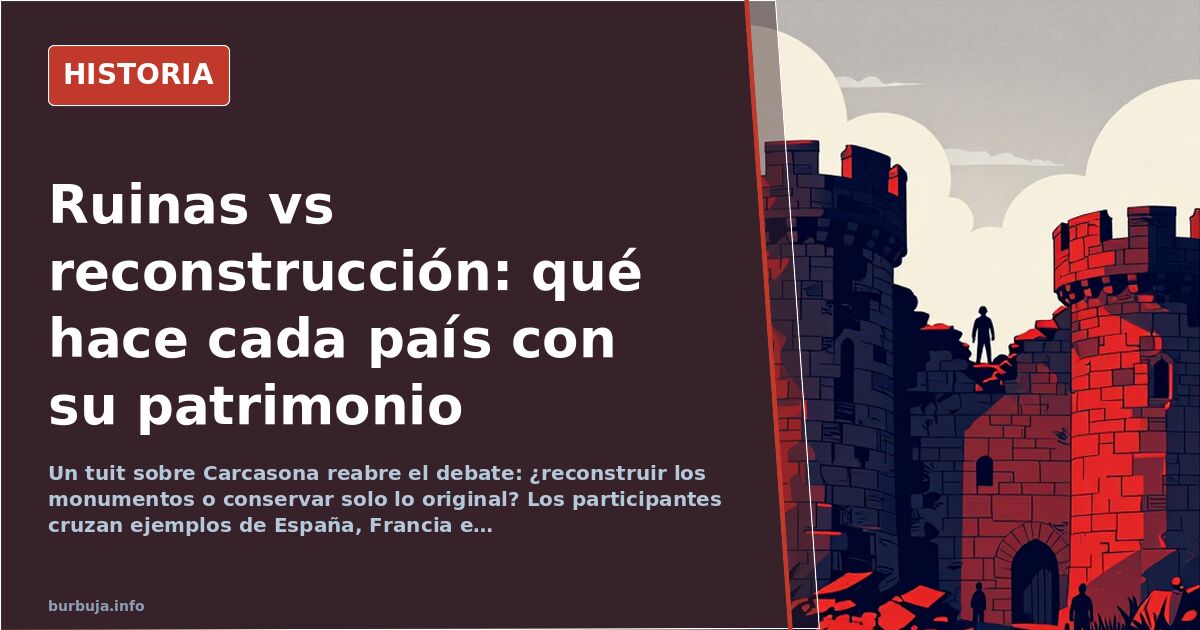
The citadel of Carcassonne is not medieval. Or not entirely. According to a tweet by @Pedro Torrijos, what existed were wall remains with no historical record, and because architect Viollet-le-Duc felt they lacked sufficient medieval character, he invented turrets and spires. The case, widely shared on social media, has peine a recurring discussion: should a monument show its scars, or can it be completed to look as it supposedly was? Each country's answer reveals more about its relationship with the past than about the stone itself.
Rebuild or Leave in Ruins: Two Opposing Models
Some argue that aggressive restoration is an improvement. If a castle was deteriorated and is recovered by adding towers and pinnacles that may have existed and collapsed centuries ago, the result is a useful, visitable building capable of generating activity. They point out that cathedrals and palaces have received additions in later eras without causing outrage. The Cathedral of Santiago de Compostela, for instance, has an 18th-century facade over a Romanesque temple.
Opposing this is the school defending the authenticity of original material. For this sector, completing missing parts based on imaginative criteria turns the monument into a stage set. The most cited example is reconstructions mixing stones of different colors to distinguish old from new. The result, they say, looks like a pixelated mosaic and breaks the historical reading of the building.
The German Case: Dresden and Blackened Stone
Dresden appears repeatedly in the conversation. The reconstruction of its historic center after the 1945 bombings incorporated blackened original stones alongside new, light ones. This chromatic mix, visible across entire facades, is used as an example of what not to do: a building that should convey historical continuity instead transmits the mark of disaster.
The comparison with Poland arises immediately. There, the choice was to reconstruct without visible seams, returning homogeneous appearances to historic centers. The argument is simple: if the goal is for heritage to remain alive and enjoyable, the distinction between original and added elements is a secondary detail.
Spain: Exemplary Conservation or Disguised Neglect?
The Spanish case generates more division. One line of analysis argues that Spain has rebuilt extensively and well, to the point where visitors cannot distinguish ancient from rehabilitated structures. Barcelona Cathedral, rebuilt in the 19th century, is the usual example: its Neo-Gothic facade passes for medieval among most tourists. With these credentials, Spain is one of the countries with the most UNESCO World Heritage sites.
Objections come from another angle. It is argued that the problem is not reconstruction, but the lack of it. Centuries-old industrial buildings, coastal forts, port warehouses: they are demolished or abandoned without protest. And when intervention occurs, the result sometimes worsens what existed. Examples include restorations using cement over original stone, removal of historical elements such as fortification cannons, and finishes in tones that recall nothing.
Italy and France: The Comparison Always Won by Those Who Avoid It
Italy enters the equation as a term of comparison. Some claim its historic centers, with alleys and classical buildings, surpass those in Spain, burdened by blocks built in the 1960s next to cathedrals that stand out awkwardly. The reply is that Italy also suffers from dirt, peeling paint, and graffiti, and that the idealized image does not withstand a walk through certain neighborhoods.
France, meanwhile, is represented by Carcassonne. The citadel receives millions of visitors, offers restaurants for dinner inside, and hosts live music. In practice, it is a high-end medieval theme park. Is that better than a pile of authentic, uninterpreted stones? It depends on whether one values experience or documentation.
What Is Lost When Rebuilding and What Is Lost When Not
The underlying discussion is not technical, but functional. A monument can be a historical document, in which case every addition is interference. Or it can be a living cultural artifact, in which case reconstruction is a way to keep it in use. Roman bridges are the clearest example: none were allowed to collapse because they crossed rivers where crossing was necessary. Each century they have received repairs, and they remain standing.
The problem arises when decisions are made by regulations rather than technical criteria. Some denounce that specific rules force buildings into a state of controlled ruin that responds to no real conservation need. In that framework, ruin ceases to be a transitional state and becomes the objective.
The Background: Identity, Tourism, and Who Pays the Bill
Behind the debate about stone lies a fight over narrative. To rebuild is to affirm that civilization continues; to leave in ruins is to accept that what existed is gone. It is not the same for a country that sees itself as heir to a long history versus one that prefers to display the wound. In the middle stands tourism: an attractive historic center generates revenue, and a lot with four columns does too, but less.
The unanswered question is uncomfortable: if two hundred years from now someone decides to complete what we today allow to fall, will we call them a restorer or a liar?
The citadel of Carcassonne is not medieval. Or not entirely. According to a tweet by @Pedro Torrijos, what existed were wall remains with no historical record, and because architect Viollet-le-Duc felt they lacked sufficient medieval character, he invented turrets and spires. The case, widely shared on social media, has peine a recurring discussion: should a monument show its scars, or can it be completed to look as it supposedly was? Each country's answer reveals more about its relationship with the past than about the stone itself.
Rebuild or Leave in Ruins: Two Opposing Models
Some argue that aggressive restoration is an improvement. If a castle was deteriorated and is recovered by adding towers and pinnacles that may have existed and collapsed centuries ago, the result is a useful, visitable building capable of generating activity. They point out that cathedrals and palaces have received additions in later eras without causing outrage. The Cathedral of Santiago de Compostela, for instance, has an 18th-century facade over a Romanesque temple.
Opposing this is the school defending the authenticity of original material. For this sector, completing missing parts based on imaginative criteria turns the monument into a stage set. The most cited example is reconstructions mixing stones of different colors to distinguish old from new. The result, they say, looks like a pixelated mosaic and breaks the historical reading of the building.
The German Case: Dresden and Blackened Stone
Dresden appears repeatedly in the conversation. The reconstruction of its historic center after the 1945 bombings incorporated blackened original stones alongside new, light ones. This chromatic mix, visible across entire facades, is used as an example of what not to do: a building that should convey historical continuity instead transmits the mark of disaster.
The comparison with Poland arises immediately. There, the choice was to reconstruct without visible seams, returning homogeneous appearances to historic centers. The argument is simple: if the goal is for heritage to remain alive and enjoyable, the distinction between original and added elements is a secondary detail.
Spain: Exemplary Conservation or Disguised Neglect?
The Spanish case generates more division. One line of analysis argues that Spain has rebuilt extensively and well, to the point where visitors cannot distinguish ancient from rehabilitated structures. Barcelona Cathedral, rebuilt in the 19th century, is the usual example: its Neo-Gothic facade passes for medieval among most tourists. With these credentials, Spain is one of the countries with the most UNESCO World Heritage sites.
Objections come from another angle. It is argued that the problem is not reconstruction, but the lack of it. Centuries-old industrial buildings, coastal forts, port warehouses: they are demolished or abandoned without protest. And when intervention occurs, the result sometimes worsens what existed. Examples include restorations using cement over original stone, removal of historical elements such as fortification cannons, and finishes in tones that recall nothing.
Italy and France: The Comparison Always Won by Those Who Avoid It
Italy enters the equation as a term of comparison. Some claim its historic centers, with alleys and classical buildings, surpass those in Spain, burdened by blocks built in the 1960s next to cathedrals that stand out awkwardly. The reply is that Italy also suffers from dirt, peeling paint, and graffiti, and that the idealized image does not withstand a walk through certain neighborhoods.
France, meanwhile, is represented by Carcassonne. The citadel receives millions of visitors, offers restaurants for dinner inside, and hosts live music. In practice, it is a high-end medieval theme park. Is that better than a pile of authentic, uninterpreted stones? It depends on whether one values experience or documentation.
What Is Lost When Rebuilding and What Is Lost When Not
The underlying discussion is not technical, but functional. A monument can be a historical document, in which case every addition is interference. Or it can be a living cultural artifact, in which case reconstruction is a way to keep it in use. Roman bridges are the clearest example: none were allowed to collapse because they crossed rivers where crossing was necessary. Each century they have received repairs, and they remain standing.
The problem arises when decisions are made by regulations rather than technical criteria. Some denounce that specific rules force buildings into a state of controlled ruin that responds to no real conservation need. In that framework, ruin ceases to be a transitional state and becomes the objective.
The Background: Identity, Tourism, and Who Pays the Bill
Behind the debate about stone lies a fight over narrative. To rebuild is to affirm that civilization continues; to leave in ruins is to accept that what existed is gone. It is not the same for a country that sees itself as heir to a long history versus one that prefers to display the wound. In the middle stands tourism: an attractive historic center generates revenue, and a lot with four columns does too, but less.
The unanswered question is uncomfortable: if two hundred years from now someone decides to complete what we today allow to fall, will we call them a restorer or a liar?
Also available in: Deutsch
Summary of a discussion on Burbuja.info - Foro de economía, actualidad y política., translated from Spanish and reviewed before publication. Read the full discussion (105 replies).
More summaries
-
Algeria Holds More Roman Ruins Than Spain and France
Algeria hosts over 500 Roman cities, second only to Italy. Why remains its heritage largely untapped? We explain.
-
ETA and GAL: two arms of the same Gladio network in Spain
Investigation linking ETA and GAL as arms of the same NATO Gladio network, with drug trafficking funding and CIA control.
-
Ceausescu Execution: Missing Video of the Shots
The video of Ceausescu's execution jumps from binding hands to bodies on the ground. Where is the footage of the actual shooting?
-
Why Muslim Conquest Failed in Asturias and Vasconia
Poor land, cavalry limits, and Berber revolts explain why the Cantabrian strip remained outside Al-Andalus.
-
Spain’s Worst Areas: Mapping Poverty and Incarceration
Bulgaria-level income, prisons with 99% locals, and uncontrolled neighborhoods define Spain’s most deprived areas.
-
Al-Andalus Genetics: Lower North African Ancestry Than Believed
G25 coordinate analysis places the highest North African genetic impact in western Iberia, not Andalusia, challenging the legacy of the Muslim conquest.