
Auchan and Leclerc consider removing self-checkout due to theft
French retailers Auchan and Leclerc are questioning self-checkout machines amid rising theft, with usage below 12% and potential returns to traditional staffing.
English · Original discussion in Spanish · Published
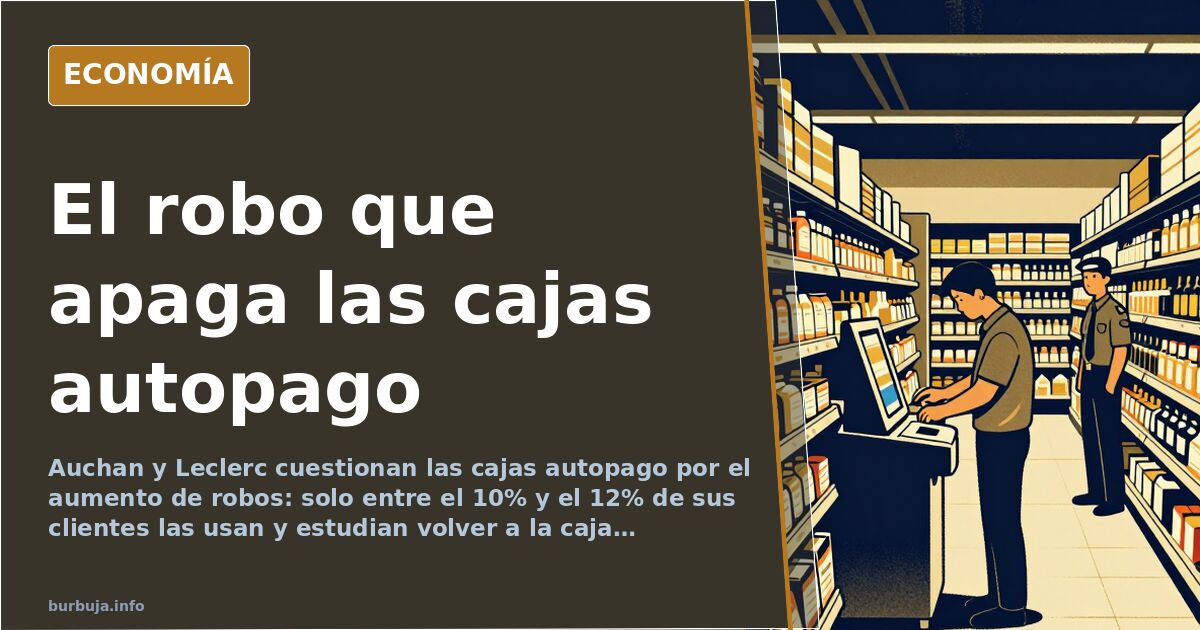
Self-checkouts shut down due to customer theft
Two of France's largest retail chains have raised doubts about the future of self-checkout lanes. Auchan and Leclerc have expressed concern over increased theft and threatened to dismantle the model in favor of traditional methods. Michel-Édouard Leclerc, CEO of Leclerc, acknowledged his disappointment and quantified actual machine usage: only 10% to 12% of customers use them. The technology intended to revolutionize shopping appears to have an expiration date.
Why French supermarkets are considering removing self-checkouts
The official reason is continuous consumer theft. The unofficial reason is more uncomfortable: the machine cannot guarantee that a person entering a lane leaves having scanned and paid for everything they took. The technology falls short, and the human cashier who once handled transactions now watches from a distance. In France, the equation does not add up.
The paradox is that the system was designed to save labor and estimulante ilegal up checkout. What has peine in many cases is the opposite: those unfamiliar with the scanner take longer than with a trained cashier, get confused by discounts and finding fruit on the screen, and end up creating queues where there were none. At Decathlon, the reader sensitivity is such that merely approaching within three meters triggers charges for items still held in hand.
The customer paying themselves as a cashier
The underlying debate is sarracena, not technological. One school of thought argues that the company committed the first theft by shifting work previously paid to employees onto the customer without lowering product prices. Under this logic, taking an item without scanning it is not a crime, but jistiprecio: the proportional part of the cashier's salary the buyer claims in kind.
Some frame it as a sarracena duty: steal as much as possible whenever these machines are present. Others share their own experiences casually: leaving without paying for certain items, claiming ignorance if caught, and passing the buck back to the store. The cashier who once processed payments now supervises ten terminals and, when asked what discount corresponds to doing their job, has no answer.
The map some already have in mind
In the realm of suspicion, part of the analysis cross-references theft rates at self-checkouts with the demographic composition of each area, anticipating a high correlation coefficient. This hypothesis is launched without data and coexists with the obvious response: the phenomenon also exists in Germany and France. The discussion then drifts into territories unrelated to the scanner.
More grounded is the observation that the problem is not the system, but the clientele. Older customers face real difficulties: applying discounts, locating bread or vegetables on the screen, and paying only by card. The result is a fast lane becoming slow, and a reduced staff unable to absorb the bottleneck.
What happens when the job disappears
The labor backdrop runs through the entire issue. These machines eliminate jobs, and cost savings go both ways: the company saves on staff, and the customer compensates independently. The lingering question is whether the model survives when the customer loses incentives to use it correctly. French chains seem to have started answering no.
With these elements, one would reasonably expect an orderly withdrawal of self-checkouts in France. What exists instead is a standoff: the company says they are removing them due to theft, while customers say the thefts are the wages they were never paid. Who sustains the system when both parties believe the other is cheating them?
Two of France's largest retail chains have raised doubts about the future of self-checkout lanes. Auchan and Leclerc have expressed concern over increased theft and threatened to dismantle the model in favor of traditional methods. Michel-Édouard Leclerc, CEO of Leclerc, acknowledged his disappointment and quantified actual machine usage: only 10% to 12% of customers use them. The technology intended to revolutionize shopping appears to have an expiration date.
Why French supermarkets are considering removing self-checkouts
The official reason is continuous consumer theft. The unofficial reason is more uncomfortable: the machine cannot guarantee that a person entering a lane leaves having scanned and paid for everything they took. The technology falls short, and the human cashier who once handled transactions now watches from a distance. In France, the equation does not add up.
The paradox is that the system was designed to save labor and estimulante ilegal up checkout. What has peine in many cases is the opposite: those unfamiliar with the scanner take longer than with a trained cashier, get confused by discounts and finding fruit on the screen, and end up creating queues where there were none. At Decathlon, the reader sensitivity is such that merely approaching within three meters triggers charges for items still held in hand.
The customer paying themselves as a cashier
The underlying debate is sarracena, not technological. One school of thought argues that the company committed the first theft by shifting work previously paid to employees onto the customer without lowering product prices. Under this logic, taking an item without scanning it is not a crime, but jistiprecio: the proportional part of the cashier's salary the buyer claims in kind.
Some frame it as a sarracena duty: steal as much as possible whenever these machines are present. Others share their own experiences casually: leaving without paying for certain items, claiming ignorance if caught, and passing the buck back to the store. The cashier who once processed payments now supervises ten terminals and, when asked what discount corresponds to doing their job, has no answer.
The map some already have in mind
In the realm of suspicion, part of the analysis cross-references theft rates at self-checkouts with the demographic composition of each area, anticipating a high correlation coefficient. This hypothesis is launched without data and coexists with the obvious response: the phenomenon also exists in Germany and France. The discussion then drifts into territories unrelated to the scanner.
More grounded is the observation that the problem is not the system, but the clientele. Older customers face real difficulties: applying discounts, locating bread or vegetables on the screen, and paying only by card. The result is a fast lane becoming slow, and a reduced staff unable to absorb the bottleneck.
What happens when the job disappears
The labor backdrop runs through the entire issue. These machines eliminate jobs, and cost savings go both ways: the company saves on staff, and the customer compensates independently. The lingering question is whether the model survives when the customer loses incentives to use it correctly. French chains seem to have started answering no.
With these elements, one would reasonably expect an orderly withdrawal of self-checkouts in France. What exists instead is a standoff: the company says they are removing them due to theft, while customers say the thefts are the wages they were never paid. Who sustains the system when both parties believe the other is cheating them?
Summary of a discussion on Burbuja.info - Foro de economía, actualidad y política., translated from Spanish and reviewed before publication. Read the full discussion (186 replies).
More summaries
-
Staff Shortages in Supermarkets: 1,100 Euros and Unfilled Shifts
Supermarket staff shortages clash with 1,100 euro salaries, split shifts, language requirements, and self-checkout machines filling the gap.
-
Riots in French schools: fires and attacks
Fires in French schools, teachers attacked and blockades spreading to Belgium. The unrest is attributed to the education strike and radical groups.
-
Call to prayer at 3 AM in Albacete: town still unidentified
A video without a specific town sparks alarm over a 3:00 AM call to prayer in Albacete. The timing doesn't add up and the controversy gets tangled between hoax, noise and…
-
Lucía Etxebarría’s Morocco assault account stirs debate in Ceuta
Lucía Etxebarría details a sexual assault in Morocco, reigniting discussions on women's safety and the Ceuta border.
-
Conscription Debate Misses Core Question of State Power
Denmark extends military service to 11 months, while Germany sees low volunteer numbers. The real issue is not who serves, but whether conscription should exist.
-
Ayuso's Shorts Spark Fire Management Debate in Madrid
Madrid's president wore tactical shorts to a wildfire, igniting controversy over firefighter cuts and emergency coordination.