
Staff Shortages in Supermarkets: 1,100 Euros and Unfilled Shifts
Supermarket staff shortages clash with 1,100 euro salaries, split shifts, language requirements, and self-checkout machines filling the gap.
English · Original discussion in Spanish · Published
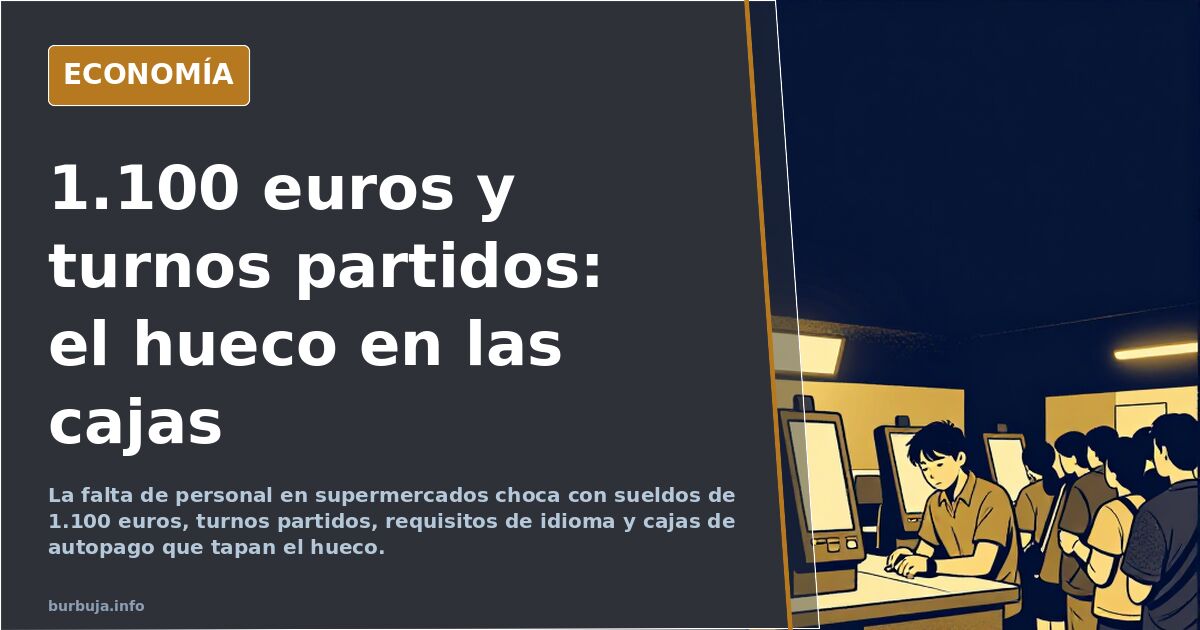
Staff Shortages in Supermarkets: 1,100 Euros and Unfilled Shifts
A checkout position at a Spanish supermarket requiring Catalan and paying around 1,100 euros remains unfilled, with the store manager stepping in to restock and operate the register. This scenario repeats across several chains, highlighting a broader food retail labor crisis where self-checkout expands not due to technological preference, but because of a lack of workers. Interestingly, these vacancies are cheaper to fill than to leave empty.
How Much Is Paid in a Supermarket?
A stock clerk earns around 1,100 euros per month. A supermarket position demanding early mornings pays 1,200 euros. Meanwhile, public assistance can reach 1,040 euros without working. The difference is consistently about 160 euros for split shifts, Saturdays, and constant schedule changes. In private security, bonuses range from 600 to 700 euros depending on the province; conversely, a luxury store clerk starts at 1,500.
Some argue the issue is not the difficulty—"it is not particularly hard"—but the pay. Others view the role merely as a bridge: workers stay until they buy a car and move to logistics, where a forklift driver may earn more than a manager. The exit, working Monday to Friday in an industrial park, arrives before any store salary increase. The position is the ramp, not the destination.
The Catalan Language Requirement Narrowing the Funnel
In chains like Bon Preu and Bon Àrea, Catalan acts as an entry filter. According to those who have experienced it, this requirement reduces the number of candidates just when the sector complains about staff shortages. Some view it as an unnecessary barrier; others argue that if the position requires the language, it should be paid for or the requirement dropped. What almost no one disputes is the result: the pool of applicants shrinks, and existing staff fill the gap through overtime.
Self-Checkout, EREs, and the Antiestéticar of Robotization
Self-checkout machines multiply despite daily users finding them less effective than human hands. The recurring conclusion is uncomfortable: they are not implemented because they are better, but because there is no one to assist. The supermarket itself forces cashiers to handle products when the checkout is plastic, undermining the promise of total self-service. Meanwhile, an Alcampo employee describes a "falling-apart" chain preparing for an ERE (collective dismissal procedure), with university graduates stuck in managerial roles.
Mercadona is the exception that proves the rule: people fight to enter because it is demanding, strict, and pays. The difference with the rest is not technological. It is managerial.
Small Pay, Public Exams, and the Narrative of Effort
The most repeated argument is the disincentive: with assistance around 1,040 euros, the difference with an 1,100 euro salary does not justify early mornings. There are those who exhaust two years of unemployment benefits, those waiting for the over-52 aid, and those who do not consider applying at all. In contrast, data shows last year between 50,000 and 60,000 civil service positions were offered, with vacant technical roles (Group A, IT, or aeronautics) representing about 1% of the total.
The nuance matters. Staff shortages do not equate to a lack of vocations across the board: competition is fierce in general administration, while specific technical posts have plenty of vacancies.
A 70-Year-Old Customer Base Without Succession
The morning scene, according to the observation opening the issue, is an aisle with 90% of customers aged 70 or older. This figure, more than salary, worries those looking ahead: the buyer base is aging, staff is unavailable, and the equation does not add up five years from now. Fruit restocking is not sustained by self-checkout alone, and customers who cannot use scanners need someone nearby.
With these elements, the sector has three options: raise salaries, lower requirements, or install machines that work worse. The first two cost money. The third is already being applied, and the result is visible to anyone shopping on a Tuesday morning.
A checkout position at a Spanish supermarket requiring Catalan and paying around 1,100 euros remains unfilled, with the store manager stepping in to restock and operate the register. This scenario repeats across several chains, highlighting a broader food retail labor crisis where self-checkout expands not due to technological preference, but because of a lack of workers. Interestingly, these vacancies are cheaper to fill than to leave empty.
How Much Is Paid in a Supermarket?
A stock clerk earns around 1,100 euros per month. A supermarket position demanding early mornings pays 1,200 euros. Meanwhile, public assistance can reach 1,040 euros without working. The difference is consistently about 160 euros for split shifts, Saturdays, and constant schedule changes. In private security, bonuses range from 600 to 700 euros depending on the province; conversely, a luxury store clerk starts at 1,500.
Some argue the issue is not the difficulty—"it is not particularly hard"—but the pay. Others view the role merely as a bridge: workers stay until they buy a car and move to logistics, where a forklift driver may earn more than a manager. The exit, working Monday to Friday in an industrial park, arrives before any store salary increase. The position is the ramp, not the destination.
The Catalan Language Requirement Narrowing the Funnel
In chains like Bon Preu and Bon Àrea, Catalan acts as an entry filter. According to those who have experienced it, this requirement reduces the number of candidates just when the sector complains about staff shortages. Some view it as an unnecessary barrier; others argue that if the position requires the language, it should be paid for or the requirement dropped. What almost no one disputes is the result: the pool of applicants shrinks, and existing staff fill the gap through overtime.
Self-Checkout, EREs, and the Antiestéticar of Robotization
Self-checkout machines multiply despite daily users finding them less effective than human hands. The recurring conclusion is uncomfortable: they are not implemented because they are better, but because there is no one to assist. The supermarket itself forces cashiers to handle products when the checkout is plastic, undermining the promise of total self-service. Meanwhile, an Alcampo employee describes a "falling-apart" chain preparing for an ERE (collective dismissal procedure), with university graduates stuck in managerial roles.
Mercadona is the exception that proves the rule: people fight to enter because it is demanding, strict, and pays. The difference with the rest is not technological. It is managerial.
Small Pay, Public Exams, and the Narrative of Effort
The most repeated argument is the disincentive: with assistance around 1,040 euros, the difference with an 1,100 euro salary does not justify early mornings. There are those who exhaust two years of unemployment benefits, those waiting for the over-52 aid, and those who do not consider applying at all. In contrast, data shows last year between 50,000 and 60,000 civil service positions were offered, with vacant technical roles (Group A, IT, or aeronautics) representing about 1% of the total.
The nuance matters. Staff shortages do not equate to a lack of vocations across the board: competition is fierce in general administration, while specific technical posts have plenty of vacancies.
A 70-Year-Old Customer Base Without Succession
The morning scene, according to the observation opening the issue, is an aisle with 90% of customers aged 70 or older. This figure, more than salary, worries those looking ahead: the buyer base is aging, staff is unavailable, and the equation does not add up five years from now. Fruit restocking is not sustained by self-checkout alone, and customers who cannot use scanners need someone nearby.
With these elements, the sector has three options: raise salaries, lower requirements, or install machines that work worse. The first two cost money. The third is already being applied, and the result is visible to anyone shopping on a Tuesday morning.
Summary of a discussion on Burbuja.info - Foro de economía, actualidad y política., translated from Spanish and reviewed before publication. Read the full discussion (213 replies).
More summaries
-
Spanish Bakery Closes With 1,200 Daily Customers: The Baker's Paradox
La Flor de Nigrán shuts down after 35 years due to staff shortages. Low margins reveal why few want to be bakers in Spain.
-
Spanish restaurant owner cancels dinner service over staff shortage
A restaurant owner cancels dinner service due to lack of staff, blaming 'paguitas' (welfare handouts). The debate centers on whether the problem is social benefits or poverty wages.
-
Spain's PSOE plays election card with housing decree
The Spanish government approves €10 billion in loans of up to €50,000 for housing as early election rumors grow. The IBEX surged on the news.
-
Ibiza's Empty Beaches: High Prices and Tourist Fatigue
Half-empty beaches in Ibiza, with €6 beers and €26 salads, drive tourists to Menorca and Morocco.
-
Feijóo's sick leave crusade backfires, hurting PP votes
Feijóo labels sick leave a 'cancer' and proposes cuts. Analysis shows how this PP strategy alienates voters and benefits Sánchez.
-
Aldama predicts Zapatero and Sánchez imprisonment
Víctor de Aldama forecasts prison for Zapatero and Sánchez. We analyze his track record and the resulting political earthquake in Spain.