
Attached Bottle Caps: EU Law Mandates New Packaging Rules
Since July 3, 2024, Spain's Waste and Contaminated Land Act 7/2022 requires caps to stay attached to bottles and cartons across Europe.
English · Original discussion in Spanish · Published
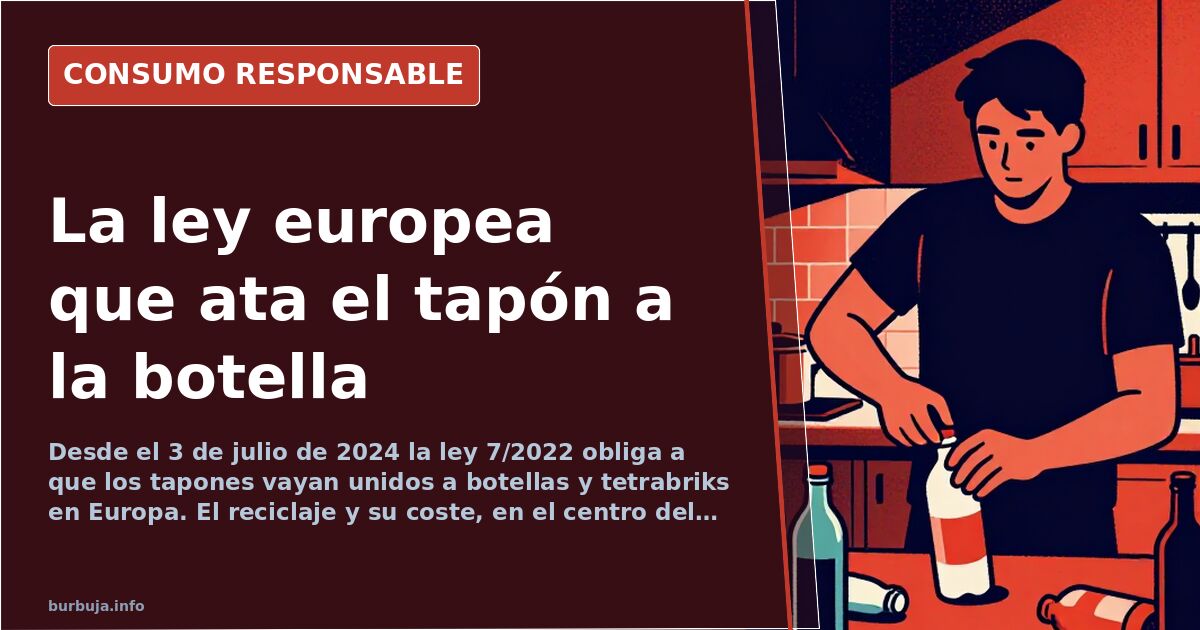
Caps Stay Attached: The Law That Changed Packaging
Since July 3, 2024, no single-use plastic bottle can be sold in Europe with a loose cap. This obligation stems not from manufacturer whims but from Article 57.1 of Law 7/2022, dated April 8, on waste and contaminated soils for a circular economy: lids and caps must remain attached to the container throughout its intended use phase. It affects bottles and Tetra Paks, excluding metal closures with plastic seals via fine print. The European regulation was approved in 2018, tweaked in 2019, and transposed into Spanish law in 2022. The result is that awkward, spinning cap stuck to the bottle neck.
Why Does the Law Require Caps to Stay Attached?
The stated goal is for bottles and caps to be collected together and reach recycling facilities together. Small caps are easily lost and rank among the most common plastics in marine environments. On paper, attachment aims to reduce this pollution and extract residual value from materials within the circular economy. Coca-Cola began distributing bottles with the new closure in late 2022, ahead of the mandate, using a design—branded as "compactflip" and developed by Berry Global—that cuts cap material by approximately 20%. All PET bottles under three liters now antiestéticature this attached closure.
The Recycling Business: Who Pays and Who Profits
Every packaged product bought by the final consumer includes an extra cost for waste management. This management involves sorting, the most expensive part of the process, which is delegated to citizens through tonalidad-coded bins. You pay for sorting, then sort for free at home, occupying kitchen space with another bag. Some analysis suggests the system retains higher-value plastics—those from caps, easy to recycle and subject to specific collection campaigns—and parks the rest, much of which isn't recyclable. The "polluter pays" principle is reinforced by extended producer responsibility, including tobacco and fishing gear producers.
Returnable Glass That Actually Closed the Loop
In the 1980s, returning glass containers to shops meant getting money back. That system—"returning the bottle"—ensured no glass bottles were left on the street: it was money. Today, that incentive doesn't exist in Spain, but it does in other countries, with supermarket machines exchanging containers for vouchers redeemable at checkout. The European Union mandates recovering 90% of plastic bottles by 2029 and sets recycled content targets. The question persists: if environmental concern is genuine, why not return to reusable glass containers?
The "Reusable" Container That Gets Thrown Away Anyway
The ban on single-use plastics has had a side effect nobody advertised. Disposable plates were prohibited, replaced by "reusable" plates similar to before but requiring more plastic in manufacturing. The result: many people use them once and throw them away, just like the banned ones, only with more material involved. Something similar happens with thinner bags: to protect bread, a compostable bag is placed inside a thin bag, ending up using more plastic than a proper bag would.
Intentionally Removing the Cap: Consumer Rebellion
The most repeated reaction is rejection. Some rip off the tab immediately upon opening because drinking directly is uncomfortable and the cap hits their nose or lips. Others used the cap to fold the container utilizing the vacuum and now deliberately separate it, throwing it in another bin. An unexpected defense: attached caps prevent choking hazards for minors who start pressing the tab out of curiosity. Between rebellious gestures and safety arguments, consumers do what they reasonably can.
Waste Europe Doesn’t Dump But Others Do
The other major criticism points outward. While Europe imposes limits on consumers, it’s argued that there are continents where trash is dumped into the sea freely. No European municipality dumps waste into the ocean, yet discomfort persists: the feeling that Europeans bear the cost of a global problem. Greenpeace estimates that 500 billion plastic bottles are dumped annually and that more plastic has been produced in the last decade than in all previous human history.
Does tying the cap to the bottle help if neighbors on other continents keep dumping everything into the sea? The law is already in force. Two years later, the answer remains unwritten.
Since July 3, 2024, no single-use plastic bottle can be sold in Europe with a loose cap. This obligation stems not from manufacturer whims but from Article 57.1 of Law 7/2022, dated April 8, on waste and contaminated soils for a circular economy: lids and caps must remain attached to the container throughout its intended use phase. It affects bottles and Tetra Paks, excluding metal closures with plastic seals via fine print. The European regulation was approved in 2018, tweaked in 2019, and transposed into Spanish law in 2022. The result is that awkward, spinning cap stuck to the bottle neck.
Why Does the Law Require Caps to Stay Attached?
The stated goal is for bottles and caps to be collected together and reach recycling facilities together. Small caps are easily lost and rank among the most common plastics in marine environments. On paper, attachment aims to reduce this pollution and extract residual value from materials within the circular economy. Coca-Cola began distributing bottles with the new closure in late 2022, ahead of the mandate, using a design—branded as "compactflip" and developed by Berry Global—that cuts cap material by approximately 20%. All PET bottles under three liters now antiestéticature this attached closure.
The Recycling Business: Who Pays and Who Profits
Every packaged product bought by the final consumer includes an extra cost for waste management. This management involves sorting, the most expensive part of the process, which is delegated to citizens through tonalidad-coded bins. You pay for sorting, then sort for free at home, occupying kitchen space with another bag. Some analysis suggests the system retains higher-value plastics—those from caps, easy to recycle and subject to specific collection campaigns—and parks the rest, much of which isn't recyclable. The "polluter pays" principle is reinforced by extended producer responsibility, including tobacco and fishing gear producers.
Returnable Glass That Actually Closed the Loop
In the 1980s, returning glass containers to shops meant getting money back. That system—"returning the bottle"—ensured no glass bottles were left on the street: it was money. Today, that incentive doesn't exist in Spain, but it does in other countries, with supermarket machines exchanging containers for vouchers redeemable at checkout. The European Union mandates recovering 90% of plastic bottles by 2029 and sets recycled content targets. The question persists: if environmental concern is genuine, why not return to reusable glass containers?
The "Reusable" Container That Gets Thrown Away Anyway
The ban on single-use plastics has had a side effect nobody advertised. Disposable plates were prohibited, replaced by "reusable" plates similar to before but requiring more plastic in manufacturing. The result: many people use them once and throw them away, just like the banned ones, only with more material involved. Something similar happens with thinner bags: to protect bread, a compostable bag is placed inside a thin bag, ending up using more plastic than a proper bag would.
Intentionally Removing the Cap: Consumer Rebellion
The most repeated reaction is rejection. Some rip off the tab immediately upon opening because drinking directly is uncomfortable and the cap hits their nose or lips. Others used the cap to fold the container utilizing the vacuum and now deliberately separate it, throwing it in another bin. An unexpected defense: attached caps prevent choking hazards for minors who start pressing the tab out of curiosity. Between rebellious gestures and safety arguments, consumers do what they reasonably can.
Waste Europe Doesn’t Dump But Others Do
The other major criticism points outward. While Europe imposes limits on consumers, it’s argued that there are continents where trash is dumped into the sea freely. No European municipality dumps waste into the ocean, yet discomfort persists: the feeling that Europeans bear the cost of a global problem. Greenpeace estimates that 500 billion plastic bottles are dumped annually and that more plastic has been produced in the last decade than in all previous human history.
Does tying the cap to the bottle help if neighbors on other continents keep dumping everything into the sea? The law is already in force. Two years later, the answer remains unwritten.
Summary of a discussion on Burbuja.info - Foro de economía, actualidad y política., translated from Spanish and reviewed before publication. Read the full discussion (182 replies).
More summaries
-
Euskola: the Basque answer to Coca-Cola shaking up Bilbao's fiestas
Euskola, the local Basque cola, arrives at Bilbao's fiestas to compete with Coca-Cola. A look at its price, production and the debate over responsible consumption.
-
The €3.61 Fee Killing AliExpress Purchases
The €3.61 per-category tariff has inflated AliExpress purchases by up to 80%. Consumers are stopping buys, and revenue is falling. Does it actually protect...
-
Best budget phones under €150: Moto G vs Lumia 640
The Moto G dropped to €139, ending the search for a phone under €150. It competes with the Lumia 640, Xiaomi, and Huawei.
-
Men’s skincare: The lingering stigma against moisturizers
Despite the rise of retinol and natural cosmetics, many men still avoid moisturizers due to deep-seated gender prejudices.
-
Study links half a glass of wine daily to obesity
A Korean study presented at the ECOICO congress finds that exceeding 7 grams of alcohol daily raises the risk of obesity and metabolic syndrome.
-
Vegan Diets Risk Critical Choline Deficiency, Expert Warns
Dr. Emma Derbyshire warns that vegan diets cause widespread choline deficiency, a nutrient vital for fetal brain development.