
Asylum in Palestine: The Legal Paradox Undermining the Narrative
Seeking asylum in Palestine as a homosexual: laws vary between the West Bank and Gaza, yet real persecution persists. An analysis of this legal paradox.
English · Original discussion in Spanish · Published
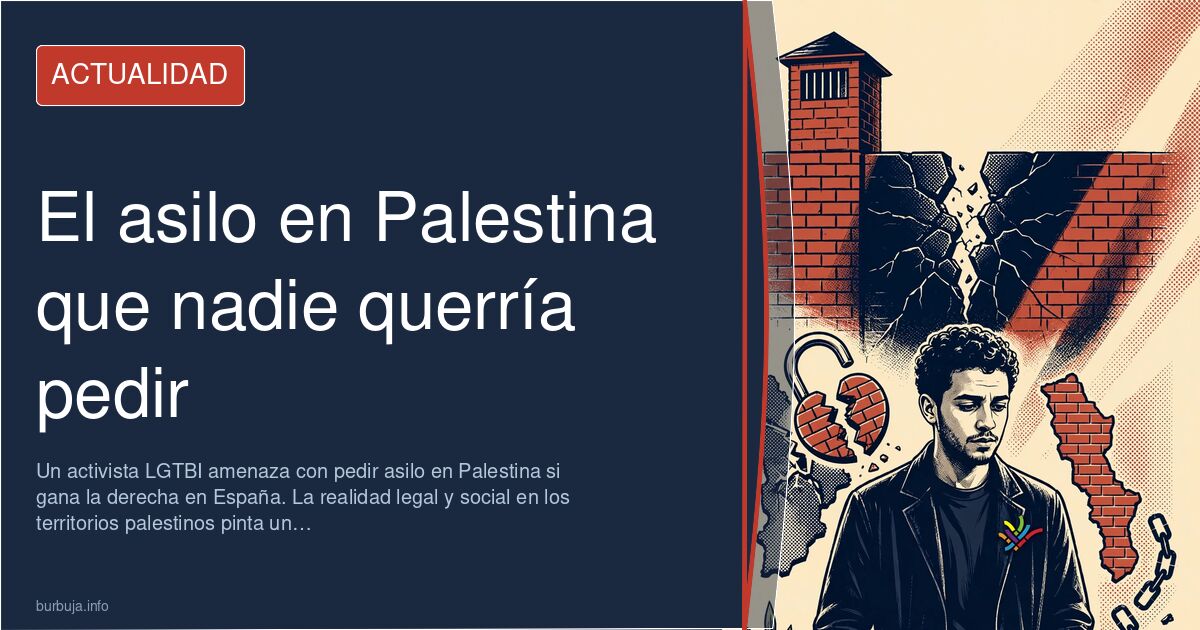
Seeking asylum in Palestine as a gai: the contradiction no one explains
Seeking political asylum in Palestine as a gai is not a survival strategy; it is, at best, an exercise in legal ignorance. The claim, circulated on social media, has sparked intense debate regarding the actual situation of LGBTQI rights in the Palestinian territories. However, a detailed analysis of current legislation reveals an uncomfortable reality that dismantles the discourse.
Two Penal Codes, One Land
Legally, there is no single Palestine. In the West Bank, the Jordanian penal code of 1951 remains in force, reformed in 1960, which does not penalize same-sens relationships. Jordan decriminalized them in 1951, and upon annexation of the West Bank, extended the same text there. On paper, therefore, gaiity is legal in that area.
In Gaza, however, another norm applies: the penal ordinance of the British Mandate of 1936, which has never been repealed. This ordinance includes provisions that penalize gai relationships, with sentences that can reach imprisonment. Thus, legality depends on the exact location of one's presence.
The Reality of Persecution: The Al Qaws Case
The law is not the only obstacle. In August 2019, the spokesperson for the Palestinian police, Louai Irzeqat, announced that they would prohibit any activity by Al Qaws, an LGBTQI organization operating in the West Bank. He described it as a “suspicious group” and promised to detain and prosecute its members. Although this announcement did not translate into mass arrests, it demonstrates that social and political persecution is real, regardless of the legal text.
The Spanish Historical Precedent
The debate has also brought up an episode from Spanish history. The Law of Vagrants and Malcontents, enacted in 1933 during the Second Republic, did not include gaiity. It was the Franco regime that, in 1954, modified the law to include gais, using it as an instrument of repression. This historical reference has been used to argue that contemporary Spanish conservatism is not comparable to that regime, but also to serve as a reminder that legal persecution can come from anywhere.
Public Reaction and Credibility
The original claim has been met with skepticism and ridicule in wide sectors. Many point out that the person making the statement does not seem to know the reality of the Palestinian territories, where the LGBTQI community suffers discrimination and violence. Others, more cynical, suggest it is a deliberate provocation to generate controversy. In any case, the lack of legal and social knowledge is evident.
It is likely that this claim will remain just a provocation on social media. But if anyone takes it seriously, the outcome would be tragic. The legal and social reality in Palestine is far from being a refuge for the LGBTQI community, and the contradiction between discourse and practice is a reminder that ignorance can be dangerous.
Seeking political asylum in Palestine as a gai is not a survival strategy; it is, at best, an exercise in legal ignorance. The claim, circulated on social media, has sparked intense debate regarding the actual situation of LGBTQI rights in the Palestinian territories. However, a detailed analysis of current legislation reveals an uncomfortable reality that dismantles the discourse.
Two Penal Codes, One Land
Legally, there is no single Palestine. In the West Bank, the Jordanian penal code of 1951 remains in force, reformed in 1960, which does not penalize same-sens relationships. Jordan decriminalized them in 1951, and upon annexation of the West Bank, extended the same text there. On paper, therefore, gaiity is legal in that area.
In Gaza, however, another norm applies: the penal ordinance of the British Mandate of 1936, which has never been repealed. This ordinance includes provisions that penalize gai relationships, with sentences that can reach imprisonment. Thus, legality depends on the exact location of one's presence.
The Reality of Persecution: The Al Qaws Case
The law is not the only obstacle. In August 2019, the spokesperson for the Palestinian police, Louai Irzeqat, announced that they would prohibit any activity by Al Qaws, an LGBTQI organization operating in the West Bank. He described it as a “suspicious group” and promised to detain and prosecute its members. Although this announcement did not translate into mass arrests, it demonstrates that social and political persecution is real, regardless of the legal text.
The Spanish Historical Precedent
The debate has also brought up an episode from Spanish history. The Law of Vagrants and Malcontents, enacted in 1933 during the Second Republic, did not include gaiity. It was the Franco regime that, in 1954, modified the law to include gais, using it as an instrument of repression. This historical reference has been used to argue that contemporary Spanish conservatism is not comparable to that regime, but also to serve as a reminder that legal persecution can come from anywhere.
Public Reaction and Credibility
The original claim has been met with skepticism and ridicule in wide sectors. Many point out that the person making the statement does not seem to know the reality of the Palestinian territories, where the LGBTQI community suffers discrimination and violence. Others, more cynical, suggest it is a deliberate provocation to generate controversy. In any case, the lack of legal and social knowledge is evident.
It is likely that this claim will remain just a provocation on social media. But if anyone takes it seriously, the outcome would be tragic. The legal and social reality in Palestine is far from being a refuge for the LGBTQI community, and the contradiction between discourse and practice is a reminder that ignorance can be dangerous.
Summary of a discussion on Burbuja.info - Foro de economía, actualidad y política., translated from Spanish and reviewed before publication. Read the full discussion (117 replies).
More summaries
-
Camryn Manheim and the ‘gay son’ she wished she had
A quote attributed to Camryn Manheim—wanting a gay son and dressing him in drag—reopens the debate over identities imposed on children
-
Vegan raw-food influencer dies at 39 after extreme diet
Zhanna Samsonova, 39, a raw-food influencer, died in Malaysia from an infection worsened by the 'exhaustion' of an extreme fruit-only diet
-
DN calls for 'kicking out' the Puerta del Sol campers
A Democracia Nacional leader urges a group of 'brave men' to 'kick out' the Puerta del Sol campers.
-
Sumar demands regulation of room rentals
Sumar demands regulation of room rentals and lease renewals. An investor warns that property maths no longer add up.
-
Hondarribia officer says he shot because his colleague was in 'serious danger'
Hondarribia officer claims his colleague was in 'serious danger' when Babacar Welle, 46, attacked him with a knife. The Ertzaintza is investigating.
-
Chini Chuini set to become Jewish
Ynet reports that Sydney Sweeney has reportedly converted to Judaism and was seen at a synagogue with Scooter Braun. She has not confirmed it.