
Asaja warns Ukrainian wheat floods EU market, crashing prices by 30%
Asaja reports a 30% drop in Spanish wheat prices since April 2022 due to tariff-free Ukrainian grain imports, with Spain as the EU's top recipient.
English · Original discussion in Spanish · Published
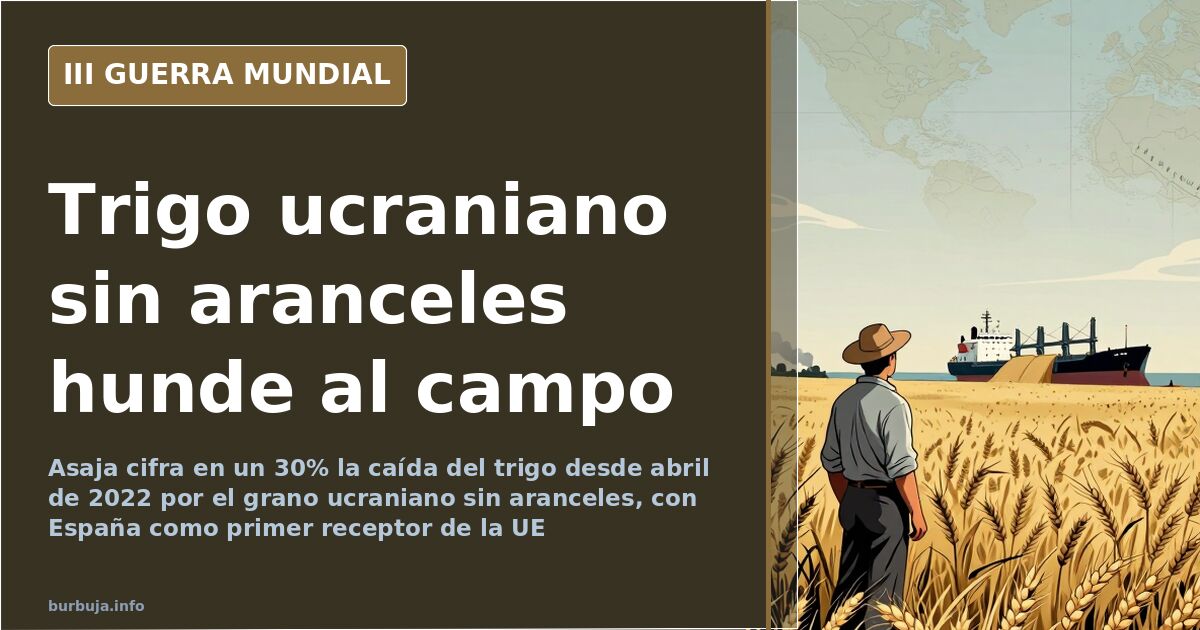
Tariff-free Ukrainian wheat floods EU, driving prices down 30%
Ukrainian wheat enters the European Union without the quotas or tariffs applied to other third countries, causing cereal prices to fall 30% below their April 2022 levels. Asaja denounces this situation, supporting solidarity with Ukraine but criticizing how the economic burden is distributed. Spain has become the largest importer of Ukrainian grain in the EU, receiving wheat, barley, and maize. The agricultural organization describes this as "Brussels' permissiveness."
This warning comes during an exceptionally difficult year. Severe drought affects the entire country, particularly Castilla y León, where harvest expectations are "declining week by week" and already considered "disastrous" across large areas. Low yields are compounded by skyrocketing sowing costs. According to Asaja, these factors result in significant losses.
Why do wheat prices fall if Spain continues to import?
Spain has a deficit in wheat, barley, and maize, necessitating substantial foreign purchases. Asaja does not advocate closing borders: "We will certainly continue importing Ukrainian grain, prioritizing it over other third countries to support their economy. However, this must occur under established EU conditions, including appropriate limits and tariffs." This is the core argument.
The organization contends that unregulated entry depresses the market, pushing prices below production costs. They describe a market "overdosed" by an influx of bargain-priced grain. If current price levels persist, Asaja warns that bankruptcy is "more than certain" for thousands of farms.
Asaja recalls its initial support for European measures to facilitate Ukrainian grain exports. It opposes, however, allowing these exports without the standard conditions applied globally. The group urges the Spanish government, led by Pedro Sánchez, to take a firm stance, similar to actions taken by other European nations.
From 45-cent bread to 70 cents: retail prices remain high
The most troubling contradiction lies here. When war threatened scarcity, flour prices surged, raising costs for all wheat-based products. Now that grain floods the market, bread prices have not fallen. "It’s ironic that when they warned of cereal shortages due to the war, flour prices hit stratospheric levels. Yet now, despite Ukrainian grain entering the market, instead of flour prices dropping, farmers are being ruined," summarizes one comment from the debate.
Another perspective aligns: "Everything containing wheat has skyrocketed, from cookies to pasta to bread. More Ukrainian grain means better margins for processors." The objection is clear: if grain is abundant and cheap, why do consumers still pay more? Some note that bread prices rose from 45 cents to 70, while sunflower oil reached nearly 5 euros.
Eastern shift: from ban to transit
Notably, several EU member states acted before Brussels and in opposite directions. Hungary, Poland, and Romania suspended Ukrainian grain imports after detecting residues of pesticides banned in the EU. Slovakia joined them, even prohibiting the trade and milling of Ukrainian wheat on health grounds.
These bans were short-lived and evolved into different policies: these countries maintain import vetoes but have peine transit routes to other destinations, citing farmer protection. The underlying issue mirrors what Asaja highlights, though these nations did not wait for market collapse. This policy shift also confuses observers tracking the sequence of events.
Is Ukrainian wheat contaminated?
Beyond pricing concerns, there are serious allegations regarding incoming grain: claims that it was grown using fertilizers and pesticides prohibited in the EU, lacking traceability and avoiding applicable tariffs. These suspicions are not isolated rumors; they underpin the health-related decisions made by Hungary, Poland, Romania, and Slovakia.
Other assertions go further—mentioning nuclear waste—but lack substantiating evidence. It is crucial to distinguish facts: four member states imposed health restrictions based on precaution, while various unconfirmed suspicions circulate separately. The confirmed fact remains that four countries halted this grain due to health precautions.
Livestock, grain, and unintended consequences
Grain feeds people and animals alike. One livestock farmer estimated daily feed costs at 250 euros for cattle due to dry fields, even as the market receives abundant imported grain. This mix of internal scarcity and imported abundance creates tension.
A final detail often overlooked: trinc international appeals and warnings about hunger in poor countries, Russia allowed grain ships to depart. Much of this grain, instead of reaching theoretically needy regions, appears across Europe. This is not just a story of cheap wheat; it is about humanitarian safe passage ending up in continental markets.
If current trends continue, national harvests will be short, and prices will remain below cost. The likely outcome requires the EU to choose between keeping supply lines open or imposing tariffs. Either option will cause financial losses for someone. Who bears those losses is still being debated.
Ukrainian wheat enters the European Union without the quotas or tariffs applied to other third countries, causing cereal prices to fall 30% below their April 2022 levels. Asaja denounces this situation, supporting solidarity with Ukraine but criticizing how the economic burden is distributed. Spain has become the largest importer of Ukrainian grain in the EU, receiving wheat, barley, and maize. The agricultural organization describes this as "Brussels' permissiveness."
This warning comes during an exceptionally difficult year. Severe drought affects the entire country, particularly Castilla y León, where harvest expectations are "declining week by week" and already considered "disastrous" across large areas. Low yields are compounded by skyrocketing sowing costs. According to Asaja, these factors result in significant losses.
Why do wheat prices fall if Spain continues to import?
Spain has a deficit in wheat, barley, and maize, necessitating substantial foreign purchases. Asaja does not advocate closing borders: "We will certainly continue importing Ukrainian grain, prioritizing it over other third countries to support their economy. However, this must occur under established EU conditions, including appropriate limits and tariffs." This is the core argument.
The organization contends that unregulated entry depresses the market, pushing prices below production costs. They describe a market "overdosed" by an influx of bargain-priced grain. If current price levels persist, Asaja warns that bankruptcy is "more than certain" for thousands of farms.
Asaja recalls its initial support for European measures to facilitate Ukrainian grain exports. It opposes, however, allowing these exports without the standard conditions applied globally. The group urges the Spanish government, led by Pedro Sánchez, to take a firm stance, similar to actions taken by other European nations.
From 45-cent bread to 70 cents: retail prices remain high
The most troubling contradiction lies here. When war threatened scarcity, flour prices surged, raising costs for all wheat-based products. Now that grain floods the market, bread prices have not fallen. "It’s ironic that when they warned of cereal shortages due to the war, flour prices hit stratospheric levels. Yet now, despite Ukrainian grain entering the market, instead of flour prices dropping, farmers are being ruined," summarizes one comment from the debate.
Another perspective aligns: "Everything containing wheat has skyrocketed, from cookies to pasta to bread. More Ukrainian grain means better margins for processors." The objection is clear: if grain is abundant and cheap, why do consumers still pay more? Some note that bread prices rose from 45 cents to 70, while sunflower oil reached nearly 5 euros.
Eastern shift: from ban to transit
Notably, several EU member states acted before Brussels and in opposite directions. Hungary, Poland, and Romania suspended Ukrainian grain imports after detecting residues of pesticides banned in the EU. Slovakia joined them, even prohibiting the trade and milling of Ukrainian wheat on health grounds.
These bans were short-lived and evolved into different policies: these countries maintain import vetoes but have peine transit routes to other destinations, citing farmer protection. The underlying issue mirrors what Asaja highlights, though these nations did not wait for market collapse. This policy shift also confuses observers tracking the sequence of events.
Is Ukrainian wheat contaminated?
Beyond pricing concerns, there are serious allegations regarding incoming grain: claims that it was grown using fertilizers and pesticides prohibited in the EU, lacking traceability and avoiding applicable tariffs. These suspicions are not isolated rumors; they underpin the health-related decisions made by Hungary, Poland, Romania, and Slovakia.
Other assertions go further—mentioning nuclear waste—but lack substantiating evidence. It is crucial to distinguish facts: four member states imposed health restrictions based on precaution, while various unconfirmed suspicions circulate separately. The confirmed fact remains that four countries halted this grain due to health precautions.
Livestock, grain, and unintended consequences
Grain feeds people and animals alike. One livestock farmer estimated daily feed costs at 250 euros for cattle due to dry fields, even as the market receives abundant imported grain. This mix of internal scarcity and imported abundance creates tension.
A final detail often overlooked: trinc international appeals and warnings about hunger in poor countries, Russia allowed grain ships to depart. Much of this grain, instead of reaching theoretically needy regions, appears across Europe. This is not just a story of cheap wheat; it is about humanitarian safe passage ending up in continental markets.
If current trends continue, national harvests will be short, and prices will remain below cost. The likely outcome requires the EU to choose between keeping supply lines open or imposing tariffs. Either option will cause financial losses for someone. Who bears those losses is still being debated.
Also available in: Deutsch
Summary of a discussion on Burbuja.info - Foro de economía, actualidad y política., translated from Spanish and reviewed before publication. Read the full discussion (117 replies).
More summaries
-
Ukraine War: Surrender for Peace or Nuclear Escalation?
Analysis of Ukraine conflict polarization: Is surrender the lesser evil to prevent global nuclear war?
-
Spain's PM Tells Putin 'You Won't Win' at NATO Summit
Spanish PM Pedro Sánchez challenged Vladimir Putin at the Madrid NATO summit, reigniting debate on sanctions costs.
-
Washington and Moscow Negotiate Ukraine Without Consulting Brussels
The call between Putin and Trump ended without consulting Brussels, leaving Europe to pay for Ukraine's post-war reconstruction.
-
Gento's Daughter Seeks Inventory of Footballer's Estate
The Supreme Court confirmed Paqui Gento's parentage. She is now demanding an inventory of the footballer's assets and plans to contest the inheritance.
-
Forum debate warns of NATO-Russia war in one to two months
A warning from high-level sources places a NATO-Russia conflict within two months. The predictor previously denied the Ukraine invasion.
-
Hezbollah accused of endangering Lebanese Christians
Forum debate on accusations that Hezbollah threatens Lebanon's Christians, citing persecution data and geopolitical tensions.