
Washington and Moscow Negotiate Ukraine Without Consulting Brussels
The call between Putin and Trump ended without consulting Brussels, leaving Europe to pay for Ukraine's post-war reconstruction.
English · Original discussion in Spanish · Published
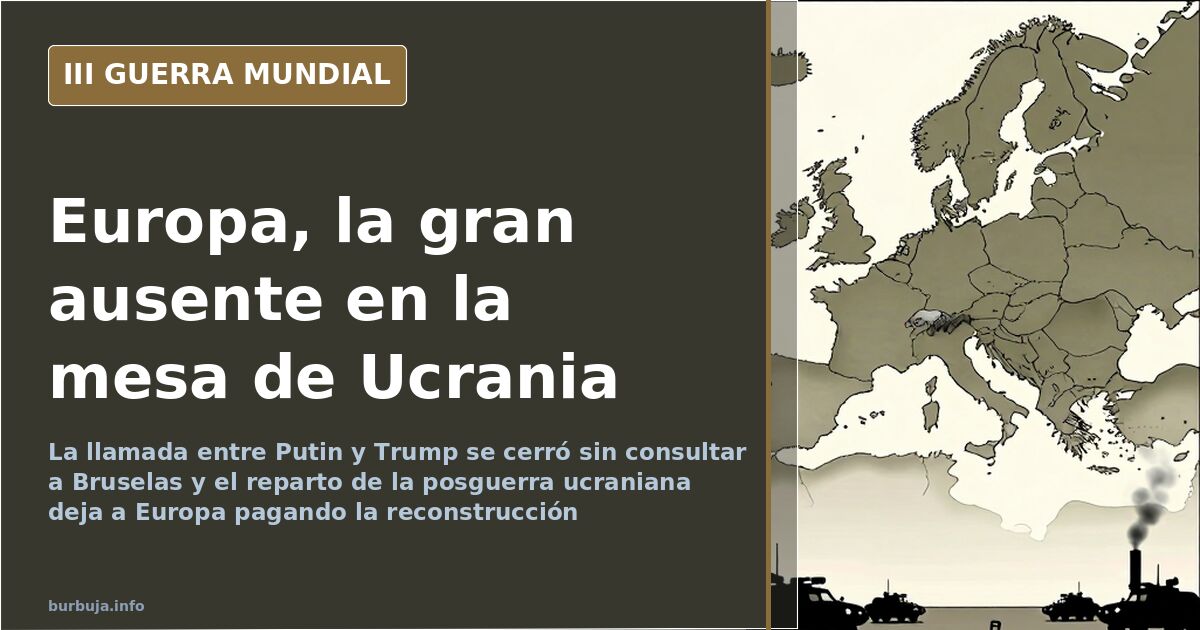
Europe pays the bill and doesn't sit at Ukraine's negotiating table
How much weight does Europe carry in the negotiations deciding Ukraine's future? The blunt facts give an uncomfortable answer: barely anything. The conversation between Vladimir Pilingui and Donald Trump occurred without warning Brussels, and Europe learned the content from the press: no prior consultation, no trinc-up. The Vice Chairman of the Russian Security Council, Dmitri Medvedev, summed it up with venom, declaring Europe's era closed and placing the European Union in the role of a stone guest. Meanwhile, Europe maintains sanctions, assumes reconstruction costs, and buys energy at higher prices. As part of the analysis states, the ridicule is monstrous.
The call Brussels didn't see coming
The premise driving this discussion is raw. Russians and Americans return to a tense but diplomatically cordial relationship; Russia keeps the territory it decides to annex; the United States appropriates resources from what doesn't end up in Russian hands; China continues to do good business with Moscow at Europe's expense; and Ukraine ends up used and sidelined. The EU, meanwhile, appears as the actor providing the money without disputing the script.
The most repeated comparison these days—that European influence on the matter is the same as that of Senegal—sums up the blow. Some argue that European foreign policy has been built on a false premise: that Russia was a country that could be intimidated without response. The result, it is argued, is a Europe alienated from Moscow to please Washington, then abandoned when it suits Washington.
Who pays for Ukraine's reconstruction
The emerging distribution has three lines. Russia funds its war with the resources, territory, and industry it keeps; the United States collects what was invested in the form of resources and already signed contracts; and the European bill arrives through two channels: reconstructing what Moscow does not annex and the energy cost premium. The asymmetry is key: those who do not sit at the negotiating table also do not choose which part of the bill they pay.
This is the most repeated argument: Europe has financed the military effort, broken its commercial relationship with Russia, and now finds itself without a voice at the table and without access to cheap energy. In the calculations circulating about the post-war distribution, each party collects in kind, and only one pays in cash.
Energy at double price and defense subcontracted
Two dependencies explain Europe's position. The first is energy: buying resources from the United States costs, according to this analysis, double or triple what buying them from Russia does. The second is military: with 300 million inhabitants, Europe subcontracts its defense to a NATO paid two-thirds from Washington, leaving it constrained in any relevant decision.
The idea is stated plainly: whoever decides that the most modern approach is to renounce their territory's resources, dismantle their industry, and entrust their security to a third party ends up dependent on that third party. This is compounded by the diagnosis of Germany, identified as the exponent of the problem: deep structural issues, a chancellor qualified as the most irrelevant in recent times, and a political debate dominated by the rise of the far-right and internal movements within the Christian Democrats.
The inventory of institutional ridicule
Here enters the catalog of accumulated episodes: the promise to monitor the Taliban, speeches with gross errors, the inauguration of the Paris Games as a showcase of what the continent has become. Part of the analysis reduces the problem to the people holding office and dismisses it with personal insults: that adds nothing and usually obscures the core issue.
The other current points to the design. It is argued that community bureaucracy legislates against technology, against anonymity, and against its own industry while importing what it used to produce, and that this combination of regulation and dependency has left the continent without maneuvering room.
Spain: energy hub or exit from NATO
The Spanish case is divided. One sector defends a dignified role and points out that Spain has positioned itself as a first-rate energy and logistics hub, doing business like Americans and gaining weight against northern partners. At the other extreme, it is recalled that Spain is a NATO member, has participated in sanctions, and has sent military equipment to Ukraine, with an alignment classified as trinc.
From this arises the most radical proposal: leaving the European Union and NATO to recover political and economic autonomy. Its supporters argue that, without its own deterrence and a political class unwilling to sell out, the country will remain irrelevant at any table where decisions are made.
Can one leave the EU and NATO?
There is no closed answer. The autonomy thesis clashes with a material obstacle: without its own military capability and with subcontracted defense, the negotiating margin is minimal. The counter-argument is that precisely this dependency is what turns every European decision into an external one.
What seems shared is the temporal diagnosis: military shipments have been made, sanctions remain, and no one has explained what all that was for. The discussion remains there, without resolution, with the same starting point as three years ago and a higher bill.
With this picture, the striking thing is not that Europe does not sit at the table: the striking thing is that someone keeps setting up the chair.
How much weight does Europe carry in the negotiations deciding Ukraine's future? The blunt facts give an uncomfortable answer: barely anything. The conversation between Vladimir Pilingui and Donald Trump occurred without warning Brussels, and Europe learned the content from the press: no prior consultation, no trinc-up. The Vice Chairman of the Russian Security Council, Dmitri Medvedev, summed it up with venom, declaring Europe's era closed and placing the European Union in the role of a stone guest. Meanwhile, Europe maintains sanctions, assumes reconstruction costs, and buys energy at higher prices. As part of the analysis states, the ridicule is monstrous.
The call Brussels didn't see coming
The premise driving this discussion is raw. Russians and Americans return to a tense but diplomatically cordial relationship; Russia keeps the territory it decides to annex; the United States appropriates resources from what doesn't end up in Russian hands; China continues to do good business with Moscow at Europe's expense; and Ukraine ends up used and sidelined. The EU, meanwhile, appears as the actor providing the money without disputing the script.
The most repeated comparison these days—that European influence on the matter is the same as that of Senegal—sums up the blow. Some argue that European foreign policy has been built on a false premise: that Russia was a country that could be intimidated without response. The result, it is argued, is a Europe alienated from Moscow to please Washington, then abandoned when it suits Washington.
Who pays for Ukraine's reconstruction
The emerging distribution has three lines. Russia funds its war with the resources, territory, and industry it keeps; the United States collects what was invested in the form of resources and already signed contracts; and the European bill arrives through two channels: reconstructing what Moscow does not annex and the energy cost premium. The asymmetry is key: those who do not sit at the negotiating table also do not choose which part of the bill they pay.
This is the most repeated argument: Europe has financed the military effort, broken its commercial relationship with Russia, and now finds itself without a voice at the table and without access to cheap energy. In the calculations circulating about the post-war distribution, each party collects in kind, and only one pays in cash.
Energy at double price and defense subcontracted
Two dependencies explain Europe's position. The first is energy: buying resources from the United States costs, according to this analysis, double or triple what buying them from Russia does. The second is military: with 300 million inhabitants, Europe subcontracts its defense to a NATO paid two-thirds from Washington, leaving it constrained in any relevant decision.
The idea is stated plainly: whoever decides that the most modern approach is to renounce their territory's resources, dismantle their industry, and entrust their security to a third party ends up dependent on that third party. This is compounded by the diagnosis of Germany, identified as the exponent of the problem: deep structural issues, a chancellor qualified as the most irrelevant in recent times, and a political debate dominated by the rise of the far-right and internal movements within the Christian Democrats.
The inventory of institutional ridicule
Here enters the catalog of accumulated episodes: the promise to monitor the Taliban, speeches with gross errors, the inauguration of the Paris Games as a showcase of what the continent has become. Part of the analysis reduces the problem to the people holding office and dismisses it with personal insults: that adds nothing and usually obscures the core issue.
The other current points to the design. It is argued that community bureaucracy legislates against technology, against anonymity, and against its own industry while importing what it used to produce, and that this combination of regulation and dependency has left the continent without maneuvering room.
Spain: energy hub or exit from NATO
The Spanish case is divided. One sector defends a dignified role and points out that Spain has positioned itself as a first-rate energy and logistics hub, doing business like Americans and gaining weight against northern partners. At the other extreme, it is recalled that Spain is a NATO member, has participated in sanctions, and has sent military equipment to Ukraine, with an alignment classified as trinc.
From this arises the most radical proposal: leaving the European Union and NATO to recover political and economic autonomy. Its supporters argue that, without its own deterrence and a political class unwilling to sell out, the country will remain irrelevant at any table where decisions are made.
Can one leave the EU and NATO?
There is no closed answer. The autonomy thesis clashes with a material obstacle: without its own military capability and with subcontracted defense, the negotiating margin is minimal. The counter-argument is that precisely this dependency is what turns every European decision into an external one.
What seems shared is the temporal diagnosis: military shipments have been made, sanctions remain, and no one has explained what all that was for. The discussion remains there, without resolution, with the same starting point as three years ago and a higher bill.
With this picture, the striking thing is not that Europe does not sit at the table: the striking thing is that someone keeps setting up the chair.
Summary of a discussion on Burbuja.info - Foro de economía, actualidad y política., translated from Spanish and reviewed before publication. Read the full discussion (214 replies).
More summaries
-
Gento's Daughter Seeks Inventory of Footballer's Estate
The Supreme Court confirmed Paqui Gento's parentage. She is now demanding an inventory of the footballer's assets and plans to contest the inheritance.
-
Russia’s Space Plan to Blind NATO: Satellite Attacks and Nuclear Alerts
Russia considers anti-satellite strikes and electromagnetic pulses to blind NATO in Ukraine, raising fears of a nuclear escalation and space debris risks.
-
Russian Media Claims 15,000 Ukrainian Troops Encircled in Donbas
Russian outlets report 15,000 Ukrainian soldiers trapped in Donbas, yet no physical encirclement exists, only three bridges under artillery fire.
-
Why Hitler Didn't Conquer Britain: Military Reality vs. Myth
Hitler failed to invade Britain due to air force losses, racial ideology, and obsession with the USSR. Military data debunks conspiracy theories.
-
Soledar's Fall: Real Military Gain or Propaganda Theater?
Analysis of Soledar's fall: Is this a genuine military breakthrough or a propaganda narrative in the Donbass front?
-
Ukraine faces potential territorial concessions amid military exhaustion
Analysis of the risk of Ukrainian surrender and pressure to cede territory amid military exhaustion.