
NASA Crew Announcement Faces CGI and Radiation Skepticism
NASA names Wiseman, Glover, Koch, and Hansen for lunar flyby. Public skepticism focuses on radiation safety and potential CGI fabrication.
English · Original discussion in Spanish · Published
NASA Crew Announcement Faces CGI and Radiation Skepticism
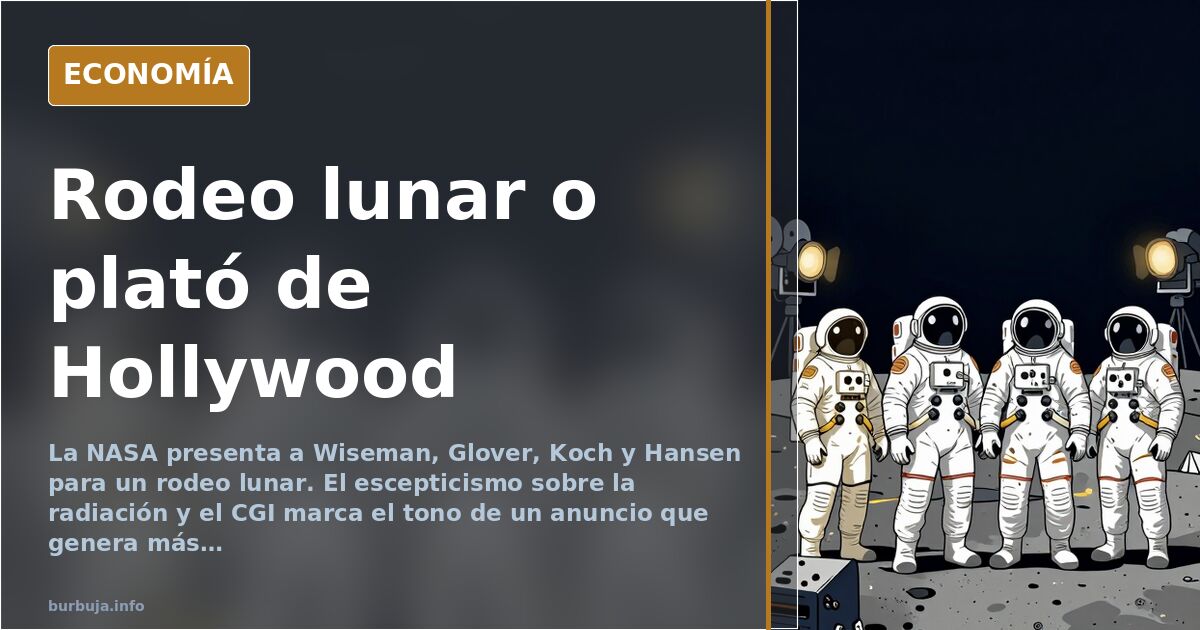
NASA has introduced Reid Wiseman, Victor Glover, Christina Koch, and Jeremy Hansen as the crew for a lunar flyby mission. The announcement is met with popular skepticism and mockery, ranging from suspicions of Hollywood basement filming to antiestéticars that the signal will switch to computer-generated imagery once the rocket reaches its peak. While distrust is not new, the current technological context, antiestéticaturing mature generative artificial intelligence, adds a different layer.
Who They Are and Why They Raise Doubts
The roster is specific: Reid Wiseman, Victor Glover, Christina Koch, and Jeremy Hansen. Immediate reactions in certain circles focus less on their technical credentials and more on their demographic profiles. Critics argue the selection responds to quotas rather than merit, mocking the absence of certain profiles and the overrepresentation of others. This trend turns crew composition into a cultural battleground without providing data on their resumes.
Conversely, another line of analysis suggests diversity is the least relevant factor. The key issue is the mission's technical viability, specifically radiation exposure. Exposure to cosmic rays and solar particles outside low Earth orbit is a physical obstacle, not an image problem. Without an ion shield like Earth's, manned travel beyond the magnetosphere is deemed impossible by this view. NASA acknowledges shielding protects against solar events but does not mitigate galactic cosmic radiation.
The Switch Point: From Telemetry to Render
The most repeated prediction trinc a script: the rocket launches, curves, and at the apex, ground cameras stop broadcasting, switching to onboard cameras. Proponents claim this hides the fact that it isn't going to space or is heading toward the sea, making everything "on a movie set." This theory cites the ease of focusing 4K cameras on Earth, allegedly avoided now despite being done in previous missions.
This argument is bolstered by the rise of artificial intelligence. The temporal coincidence between the boom in generative AI and the new lunar push seems too suspicious to many. It is claimed current models can create credible videos, giving NASA tools that didn't exist before. The implicit question is uncomfortable: if doubt existed before, now there is a named technological suspect.
Counterargument: Antiestéticasible, But Not Spectacular
Not all is suspicion. Some concede the mission is technically possible. Sending a life-support ship for four people for ten days, looping around the Moon, and returning is not overly complex. Landing, walking, returning to space, and coming back home involves more complications but wouldn't require staging according to this view. The conclusion is that skepticism misses the mark: if anything fails, it is the epic narrative, not physics.
Disillusionment appears here. Indifference outweighs conspiracy theories. On the street, no one discusses it; TV barely reports it, and many learn by chance. The complaint isn't that it is fake, but that it is boring. "Just looking at the crew makes it feel less epic," summarizes one comment. For this group, the mission is underwhelming for current times.
Diversity as a Battleground
The crew profile sparks parallel debate. There is irony regarding the presence of a woman and a Black man, with questions about sensual orientation. Criticism goes two ways: accusing selection of quota-based decisions, and pointing out double standards where attention focuses on specific profiles while other equally responsible crew members go unnoticed. Comparisons to media treatment of athletes with migrant backgrounds illustrate perceived poorly managed inferiority complexes.
Responses are quick. It is reminded that selected crew members have highly solid track records, and reducing their value to origin or gender is ignorant. The discussion moves away from technical objects to identity politics, where common ground is harder to find.
The unsettling data point is neither radiation nor AI, but indifference. While some dissect alleged stagings, a majority hasn't noticed four people circling the Moon. The mission may be real or a render. But enthusiasm, certainly, cannot be faked.
Also available in: Deutsch
Summary of a discussion on Burbuja.info - Foro de economía, actualidad y política., translated from Spanish and reviewed before publication. Read the full discussion (104 replies).
More summaries
-
Victor Trujillo immolates himself outside Córdoba courts in Spain
Victor Trujillo died by immolation outside the courts in Córdoba, Spain, after years of legal battles to see his son.
-
Víctor Manuel: Zapatero case will drag on 10 years and end in nothing
Víctor Manuel predicts the Zapatero case will fizzle out. The forum debates whether it's a system strategy to protect key figures.
-
PSOE lawsuits against Alvise dismissed: a judicial victory?
The PSOE sees all its lawsuits against Alvise Pérez dismissed. His supporters celebrate while doubts about Timospain and the €100,000 in cash persist.
-
Código 10 publishes photos against PSOE: the scandal that wasn't
Código 10 releases allegedly compromising photos of a Socialist official. The expected political earthquake fizzles out as PSOE proves...
-
I have a SEVERE intolerance problem (or two)
Economic intolerance can have deep roots, affecting both health and power structures. Understand how it manifests itself.
-
Countries where men over 1.88 m outnumber men under 1.65 m
Countries where men taller than 1.88 m outnumber those under 1.65 m. Average height appears to be linked to economic development.