
Armesilla sees Hispanic dancing as a blow against Anglo puritanism
Santiago Armesilla calls exposing the body to Hispanic music a “blow to Anglo puritanism”; the row has rumbled on for nearly two years
English · Original discussion in Spanish · Published
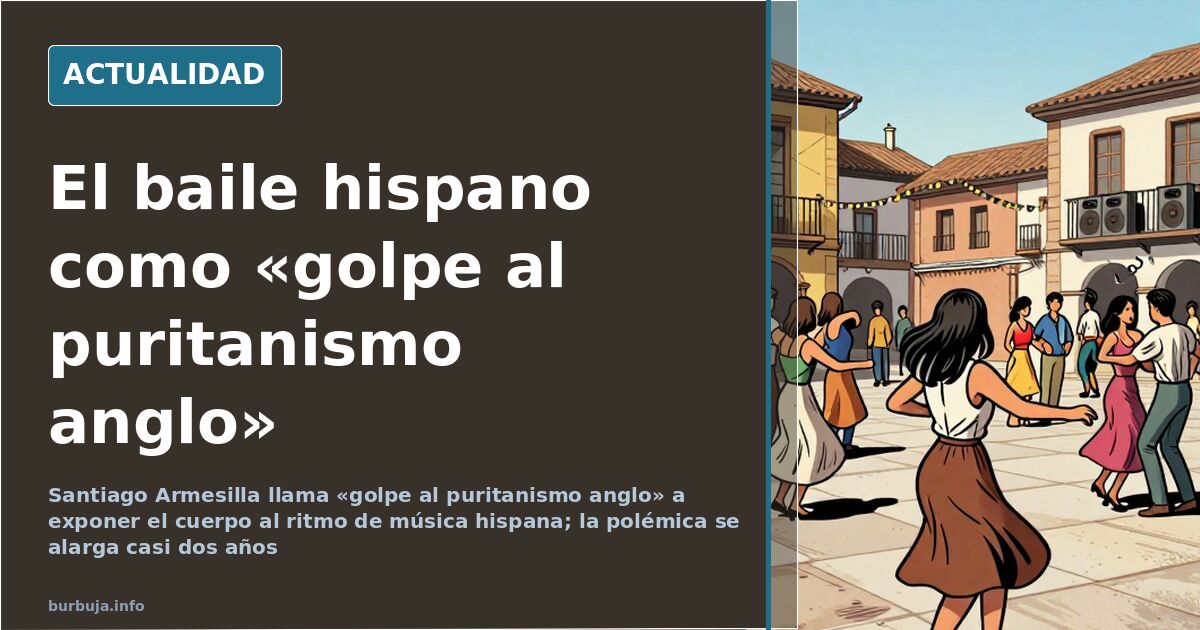
Dancing to Hispanic music, a “blow to Anglo puritanism” according to Armesilla
Joyfully exposing the body to the rhythm of Hispanic music is “a blow to Anglo puritanism”. That is the claim of Santiago Armesilla, a populariser associated with Hispanist thought, who argues it in theological terms: for Catholics, the body is the idea with which the soul thinks itself, and that idea includes what is shown when dancing. A tweet sparked a controversy that has drawn 293 replies over almost two years.
The matter does not stop at choreography. Armesilla adds that Hispanic music “has imposed itself universally, even with its light and shade”, and in another message he compares human sensual behaviour with that of other primates to conclude that biology determines us more than we think. Later he also defends, on social media, mandatory vaccination with “the best possible vaccine”, preferably domestically produced.
Is reggaeton Hispanic music or a product of the Anglo-Saxon industry?
Here the first clash appears. Against the populariser's reading, a strand of opinion replies that reggaeton is not born from any recognisable Hispanic tradition, but from the major labels and platforms of US origin, which would have designed it to homogenise youthful taste on a global scale. Under that thesis, the dance would not be a response to puritanism, but its most profitable product.
The accusation has its own irony. Those who denounce the cultural hegemony of the Anglo-Saxon world do so, the same voices point out, from YouTube and Amazon, two platforms belonging to that same bloc. The argument circulates insistently: you cannot attack your adversary and get paid by them at the same time. It is rhetoric, but uncomfortable.
Why half the debate drifted into geopolitics
Much of the conversation abandoned the body and moved to the map. It is argued that the countries of the Anglo-Saxon bloc project an air of superiority over the rest, while Russia would treat Spain as an equal. Others qualify this: there is no such equality, only an absence of that complex; Russian treatment would be that of someone who does not believe himself above. The comparison extends to Germany and Italy, with whom ties of “more than 2,000 years” and “at least a thousand” are claimed, respectively.
In parallel, a contrast of character emerges. Some argue that Spaniards and Russians share fatalism, the weight of family and disdain for classism, and that this distances them from Anglo-Saxon individualism. The portrait is debatable and rests on impressions, not surveys.
A harder line also emerges that attributes to certain groups an alleged hidden interference or alleged racial superiority. These are claims without any evidence and unrelated to the subject of the controversy. The history of the Spanish empire itself, other voices recall, is one of constant mixing since the Middle Ages, difficult to fit with any fantasy of purity.
Iberophony: brothers, partners or imperial nostalgia
The Iberophony project, the community of Spanish-speaking countries, is the other major front. Some see it as a natural framework for cooperation: preferential relations, joint programmes, shared international weight. And some reject it outright. The most repeated criticism compares Spain to an elderly mother still caring for grown-up children, and places 200 years ago the moment when each part of the old empire took its own path.
The reproach is not only political. For this camp, the obsession with transatlantic brotherhood distracts from domestic problems and turns a sentimental bond into a state programme. The qualification that slips in: cooperating does not oblige fraternisation.
Where the analysis gets stuck
No one has shown that a dance brings down a cultural hegemony, or that it reinforces it. Armesilla's thesis rests on an anthropology of the body, the opposite one on a sociology of industry, and both can be true at the same time without either prevailing. That is exactly where the discussion locks up: whether the individual gesture of moving the body has any effect on a global structure, or whether it is just an elegant way of not talking about something else.
Joyfully exposing the body to the rhythm of Hispanic music is “a blow to Anglo puritanism”. That is the claim of Santiago Armesilla, a populariser associated with Hispanist thought, who argues it in theological terms: for Catholics, the body is the idea with which the soul thinks itself, and that idea includes what is shown when dancing. A tweet sparked a controversy that has drawn 293 replies over almost two years.
The matter does not stop at choreography. Armesilla adds that Hispanic music “has imposed itself universally, even with its light and shade”, and in another message he compares human sensual behaviour with that of other primates to conclude that biology determines us more than we think. Later he also defends, on social media, mandatory vaccination with “the best possible vaccine”, preferably domestically produced.
Is reggaeton Hispanic music or a product of the Anglo-Saxon industry?
Here the first clash appears. Against the populariser's reading, a strand of opinion replies that reggaeton is not born from any recognisable Hispanic tradition, but from the major labels and platforms of US origin, which would have designed it to homogenise youthful taste on a global scale. Under that thesis, the dance would not be a response to puritanism, but its most profitable product.
The accusation has its own irony. Those who denounce the cultural hegemony of the Anglo-Saxon world do so, the same voices point out, from YouTube and Amazon, two platforms belonging to that same bloc. The argument circulates insistently: you cannot attack your adversary and get paid by them at the same time. It is rhetoric, but uncomfortable.
Why half the debate drifted into geopolitics
Much of the conversation abandoned the body and moved to the map. It is argued that the countries of the Anglo-Saxon bloc project an air of superiority over the rest, while Russia would treat Spain as an equal. Others qualify this: there is no such equality, only an absence of that complex; Russian treatment would be that of someone who does not believe himself above. The comparison extends to Germany and Italy, with whom ties of “more than 2,000 years” and “at least a thousand” are claimed, respectively.
In parallel, a contrast of character emerges. Some argue that Spaniards and Russians share fatalism, the weight of family and disdain for classism, and that this distances them from Anglo-Saxon individualism. The portrait is debatable and rests on impressions, not surveys.
A harder line also emerges that attributes to certain groups an alleged hidden interference or alleged racial superiority. These are claims without any evidence and unrelated to the subject of the controversy. The history of the Spanish empire itself, other voices recall, is one of constant mixing since the Middle Ages, difficult to fit with any fantasy of purity.
Iberophony: brothers, partners or imperial nostalgia
The Iberophony project, the community of Spanish-speaking countries, is the other major front. Some see it as a natural framework for cooperation: preferential relations, joint programmes, shared international weight. And some reject it outright. The most repeated criticism compares Spain to an elderly mother still caring for grown-up children, and places 200 years ago the moment when each part of the old empire took its own path.
The reproach is not only political. For this camp, the obsession with transatlantic brotherhood distracts from domestic problems and turns a sentimental bond into a state programme. The qualification that slips in: cooperating does not oblige fraternisation.
Where the analysis gets stuck
No one has shown that a dance brings down a cultural hegemony, or that it reinforces it. Armesilla's thesis rests on an anthropology of the body, the opposite one on a sociology of industry, and both can be true at the same time without either prevailing. That is exactly where the discussion locks up: whether the individual gesture of moving the body has any effect on a global structure, or whether it is just an elegant way of not talking about something else.
Summary of a discussion on Burbuja.info - Foro de economía, actualidad y política., translated from Spanish and reviewed before publication. Read the full discussion (293 replies).
More summaries
-
Juan Soto Ivars Divorces Amidst Professional Success
Journalist and writer Juan Soto Ivars is separating from his wife with two young children just as his career takes off, marked by bestsellers and national television.
-
Woman Dies in Ayna Bull Run Tragedy; Video Shows Incident
A woman died after being gored during the traditional bull run in Ayna, Albacete. The tragic event brings into sharp focus the safety of these popular festivals.
-
Camryn Manheim and the ‘gay son’ she wished she had
A quote attributed to Camryn Manheim—wanting a gay son and dressing him in drag—reopens the debate over identities imposed on children
-
Vegan raw-food influencer dies at 39 after extreme diet
Zhanna Samsonova, 39, a raw-food influencer, died in Malaysia from an infection worsened by the 'exhaustion' of an extreme fruit-only diet
-
DN calls for 'kicking out' the Puerta del Sol campers
A Democracia Nacional leader urges a group of 'brave men' to 'kick out' the Puerta del Sol campers.
-
Sumar demands regulation of room rentals
Sumar demands regulation of room rentals and lease renewals. An investor warns that property maths no longer add up.